


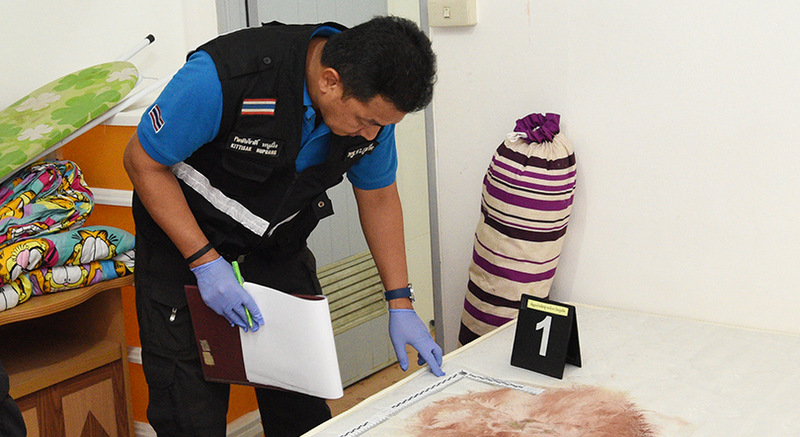
Police arrived at the room, in Moo 2 Chalong, at about 10:20am yesterday (July 13) after relatives made the disturbing discovery on Wednesday night.
The room had reportedly already been searched by forensic police twice before.
Ms Pischa and her ex-boyfriend Nico Papke, now under guard at Vachira Phuket Hospital and charged for Ms Pischa’s murder (see story here), used to live together in the room, said police.
“Ms Pischa’s relatives were collecting her belongings yesterday night (July 12) after her cremation in the afternoon,” one forensic officer, who asked not to be named, told The Phuket News yesterday (July 13).
“They searched for things that Ms Pischa might keep in the secret places,” he added.
“They turned the mattress over and found a brown curtain, a white towel and a plastic bag still stuck the mattress. They removed these and found the blood stain underneath.
“It is believe the suspect used these items to cover the mattress and prevent the blood from flowing down onto the floor. Forensic police cut the blood-stained section of the mattress and sent it for the further investigation,” the officer said.
Lt Chanat HongsitthiChaikul of the Chalong Police confirmed that Papke remains in custody at Vachira Hospital.
“The doctor has not allowed him to leave yet. He has to stay in hospital for two to three more days,” Lt Chanat said.
Police are still awaiting autopsy, DNA and fingerprint results which will form part of the evidence in the investigation, Lt Chanat confirmed yesterday. (See story here.)
Police on Monday also found blood stains inside a car rented by Papke (see story here.). Samples of the blood found were sent to determine for DNA tests to deteremine whether it was that of Ms Pischa, whose body was found wrapped in blankets and dumped in the Phuket jungle last Saturday (See story here).
Asked this morning how forensic police failed to find the blood stain on her mattress, Lt Chanat declined to answer.
Of note, forensic police are specialised division within the Royal Thai Police separate from regular officers and investigators, and are called in by regular police to conduct forensic-level inspections of crime scenes.