


Chinese tourist Shi Yiqeng, just 22 years old, died after being pulled away from the beach by a strong rip tide at Kata on Saturday (Sept 30). Her body washed ashore at Kata Beach last night. (See story here.)
At Nai Harn, two tourists were reportedly rescued. However, the rescue confirmed by The Phuket News was not by a lifeguard. Instead, a Russian man at the beach noticed Chinese tourist Liu Su, 46, in trouble and ran to the rescue.
Similarly, over the weekend local surfers at Kata reportedly rescued three swimmers in danger.
At Nai Thon, lifeguards who hail from the Surin-Bangtao Surf Lifesaving Club rescued a Russian man from dire trouble after he was overcome by the strong surf and left floundering while being pummelled by the waves.
At Surin Beach, lifeguards who have volunteered to continue to provide their vital services carried out several rescues, despite two Navy personnel being assigned to the beach.
“The Surin-Bangtao Surf Lifesaving Club professional lifeguards all reported to work today (Oct 1). The professional guards made multiple rescues throughout the day, whilst the Navy guards made none,” one local lifeguard told The Phuket News.
“The first rescue was at 10am hours, at the north end of the beach, where a deep rip current channel had formed,” the lifeguard explained.
“An experienced, qualified volunteer international lifeguard spotted a 60-year-old Russian tourist struggling in the flash-rip, responded to the location, and towed the woman to shore single-handedly, while the Navy guards watched from the shore,” he added.
CRITICAL SKILLS
The incident cast doubt on the “quick draw” beach safety teams’ ability to provide adequate protection from the dangerous surf simply through a lack of training.
“The two ‘lifeguards’ supplied by the Thai Navy were clearly overwhelmed, and repeatedly failed to notice swimmers in trouble in area they were assigned,” one lifeguard explained.
“Throughout the day, the professional lifeguards had to continuously respond to the area the Navy was supposed to cover, rescuing four in the small patrol area. Assigning personnel with no real knowledge of Phuket’s beaches, and no ability to spot swimmers in trouble, only complicates the problem. Left unchanged, this will lead to disaster.
“In addition, providing two ‘ocean lifeguards’ for all of Surin Beach is not nearly enough. Without proper training and rescue equipment, if these guards do actually enter the water and attempt a rescue, they are likely to become victims themselves. I worked alongside two of them yesterday. Unfortunately, they have a long way to go before they are qualified to function as ocean lifeguards in Phuket,” the professional lifeguard added.
ON SHOW
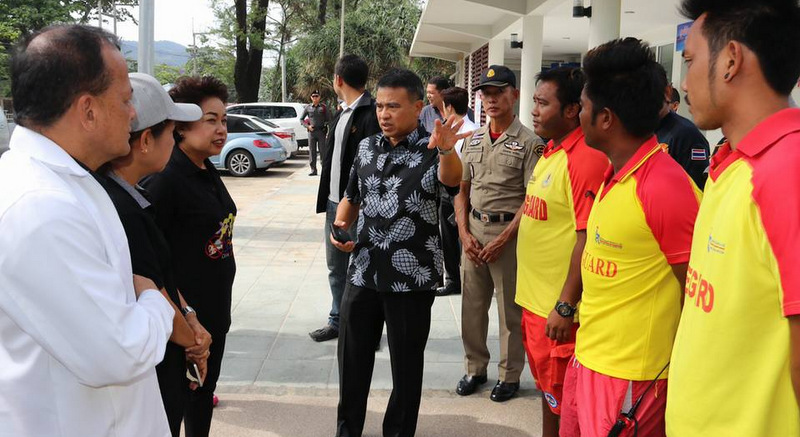
The seeming mayhem in providing surf safety over the weekend came as Phuket Governor Norraphat Plodthong visited Kata Beach and Patong Beach yesterday (Oct 1) to see firsthand how the hastily assembled “beach safety teams” were performing
In Karon, officers from Karon Municipality, local police, Civil Defense volunteers and “lifeguards” welcomed Phuket Governor, reported the Phuket office of the Public Relations Department in its latest “assuring” missive.
However, Karon Police earlier today confirmed there are no actual lifeguards on duty at Kata or Karon beaches, calling into question exactly which “lifeguards” were present to welcome the Governor.
After Kata, Governor Norraphat next visited the Patong Tourist Help Centre where he was welcomed by Patong Mayor Chalermluck Kebsup and other officers.
“On Patong Beach there are 22 lifeguards, which cover all beaches (sic) in Patong,” said the PR report.
“Gov Norraphat ordered (sic) Patong lifeguards to sign a contract with the Phuket Provincial Administrative Organisation (PPAO, or OrBorJor) with B14,000 salary per month,” the PR report added.
“I want to repeat for every office to strongly work together in order to take care of tourist beach safety. Lots of Chinese tourists are swimming at the beaches,” Gov Norraphat said.
“There must not be any gap [in providing beach safety]. Police are also to keep an eye on tourists in case some of them do not follow the rules and still go into the sea during the bad weather,” he added.
Gov Norraphat’s short tour yesterday followed him calling all local mayors to the Governor’s House on Saturday (Sept 30) as officials scrambled to arrange some form of beach safety in place following the Phuket Lifeguard Service declining to re-apply for the annual government tender to provide lifeguard services.
The PLS declined to bid for the contract over a lack of funding, and no other bids for the contract were submitted. (See story here.)
SCRAMBLE
In response, Governor Norrphat at the meeting on Saturday ordered each municipality to be responsible for beaches in their respective areas.
He also ordered them to assemble beach safety teams comprising staff from local administration and municipal offices, Civil Defense Volunteers, Royal Thai Navy Third Area Command (based in Phuket), police, beachfront hotels’ lifeguards and some lifeguard volunteers.
“There will be lifeguards on every beach. Next, the first step in our long-term plan, lifeguards will be hired individually for two months at a wage of B14,000 per month,” said the Governor.
According to a PR Dept report of the meeting, the Gov Norraphat said, “We are hiring now.”
However, the same report also said, “We have received applications from about 30%-40% of all those who used to work as lifeguards [to be rehired].”
Oddly, that sentence came after lifeguards at Patong had already confirmed that they had been hired only temporarily by the PPAO to continue to patrol Patong Beach. (See story here.)
“All will support each other in keeping the beaches safe until the OrBorJor (PPAO) is able to contract a lifeguard company to take over the services fast as possible,” Gov Norraphat reportedly confirmed.
However, The Phuket News has yet to independently confirm the exact current status of which officers are patrolling which beaches in Phuket, and what training or equipment those offices and/or “lifeguards” have been given to work as actual lifeguards.
AN AUTHORITY FOUND LACKING
Gov Norraphat so far has been too polite to explain why he has taken such a leading role in the last-ditch scramble to get some sense of security on Phuket’s world-renowned beaches despite PPAO Council President last Wednesday (Sept 27) publicly vowing to have lifeguards on Phuket’s beaches by Sunday.
“The PPAO can provide Phuket lifeguards ourselves. We do not need Phuket Lifeguard Service Co Ltd anymore,” Council President Teera Jiasakun said. (See story here.)
However, The Phuket News has yet to identify any reports, including in the Thai media, confirming that the PPAO has been directly involved in getting any lifeguards on any beaches without Gov Norraphat’s direction.
Gov Norraphat has led the fight on that front.
Meanwhile, the current lifeguard situation in Phuket over what is required to ensure Phuket beaches are patrolled by professional, qualified lifeguards follows Deputy Prime Minister Gen Thanasak Patimapragorn in only March this year visiting Phuket in person and ordering officials to take steps to support Phuket’s vital lifeguard service.
“Make a list of what you need for me,” Gen Thanasak told Phuket Lifeguard Service Chief Prathaiyut Chuayuan during the visit, also attended by Tourism Minister Kobkarn Wattanavrangkul and attended by PPAO Acting Chief Watcharin.
Gen Thanasak also ordered then-Phuket Governor Chokchai Dejamornthan to follow up what the PLS wants. (See story here.)
MONEY MATTERS
The threat of Phuket beaches not having lifeguards due to poor organising of the tender-bidding process and disagreements of the terms of the contract is nearly an annual affair, with last-minute agreement usually reached within days before or after the existing contract expires.
Of note, however, is that in the entire history of Phuket having paid lifeguards on our beaches, no company or organisation other than the PLS has ever submitted a bid for the contract.
In explaining some of the unattractive aspects of bidding for the contract, PLS President Prathaiyut told The Phuket News in 2014 that the company makes a return of about 10% per year.
“This lifeguard company gives us a return of no more than 10%. Realistically, you need to get at least 30 to 40% if you want to call it a real business. That’s why no one else bid for this contract,” he said.
In addition, the terms of the contract by law require a deposit of 5% of the total contract value to be held as a “deposit to enter the bid” and a further 5% to be held as a deposit to guarantee the contract terms are fulfilled.
In order for the PLS to make its bids in years past, Mr Prathaiyut explained during the 2015 standoff, “We have had to pledge our house and land to get the performance guarantee under the terms of the contract.” (See story here.)
In bidding for that contract, over the preceding 12 months PLS lifeguards had rescued 928 people. In the year before that, PLS lifeguards had rescued 882 people – an average of 80 a month for the duration of the contract.
The Phuket News reminded readers as recently as July this year that the Phuket’s lifeguards are actually funded through a 1% tax on all room rates charged on the island – a tax introduced by the PPAO in 2000. (See story here.)
At the time, many hotels refused to pay the tax over the lack of clarity of how the cash collected would be spent.
Meanwhile, in this latest round in the deadly game of who will protect our tourists at the beaches during this dangerous time of year, the PPAO – as always – has neglected to explain how much money has been collected from the room tax, and why those funds fail to pay for the lifeguards the island direly needs.