





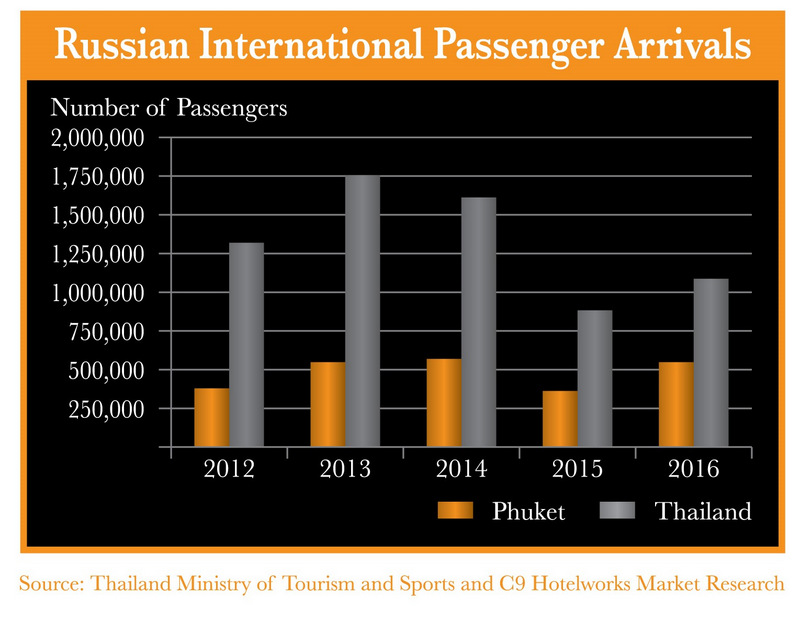
“Phuket experienced a strong recovery in its Russian tourism market in 2016, with total passengers arriving via international flights to the island up by 51% year-on-year. This is substantially higher than the growth of the total market of travellers from Russia to Thailand, which rose by 23% in the same period,” writes Bill Barnett, Managing Director of C9 Hotelworks.
According to Mr Barnett, Russian tourism market to the island valued B30 billion in 2016 thanks to a row of positive factors including zero competition from Egypt, flights to which were banned by the Russian government in 2015, and strengthening of the ruble due to rising oil prices.
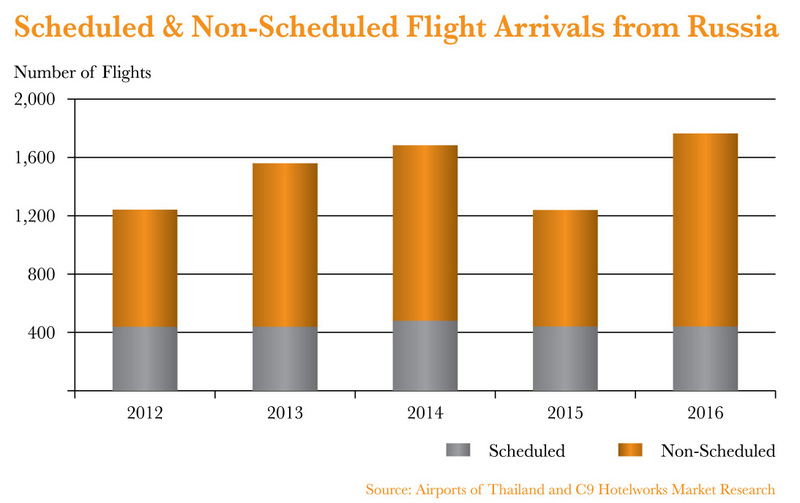
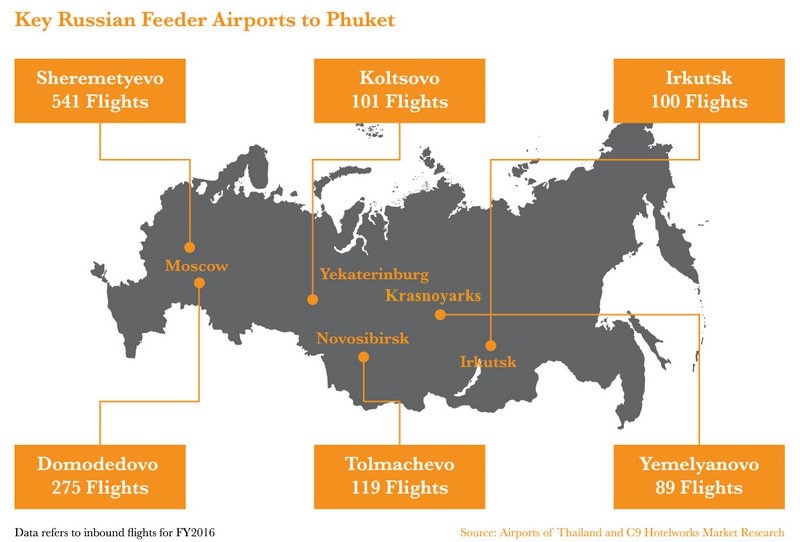
In 2016, Phuket International Airport hosted a total of 524,073 passengers flying directly from Russia on international flights, mostly charter (non-scheduled routes accounting for approximately 75% of total inbound flights). Over 50% of all flights to Phuket arrived from Moscow, Russia’s main aviation hub hosting three developed international airports.
As reported by C9 Hotelworks, inbound flights from Russia rose 42% in 2016 versus the previous year and reached 1,767 flights. The growth is based on strong uplift in charter traffic, while the number of regular flights from Russia remained barely unchanged at the level of slightly over 400 aircraft arriving annually.
Mr Barnett highlights three key trends characterising the Russian tourism market in Phuket in 2016. First, traditional brick-and-mortar travel agencies are still the most influential players in the field, accounting for approximately 80% of all Russian tourists.
Second, Russians enjoy Phuket with their family members and kids. Families make up 65% of total visitors followed by couples, friends and solo travellers. These segments favour four-star hotels and increasingly use non-traditional accommodation.
Last, but by no means least, Russians are a “payable quality” audience. As noted in the report, Russian tourists typically spend B5,520 per person per day, which is higher than the Thailand-wide average by 11%.
Also, Russians enjoy their Thai vacations for more than a week, with an average length of stay (ALOS) of 10.5 days per trip.
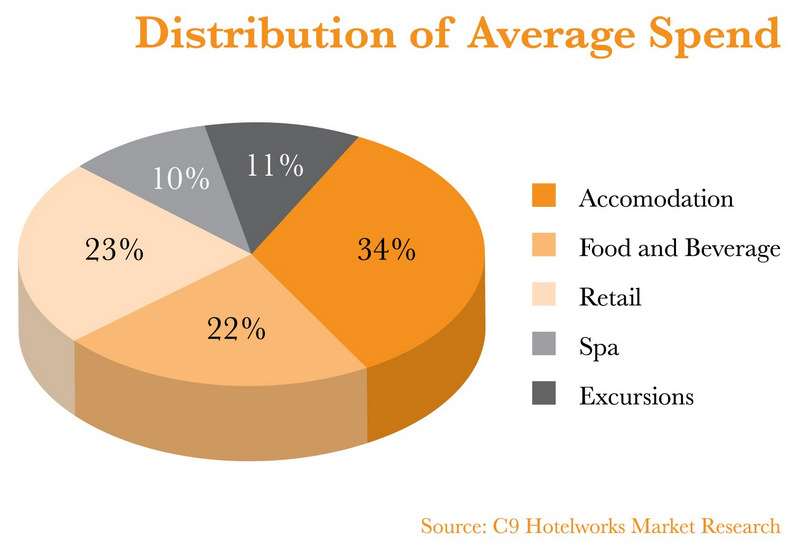
Thus an average Russian on an average holiday spends B57,960, with 34% spent on accommodation, 23% on retail, 22% on food and beverage, and 10% and 11% respectively on Spa and Excursions.
Mr Barnett’s forward outlook is positive.
“We foresee the momentum continuing throughout this year, as the demand pressure in 2016 allowed the island to tap into the Russian tourism market. This will broaden demand for Phuket and will help to diversify the source market profile of international visitors”, he writes, stating that even when tour operators resume flights to Egypt, “Phuket will continue to attract Russian tourists as it is an affordable holiday destination with favourable brand sentiment”.
Among other trends of the year, C9 Hotelworks predicts growth in the FIT (Frequent Individual Traveler) segment, as younger tourists from Russia are more focused on value for money and personalised trips.
As for organized tours, C9 emphasises that wholesale agents report a trend towards basic packaged tours, which only consist of flight and accommodation components.
For the full “Russian Phuket Arrivals – March 2017” report by C9 Hotelworks, click here.
The Russian tourism rebound has been a long time coming, as reported by The Phuket News and Novosti Phuketa. See also:
Russian tourist arrivals rebound in Phuket, as Chinese arrivals stutter (click here)
Russians on the rise 1.15mn tourists from Russia forecast for 2016, up 31% (click here)
Cabinet approves increase in flights from Russia (click here)
Russian arrivals to Thailand spike by 42% in August (click here)
Russia, China drive tourist arrivals up 12% in January-July (click here)
Russian arrivals ripe to rebound, says TAT (click here)