


Frequent offshore storms can push birds off course and subsequently Phuket is often the recipient of many odd visitors. More so, birds that use Thailand and Phuket specifically as a stop off can attract other birds from the likes of Australia, India, Africa, Tibet and Siberia. That, coupled with natural migration routes, means Phuket can get a great variety of seasonal visitors. This year is no exception.
A rare visitor to Phuket this year was a bird called the Great Knot, a wading bird that forages on mud flats and beaches, probing or picking up food by sight and mainly eating shellfish and insects. The species is endangered, both globally and within Thailand, listed as endangered by Birdlife International and the Thai National Parks organisation due to a rapid population decline caused by the loss of critical stopover and non-breeding grounds.
It migrates from Eastern Siberia, where its breeding grounds are right through Southeast Asia to Australia. One of its main stopping off areas was in South Korea. However, due to loss of habitat, the numbers plummeted and the large flocks had fewer places to go. One alternative location was the upper areas of the Gulf of Thailand, where they now stop off on their migration.
Still, situated on the other side of the country, this is a fair way from Phuket. With its numbers having dwindled significantly over time, spotting a Great Knot is a rare and infrequent sight in Thailand. To therefore have one turn up on Patong Beach recently was very odd. To then be joined by a second a week later was even stranger. Both birds joined a couple of Siberian Plovers, that are regulars in Phuket, for a week or two and then all went off together.
Tropical plains
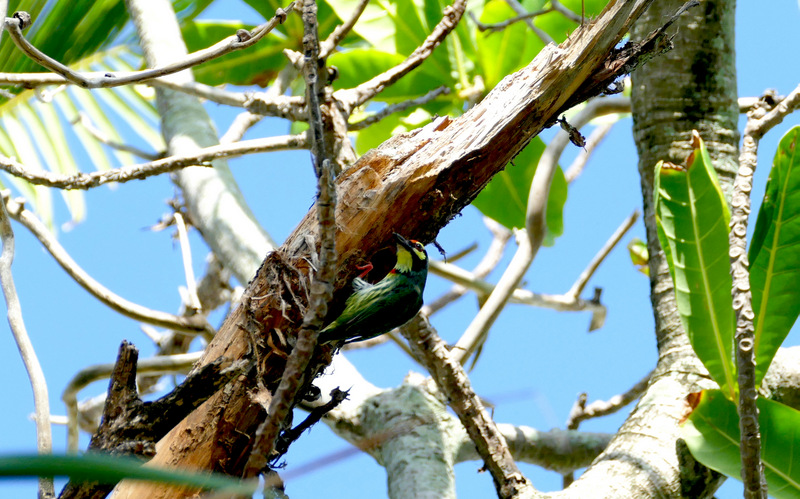
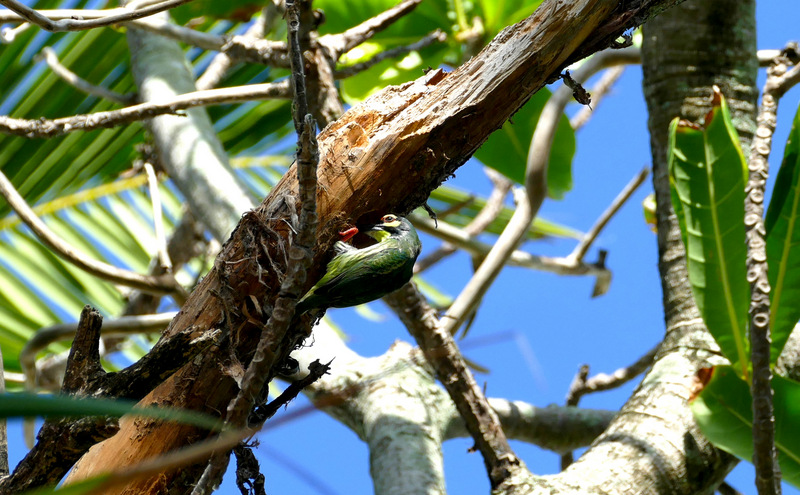
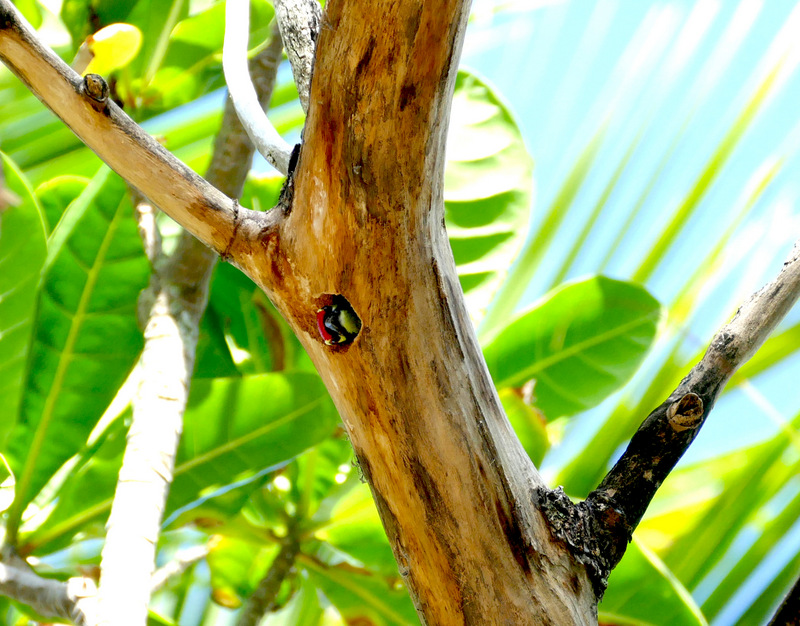
Although not rare or endangered, a very colourful bird to have appeared this year was the Coppersmith Barbet. The name comes from the birds call, which is ment to sound like a coppersmith striking copper with a metal hammer. This bird is very colourful and makes its nests in small holes hollowed out in trees, much like a woodpecker. While its main diet is fruit, they also eat insects and it is possible for them to eat up to three times their own weight per day. They do not flock in large groups but tend to travel alone or in small groups.
Recently, I was fortunate enough to see a tree riddled with small holes before I spotted several small heads looking out. These were the young, looking for their parents to bring the food. Over the next couple of weeks, the 3-4 pairs that were there all left the nesting tree, leaving just one pair and their young for around another week. From what I gather from talking to local bird experts, although the Coppersmith Barbet is considered a common bird, to see them nesting on a busy beach front is a rare sight. Makes one realise it is always good to sit back and have a look at what’s about.
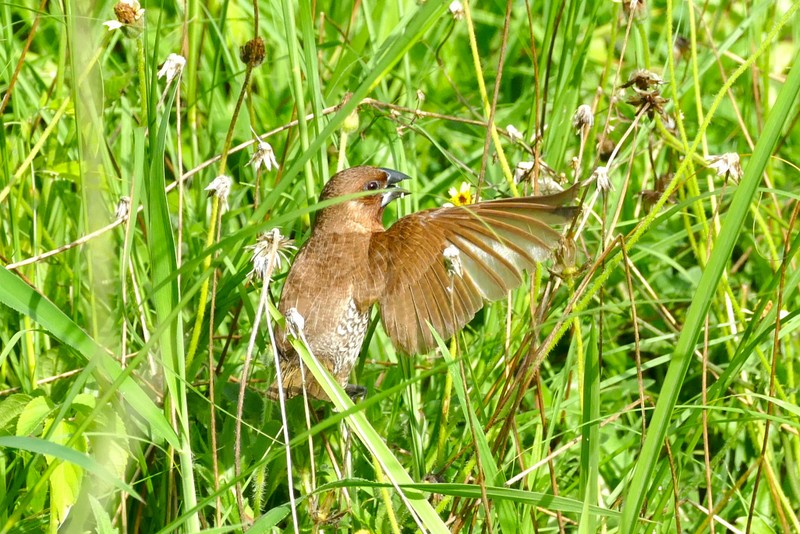
For those that actually travel out of the built up areas of the island and into more natural areas, you may see small flocks of small sparrow hiding in the long grass. These are called Munia. There are two types here on Phuket: The white breasted and scaly breasted Munia, both similar to sparrows but with a much larger bill. The Munia eats mainly grass seeds as well as berries and small insects. They are found in flocks and communicate with soft calls and whistles. The species is highly social and may sometimes roost with other species of Munias, typically found in tropical plains and grasslands. Breeding pairs construct dome-shaped nests using grass or bamboo leaves. They seem to not mind humans and allow you to get quite close before flying off, even to the extent of them being almost underfoot before shooting up and giving you a fright. The two are easy to tell apart as one has a white breast and the other has a spotty or scaly pattern.
Exotic
Next up is an attractive bird that has that exotic look: The Black-Crested Bulbul. I see these fairly often in lower tree branches in mid to late afternoon after the heat of the sun has gone. Where there is one you often find more. Again, bright yellow with a black head and a very visible crest on top of the head, they are easy to spot. Typically between 18.5–19.5 cm in length, it has black eyes with a yellow iris, and the bill and feet are black. Both the male and female are similar in plumage while younger birds are slightly duller. This is a bird that lives in the forest and dense scrub, building its nest in a bush, with two to four eggs a typical clutch. The Black-Crested Bulbul feeds on fruit and insects.
While most people, tourists and expats alike, spend most of their time in built up areas, there is so much to see, even just a few minutes from the town centers. You do not need to go out to wildlife sanctuaries or national parks to see lots of tropical birds and animals in Phuket. Yes, there is way more to see if you do go to the national parks, but to many everything is new and tropical anyway.
For anyone into birds, butterflies, wildlife and photography, there is so much to see on our doorstep. All the photos I have taken for this column over the past 18 months have been on my walk to work from my home. When I decided to rise an hour earlier each day and walk to work as opposed to just hopping on my scooter, I found I saw so much more. There is so much activity in the natural world around us and it is somewhat refreshing to acknowledge and understand so much of what I had never really noticed before.