


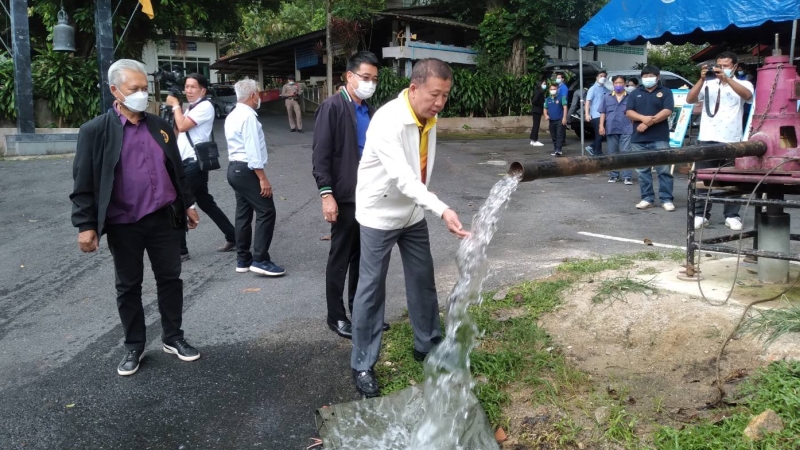
Sakda Vicheansil, Director-General of the Department of Groundwater Resources, was on the island on Thursday (May 26) to inspect, and announce, the project underway. The project has already identified 14 large-volume water sources among 45 wells drilled across the island.
Mr Sakda said that the Minister of Natural Resources and Environment Varawut Silpa-archa had ordered the Department of Groundwater Resources to investigate the underground water resources available. With Mr Varawut so publicly visible in protecting the environment that statement is very believable. But to say that the project is to investigate how those water sources may be exploited beggars belief.
Mr Sakda surely as head of the Department of Groundwater Resources has his role limited to that select area of involvement, but when investigating underground water resources in Phuket it must involve the Royal Irrigation Department, which is responsible for providing the public water supply delivered by the Provincial Water Authority, including all the private water sources used to serve the PWA as well as the three major reservoirs on the island (Bang Wad in Kathu, Bang Neow Dum in Srisoonthorn and Klong Krata in Chalong).
Mr Sakda may be unaware that the PWA started to roll out a major push to expand the public water supply network across Phuket over a decade ago. That major push did not come out of nowhere. Wells and aquifers across the island were already drying up. Residents in the southern reaches of Phuket, especially in Rawai where most people still relied on well water and water trucks, were among the last to finally be connected to public mains water supply. Much of the area today is still dependent on wells.
Phuket may be a large island, but is still an island. Bountiful in rain, Phuket has enough precipitation and catchment areas to support a relatively large population for an island this size – yet those limits have already been found. The limits were plainly evidenced by the water shortages of 2018 and 2019, when the Army was called in to supply entire neighbourhoods, some of which had residents carrying water back to their homes from communal tanks for months.
And the solution presented this week was to explore further depleting those resources? The logic is simply stunning.
In trying to avoid water shortage crises in the future, the Phuket office of the Royal Irrigation Department and the PWA did well to look to small private water sources on the island that are naturally replenished. They also finally got the ball rolling on the pipeline from Phang Nga to bolster supply from a reservoir there dedicated to supplying Phuket.
In their assessments and selections, they were careful to check first to ensure the water sources being added to the collective supply would not be overly depleted. Mr Sakda must do the same. Conduct a widespread survey to identify where large aquifers may be used in case of emergency? Sure. To identify them with the preconceived intent of exploiting them? No.
“The guidelines developed will be used in other archipelago areas with similar geological features in the future,” Mr Sakda said. Fine, but it is very difficult to see how the eventual guidelines produced could provide any advice other than: “Use as little as possible; draw only what is necessary.”
On any island saltwater intrusion is a key concern. As Australian experts Greene, Timms, Rengasamy and Arshad wrote as recently as 2016: “Degradation of the quality of groundwater due to salinization processes is one of the key issues limiting the global dependence on groundwater in aquifers. As the salinization of shallow aquifers is closely related to root-zone salinization, the two must be considered together.”
As for any intention to use more groundwater in Phuket for farming, experts Pulido, Rigol-Sanchez, Vallejos and Sola said more recently in 2018, “Agricultural irrigation represents the main use of global water resources. Irrigation has an impact on the environment, and scientific evidence suggests that it inevitably leads to salinization of both soil and aquifers.”
There are limits to exploiting natural resources, and on this island groundwater is one of them. Many people across the island still today rely on groundwater for their household supply. How much is already drawn from Phuket’s aquifers must be first determined before any thought of drawing more can be considered. Mr Sakda needs to look first, before diving in.