


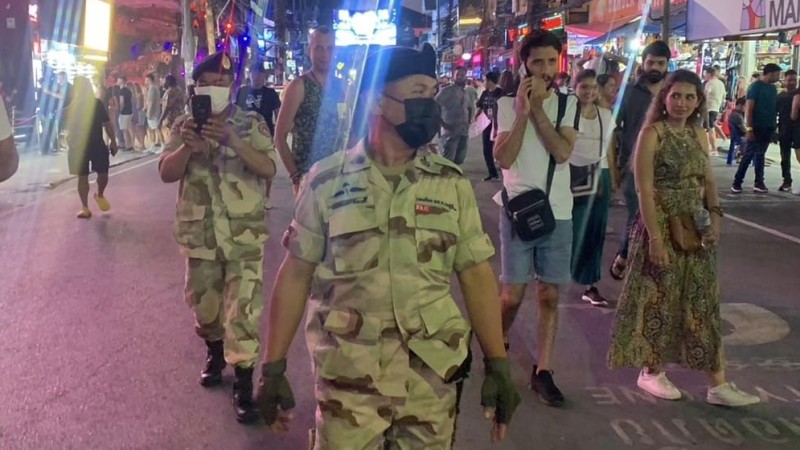
Personnel from the local branch of the Volunteer Defense Corps (OrSor) are now being regularly called in to “assist” police in having so-called “random” drug tests performed on staff at night entertainment venues on Bangla Rd.
There is so much wrong with this that it is difficult to know where to begin. First, as plainly shown by even official photographs of the “random” tests, the OrSor were not “assisting” with anything. They were conducting the operation themselves, under orders from the Kathu District Chief, with police officers present only to officially sanction their actions as “law enforcement”.
Worse, the people were not randomly selected at all. They were singled out from a list drafted by the local District Office. Seriously, we now have local officials singling out individuals for processing by a paramilitary unit – and yes, the OrSor is a paramilitary unit. Take just 10 seconds and think of other countries where this happens.
The OrSor are not military, or police. They are a militia of “volunteers”, meaning only they were not conscripted. Named in full as Kong Asa Raksa Dindaen, they are more easily identified by the white elephant on the patches on their uniforms.
As explained earlier this week, they operate under the Ministry of Interior. The local branches report to the District Chief, and in turn to the provincial governor, and ultimately operate under the Minister of Interior, currently Gen Anupong Paochinda.
Established under the Volunteer Corps Act 1954, the OrSor was set up by the government specifically to counter communist threats and attacks at the village level at the time. Officially, their main duty is to maintain the interior security of the nation at war time or from natural disaster. With no war or disaster to attended to, they are called on to assist police and officials in law enforcement and render assistance to villagers in case they are under threat from disaster or a common armed force.
The OrSor is literally an army in waiting, and the white elephant remaining on their shoulders is not a coincidence. Why they still exist begs the question of how much a superior authority in the capital does not trust the armed forces or the police force to maintain the peace if push comes to shove.
As Thailand has repeatedly shown, it has a military that is more than willing to run the country – without opposition or support from the OrSor, showing just how unnecessary they are. In parallel, police have long been a force unto themselves.
What’s worse with the OrSor is that without being called upon to fight a common enemy, or assist agencies in times of natural disaster, they tend to be put to use as a show of strength by local officials carving out their own presence away from the capital. This, Phuket does not need.
Calling in the OrSor for “weapons and drugs checks”, as conducted on Bangla Rd this week, is not new. We’ve been down this road before. The move is very reminiscent of both the ‘Better Social Order’ and the ensuing ‘War on Drugs’ campaigns under the Thaksin administration.
Under the former, nightlife raids saw venue doors locked and all people, including foreigners, being forced to undergo mandatory urine tests on site. The latter saw some 2,800 extrajudicial killings in its first three months. Not all the triggers were pulled by police. Once OrSor are “deputised”, they simply follow orders.
Instead of glorifying the OrSor in “supporting officials” carrying out their duties, the OrSor needs to be shut down. There is no reason for them to exist. Existing “volunteers” wanting legalised gunplay can join the military, those not willing to commit to that level of discipline can join the police, while those wanting to help people in times of dire need can join the Civil Defense Volunteers and support the Department of Disaster Prevention and Mitigation (DDPM) to do the greater good.
If any local officials feels that their authority is not being taken seriously when they are not accompanied by personnel in military-style uniforms, then the problem is much more serious than just image and a photo opportunity – and should be treated as such. Call in the right agencies to deal with the problem, not some anachronism from the last century that only highlights how many armed forces are still available at whim within the country.