


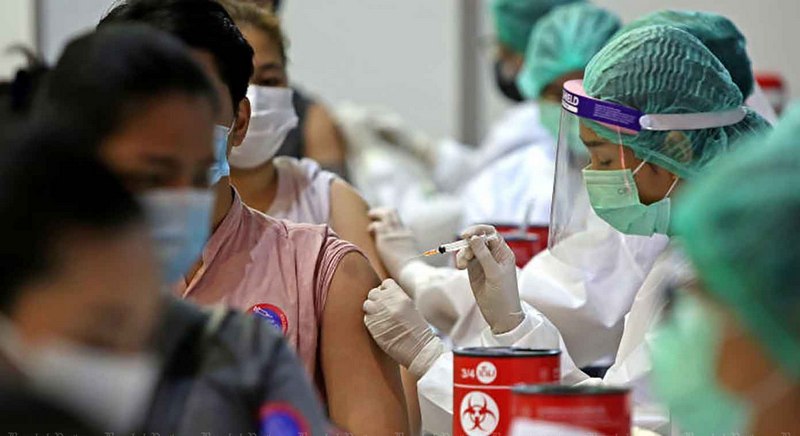
Many LAOs are rushing to place orders for the alternative Sinopharm vaccine supply being bought by the Chulabhorn Royal Academy (CRA) from China, however, Prime Minister Prayut Chan-o-cha yesterday (May 31) voiced concern over whether they can afford it or are even legally entitled to spend their budgets on the purchase.
However, the premier insisted he had no objection to the LAOs buying the vaccine assuming any restrictions that bar them from appropriating funds to do so can be lifted.
“If they can undo this [restriction], by all means go ahead and do it,” he said, adding relevant laws may need to be studied first.
“I don’t want the issue to become politicised,” Gen Prayut said.
Deputy Prime Minister Wissanu Krea-ngam, who is also the government’s legal expert, insisted the LAOs must ask the Interior Ministry to work to remove the restriction. “Otherwise, the LAOs will be in trouble with the State Audit Office for wrongful utilisation of state funds,” he said. However, Interior Minister Anupong Paojinda said entrusting the more than 7,000 individual LAOs nationwide to conduct the vaccine purchases on their own could be potentially chaotic.
Also, there are both richer and less well-off LAOs, a discrepancy which affects their ability to afford the purchase, said Gen Anupong. The CCSA should decide whether to let LAOs acquire the vaccine themselves or whether the state should procure it for them.
Mr Wissanu explained yesterday the LAOs are in no position to buy the vaccine directly from manufacturers because the companies will not sell to them.
However, the organisations can order from appointed representative agents of the respective vaccine producers. In the case of Sinopharm, the LAOs must contact the CRA.
“But the problem rests with how the organisation can get their hands on the money to buy the vaccine,” he said.
Somsak Kittithornkul, president of the LAOs of Thailand, said the government should spell out clearly whether or not the LAOs are authorised to purchase the vaccine as well as consider supporting the purchases after many fell short of their tax revenue targets caused by the economic slowdown and exacerbated by the continuing COVID-19 pandemic.
No vaccine shortage: Prayut
Meanwhile, Gen Prayut gave assurances yesterday that vaccine deliveries would arrive on time and Thailand would not experience any shortages.
The pledge was made during an address to the House of Representatives as it kicked off its debate on the budget bill for the 2022 fiscal year ahead of the mass vaccination programme due to start on June 7.
“The government continues to procure COVID-19 vaccines and has primary, secondary and emergency plans. I expect the delivery of the supplies to be made on schedule.
“The government has procured vaccines from Sinovac and AstraZeneca while an alternative vaccine [from Sinopharm] is being procured by Chulabhorn Royal Academy (CRA),” he said.
He defence came after the Mor Prom (Doctor’s Ready) mobile appointment app was temporarily suspended.
Gen Prayut also said the government would speed up allocation of vaccine especially to areas with large clusters of infections.
Permanent secretary for public health Kiattiphum Wongrajit said yesterday the vaccine rollout will take place from June 7 as scheduled with AstraZeneca insisting the vaccine will be delivered as planned.
Dr Kiattiphum said that about 70% of the population will get their first shots by the end of September in line with the Centre for COVID-19 Situation Administration’s (CCSA) plan.
Supakit Sirilak, director-general of the Department of Medical Sciences, said yesterday 19 samples of AstraZeneca’s vaccine including five produced locally by Siam Bioscience had passed quality tests.
Meanwhile, the CCSA yesterday reported 5,485 new cases with 3,532 among the general population and 1,953 in prisons.
CCSA assistant spokeswoman Apisamai Srirangson said two new clusters had been found in Bangkok, one at a construction worker camp in Bang Na and the other in a community in Sathon.
Meanwhile, Udon Thani health authorities yesterday reported that four of the most recent cases diagnosed were found to be of the variant first detected in India.
Uthen Hakaew, deputy chief of the provincial public health office, said the three women and one man were being treated at four separate hospitals.