


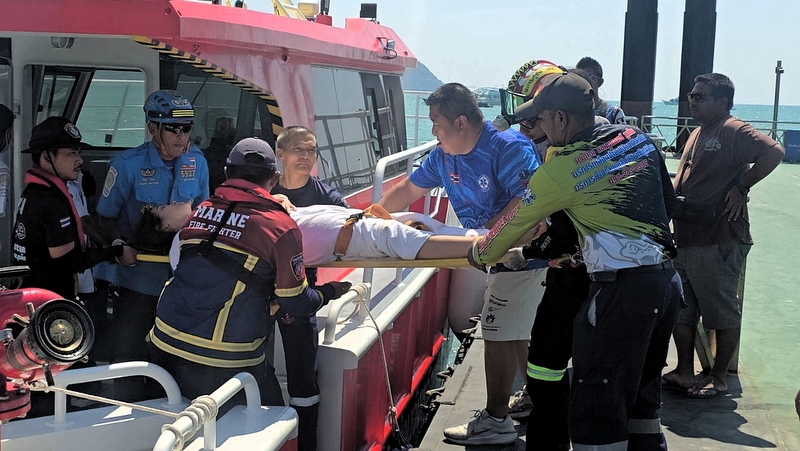
Phuket Marine Office Director Adoon Raluekmoon, who took up the post only recently, said the two incidents ‒ one claiming the life of a teenage tourist and the other causing more than B40 million in damage ‒ exposed systemic weaknesses that can no longer be addressed through temporary or reactive measures.
Instead, he announced a raft of preventive reforms aimed at tightening oversight of tour boat operators, improving crew discipline, reducing congestion at key marine hubs and restoring confidence in Phuket’s marine tourism industry.
Among the most significant changes are a ban on tour speedboats being lined up overnight on beaches, stricter anchoring and zoning rules, intensified inspections, mandatory drug testing, enhanced crew training, and tougher penalties ‒ including licence suspension or revocation ‒ for operators repeatedly found breaching safety regulations.
“These incidents are not isolated accidents,” Mr Adoon said. “They reflect long-standing structural problems. If we continue to treat each case as a one-off, the same tragedies will keep happening.”
The renewed scrutiny follows a high-speed collision near Phi Phi Island last Sunday morning (Jan 11) that killed a 17-year-old Russian girl and injured at least 20 other passengers, including children.
The collision occurred at about 8:55am, about five nautical miles from Koh Phi Phi. The speedboat, ‘Koravich Marine’, operated by ‘A Time Company’, was travelling from Phuket with 55 people on board, including 50 tourists, two guides and three crew members, when it struck the fishing trawler ‘Pichai Samut 1’, which was operating in the area.
Authorities confirmed the passengers included 33 Russian nationals, eight from Kazakhstan, four from Uzbekistan, two from Kyrgyzstan, three Polish nationals, one British national and four Thais. The collision resulted in one fatality and at least 20 people suffering injuries of varying severity.
In explaining how the collision occurred, new Phuket Marine Chief Mr Adoon said, “The captain assessed that he could avoid the fishing boat, but waves caused the vessel to veer and collide.”
Regardless, Phi Phi Police Chief Pol Col Atthawat Suwannarat confirmed that the driver, identified by police only as ‘Mr Suriya’, 44, faces a charge of negligence causing death, with an additional charge on Wednesday (Jan 14) of illegal possession and use of a Category 1 narcotic (methamphetamine).
While drug use was detected among crew members, Mr Adoon stressed this was a “secondary factor”. “This type of accident is not unprecedented,” he said. “Over the past year, we have seen similar collisions, and the common factors are always negligence and misjudgement.”
He said these recurring patterns demonstrate the need for stronger preventive controls rather than relying solely on post-incident punishment.
BEACHFRONT INFERNO
Just days earlier, Phuket suffered another serious marine safety incident, when a pre-dawn fire near Chalong Pier on Jan 7 destroyed 24 speedboats belonging to 13 tour operators, causing losses estimated at more than B40 million. Thankfully, no injuries were reported.
The boat where the fire originated was identified as a Nikorn Marine tour speedboat, Mr Adoon said.
Forensic police are investigating the cause of the fire. Electrical faults are suspected, but the fire did not originate in an engine compartment, and no conclusion has yet been reached, he added.
Mr Adoon said the Chalong Bay fire closely mirrors previous incidents in the same area seven and three years ago, all involving boats moored overnight near the shore. “The patterns are very similar ‒ night-time fires, stationary boats, rapid spread,” he said.
As a result, the Marine Department is now reviewing historical data to identify contributing factors such as mooring practices, electrical systems, refuelling procedures and operator management.
Boats or companies found to be linked to repeated incidents will be subject to heightened scrutiny and stricter regulatory measures.
In response to the two incidents, the Marine Department has ordered a comprehensive overhaul of marine safety practices across Phuket, with most measures to be implemented within one to two weeks.
Key changes include:
- A ban on overnight beach mooring of tour boats
- Mandatory anchoring only in designated zones
- Clear marine zoning and on-site supervision
- Standby fire boats and emergency response drills
- Mandatory pre-departure reporting of passenger lists, routes, captains and travel times
- Full inspections of hulls, engines, electrical systems and safety equipment
- Random drug testing and certification checks for captains and crew
- Additional safety training under newly upgraded standards
- Real-time monitoring of voyages through the Vessel Traffic Control Center
“If even one item fails inspection, the vessel will not be allowed to depart,” Mr Adoon said.
Vessels with accident histories will be classified as “high-risk” and subject to more frequent inspections, operating restrictions or route limitations until they pass a new assessment.
A “safe boat” rating system will also be introduced, with compliant vessels publicly listed to help tourists make informed choices, particularly through online booking platforms.
ENFORCEMENT
Repeated violations will trigger escalating penalties, including licence suspension or revocation. “Reporting inspections is not paperwork ‒ it is a safety measure,” Mr Adoon warned. “Failure to comply will result in administrative and legal penalties.”
Authorities are also considering how and when to disclose the names of vessels and operators involved in incidents, within the framework of the law, to ensure transparency without compromising investigations, he said.
Mr Adoon admitted that the two incidents should serve as a wake-up call for Phuket’s marine tourism sector. “This is not an immediate problem. It is a structural one,” he said. “If it is not seriously addressed, there will be more accidents ‒ more lives lost, more damage to businesses, and more harm to Phuket’s image.
“All these measures aim to ensure one thing,” he added. “That marine travel in Phuket is properly controlled, properly monitored, and genuinely safe.”