


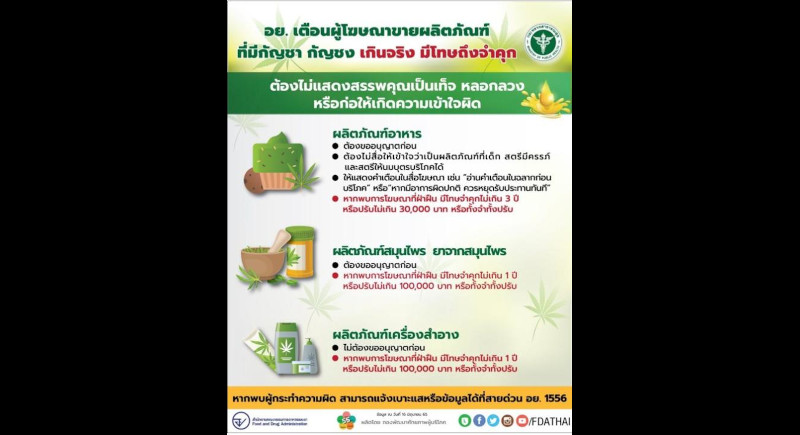
The FDA’s posts and press statements reiterated that the sale of this “controlled herb” to pregnant women or students or through vending machines and electronic or online channels is prohibited. This also extends to unapproved commercial advertising.
These announcements are seen as a reaction to the Pheu Thai Party court filing which attempts to reverse the decriminalisation of the cannabis plant. According to their press release, this refers to the removal of cannabis from the narcotics list where THC was less than 0.2% by weight. If the court filing is successful, it would put commercial use of cannabis (hemp) back on the restricted list.
The FDA moved cannabis to the list of “controlled herbs” under the Protection and Promotion of Knowledge on Thai Traditional Medicine Act B.E. 2542 (1999) (“the Act”) and stated that the FDA would now control any non-medical use of cannabis.
The FDA website posted an update last weekend specifying advertising standards. The post warned that the unauthorised advertising or exaggeration of claims for products containing cannabis is punishable by substantial fines and imprisonment. It specified three categories, namely food, herbal products and cosmetics. For food and herbal products, prior approval of the advertisement is required.
Cannabis as a controlled herb
The classification of the plant as a “controlled herb” means that licensed businesses must report the quantity of controlled-herb stocks they hold and provide details about where they are sources and their uses.
Thongchai Lertwilairattanapong, Director-General of the Department of Thai Traditional and Alternative Medicine, said “as the draft bill is not yet complete, we need to control it in ways that still allow beneficial uses.”
Under the Act, businesses are required to inform the government each time they export controlled herbs. But as cannabis exports are tightly controlled as a scheduled drug under The Single Convention on Narcotic Drugs 1961, it is unlikely there will be anything to report.
However, the Act provides (s.46.) that “a person shall not… distribute or transform controlled herbs for commercial purposes unless that person is granted a licence from the licensing authority.” Further, the Act (s.45) allows the Minister to control the source and use of any controlled herb and determine the number or quantity of any controlled herbs possessed, used, monitored, kept or transferred. It also requires specific notification to the registrar.
We are still waiting for these regulations and reporting requirements. But in the interim, the FDA has also moved forward and has been licensing certain commercial cannabis growers provided they sell via licensed distribution channels. Unlicensed growers and distributors could be impacted by this regulation with penalties under the Act including imprisonment for up to six months or a fine of up to B10,000, or both.
By Dr Paul Crosio
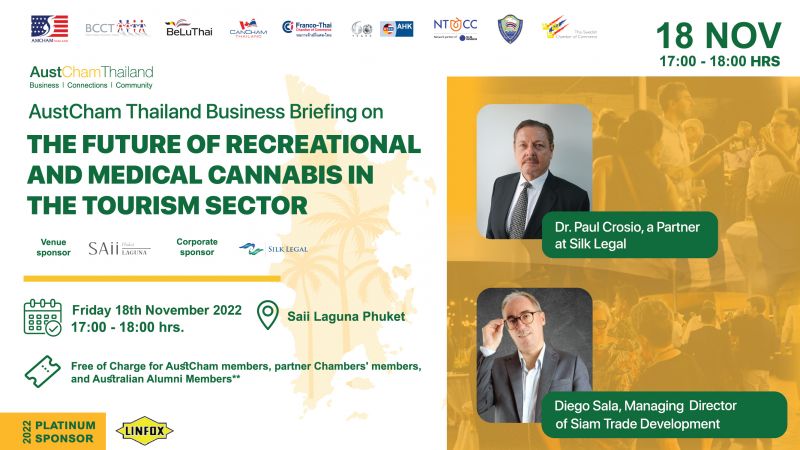
Dr Paul Crosio, a Partner at Silk Legal who was recently recognised as one of the Top 200 Global Cannabis Lawyers of 2022, will be a key speaker at the AustCham Thailand Business Briefing at Saii Laguna Phuket tomorrow (Nov 18).
Starting at 5pm, the event will cover: The future of Recreational and Medical Cannabis in the Tourism Sector: Will cannabis be a high or just a bad trip for Thailand’s tourism sector? The talk will highlight topics to gain practical insight about operating a medical cannabis business focused on tourism in Thailand.
Topics include: Marketing and pitch deck considerations for start-ups. Changes to the Cannabis and Hemp Act and how they will affect businesses in the sector. The future of medical cannabis in Asia.
Joining Dr Crosio will be Diego Sala, Managing Director of Siam Trade Development, who specialises in regulated activities surrounding cannabis products, dietary supplements, and medical devices.
For details of the event, click here.
About Silk Legal:
Silk Legal is a boutique law firm that focuses on complex legal matters in Thailand. We are a full-service commercial law firm with dedicated practice areas in corporate and commercial, restructuring and insolvency, mergers and acquisitions, and regulatory matters.
We have served companies of all sizes, from start-ups to multinational corporations in several industries, including Fintech, Board of Investment (“BOI”) promotion, manufacturing, and hospitality. Our first goal is to always help our clients succeed in business.
Contact us to learn more about the cannabis laws in Thailand as they emerge and how to set up a business in Cannabis. Submit your inquiries or let us know how we can assist you by contacting info@silklegal.com.