


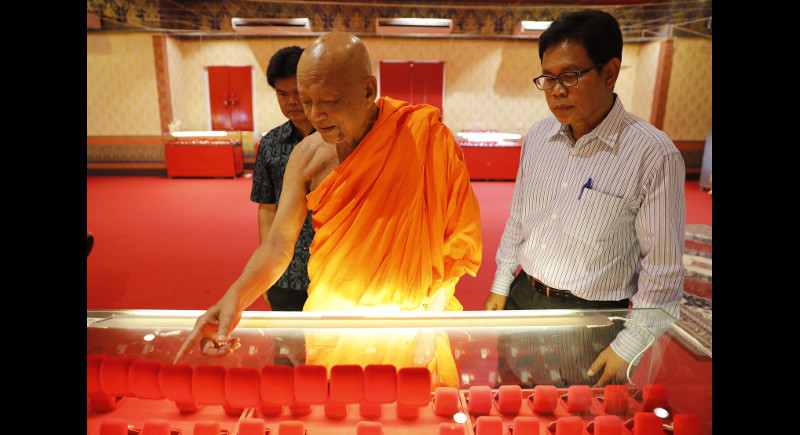
The chief of the Phuket office of the National Office of Buddhism, Winya Paladkwa, revealed the news yesterday (Nov 24) after inspecting the operation, which sits on temple grounds in a building designed as a temple chapel.
The operation has been accused of overcharging Chinese tourists brought in by the busload for items and artefacts sold in the building, and the legality of the building itself has been challenged. (See story here.)
In essence, the operation is privately run, not run by the temple, Mr Winya explained.
“The temple assigned Pairoj Nokbanjong as a representative to enter a one-year contract with Somkiet Kaewsakul to rent the area on temple grounds for B50,000 per month. The contract started in 2013 and has been renewed every year until now,” Mr Winya said.
“We found that one part of the rental contract is not regulated,” he added.
“Contracts for areas on temple grounds for periods of three years or less has no need to even involve any other higher-ranking temple authorities. However, this contract stipulates that it is being carried out ‘in order to do benefit’ – and any contracts that claim this must be reported to the National Office of Buddhism head office in Bangkok,” Mr Winya explained.
“In the meantime, we have yet to decide whether or not to suspend this operation while our investigation continues,” he said.
Somkiet Kaewsakul, who heads Puttatham Co Ltd, which literally translates as “Buddhism Virtue Co Ltd”, during the inspection yesterday told the press, “Chinese tourists have visited the temple for more than 10 years. As Chinese and Thai are culturally different, sometimes this can cause damage to the image of Buddhism. So we made the building to look similar to a temple to help the tourists understand how to behave appropriately while they are here.
“The items and artefacts are all real. We did not force anyone to buy them. The prices range from around B1,000 to more then B10,000,” he said.
“Also, we invited monks to give sacred water to tourists for luck. If Buddhists believe this is not the proper thing to do, we are willing to stop this,” Mr Somkiet added.
Meanwhile, Phra Kru Metta Pirom, Abbot of Wat Mongkol Nimit in Phuket Town and head monk overseeing the administration of all temples within the diocese of Muang Phuket, yesterday defended the building despite the obvious and now self-confessed attempt to make it look like a Buddhist chapel.
“There is no fake chapel. The area where the building sits is rented by a private entity to build a commercial building,” he said.
“The structure is in Thai style, which is identical to a temple, so this caused a misunderstanding,” he added.
“After the rental contract expires, the building will be handed over to the temple,” Phra Kru Metta Pirom explained.
“Regarding overpriced items and artefacts and the sale of items that might be fake, this issue is a matter for the renter to deal with. The temple has not been involved in this issue. If Buddhists want us to check or control this operation, the abbot [of Wat Tai] will investigate,” he said.