


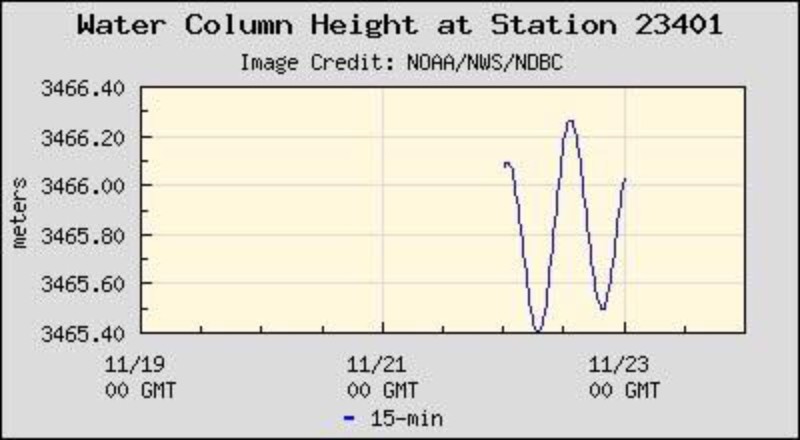



Station 23401, installed as part of a multinational array of tsunami-warning buoys in the Bay of Bengal, began transmitting real time data to the US Government’s National Oceanic and Atmospheric Administration (NOAA) National Data Buoy Center (NDBC) at midnight last night (Nov 22, see image in gallery).
However, the data range presented by the NDBC shows that the buoy actually became operational at midnight Saturday (Nov 19).
The milestone marks the return to service after more than a year of the buoy being out of action.
Station 23401 stopped transmitting data in October last year. The buoy was confirmed as “missing” from its installed location, but later recovered.
Station 23461, installed in the Andaman Sea approximately 340km northwest of Phuket, about halfway between Phuket and the Nicobar Islands, began relaying real-time data to the NOAA last Thursday (Nov 18).
Station 23461 stopped transmitting data on June 7 this year, with Thai authorities explaining that the problem was with data not synching with NOAA servers.
(See Station 23461 live data here; See Station 23401 live data here.)
The two warning buoys were installed by crew on board the ship MS Seafdec, which left Phuket on its DDPM mission to “replace” two tsunami warning buoys that were no longer functioning last week.
DDPM Director-General Boontham Lertsukeekasem was in Phuket to officiate the high-profile sending off of the MS Seafdec, named after the Southeast Asian Fisheries Development Center.
The ship departed Phuket Deep Sea Port, on the east coast of Cape Panwa, at 3pm on Nov 15 with two tsunami-warning buoys on board to “replace” the two that were not functioning.
In announcing this morning (Nov 23) that both tsunami-warning buoys were operational again, the Phuket Info Center, which operates under the Phuket Governor’s office, noted, “The new set of tsunami monitoring buoys in the Andaman Sea and Indian Ocean have been installed to replace the original buoys. That completes the maintenance cycle for tsunami-monitoring buoys.
“They are ready to use continuously and efficiently and can warn in advance quickly. This allows government agencies and the public to be prepared to deal with tsunamis and evacuate in a timely manner, as well as build confidence in the safety of life and property for the public and tourists,” the centre noted.
However, even with Station 23401 back online, it remains the only tsunami-warning buoy in the multinational array in the Bay of Bengal that is transmitting real-time data to the NOAA.
There have been no updates to confirm if they the other buoys are still operational, or whether they are able to relay any data warning of an impending tsunami.