


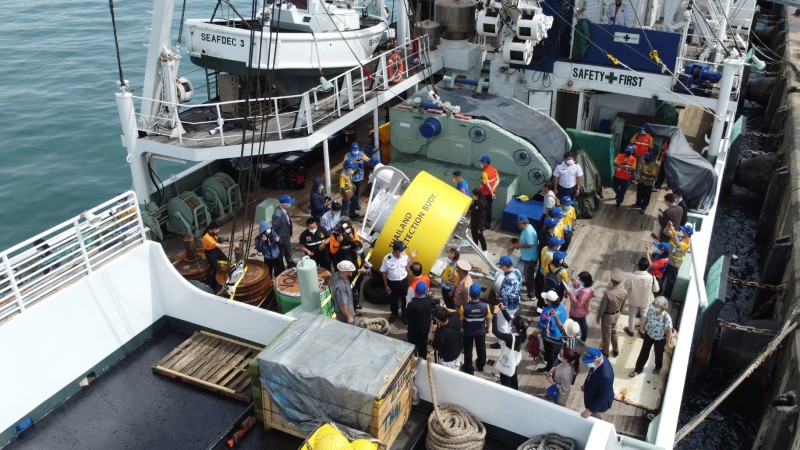
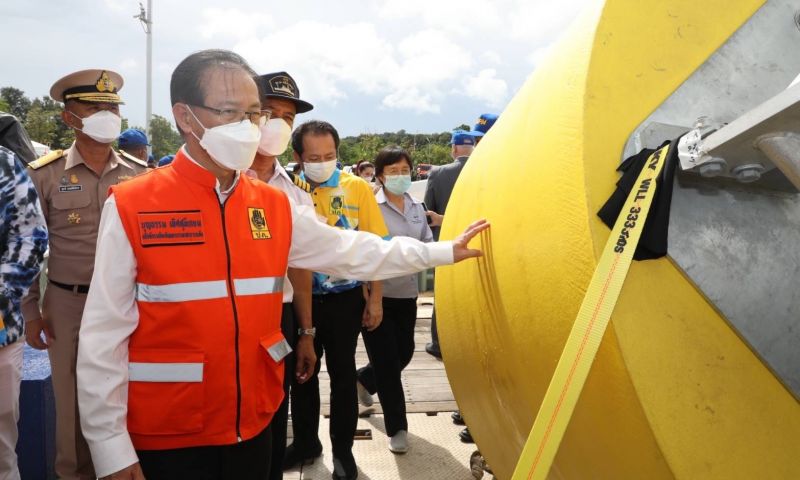


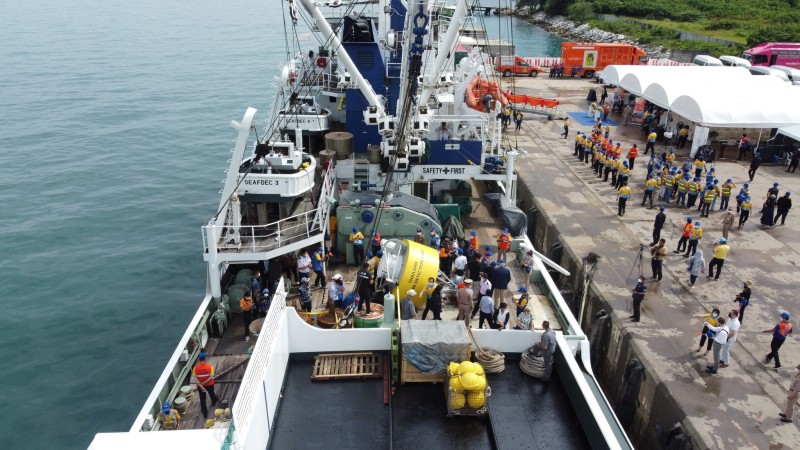
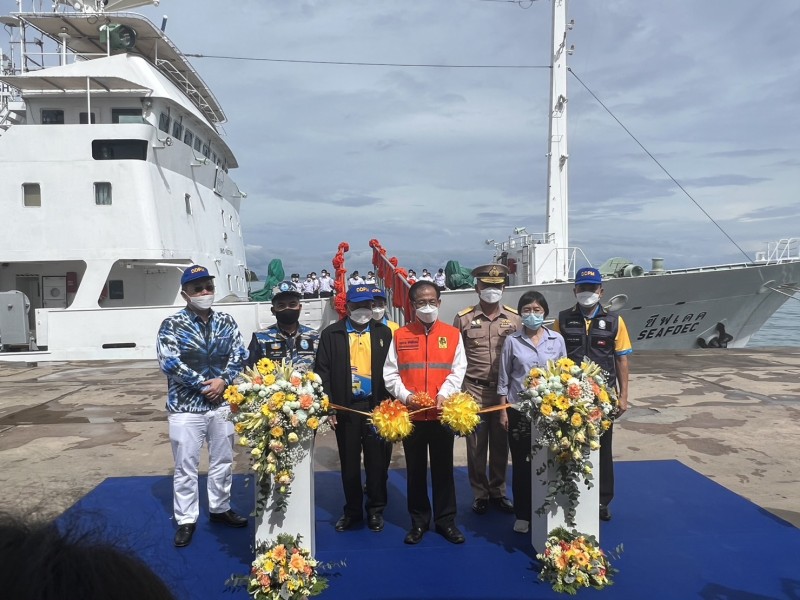
The ship MS Seafdec, named after the Southeast Asian Fisheries Development Center, departed Phuket Deep Sea Port on the east coast of Cape Panwa at 3pm with the two tsunami-warning buoys on board.
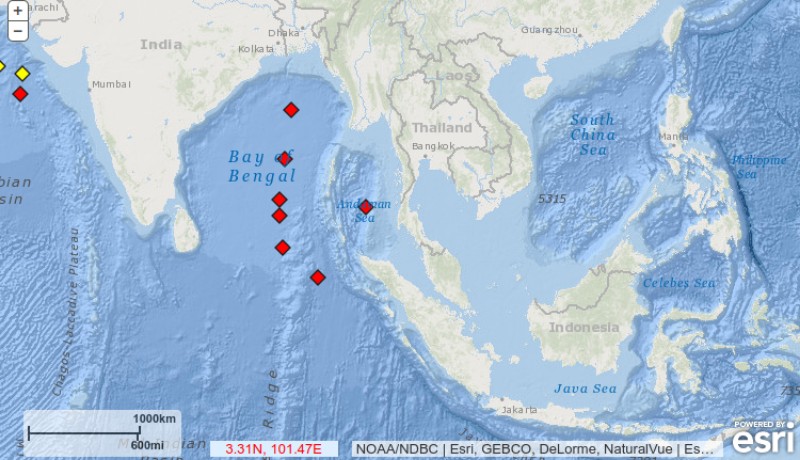
Mr Boontham explained that one of the buoys was to be installed amid the multinational Bay of Bengal tsunami-warning array some 965km west of Phuket. The other is to be installed in the Andaman Sea about 340km northwest of Phuket, about halfway between the Nicobar Islands and the Thai mainland.
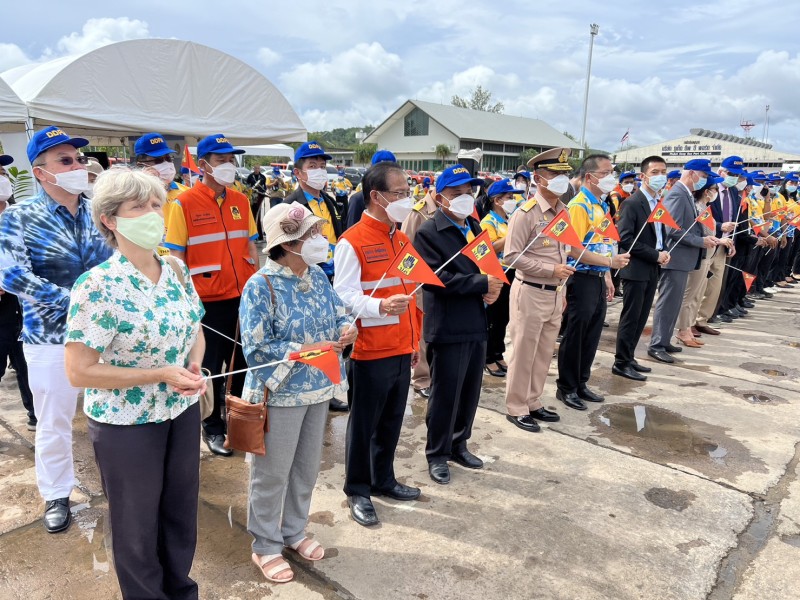
The send-off was a high-profile affair, with envoys from 11 countries present, official reports of the event noted, singling out Russia, India, Nepal, Switzerland and China for specific mention.
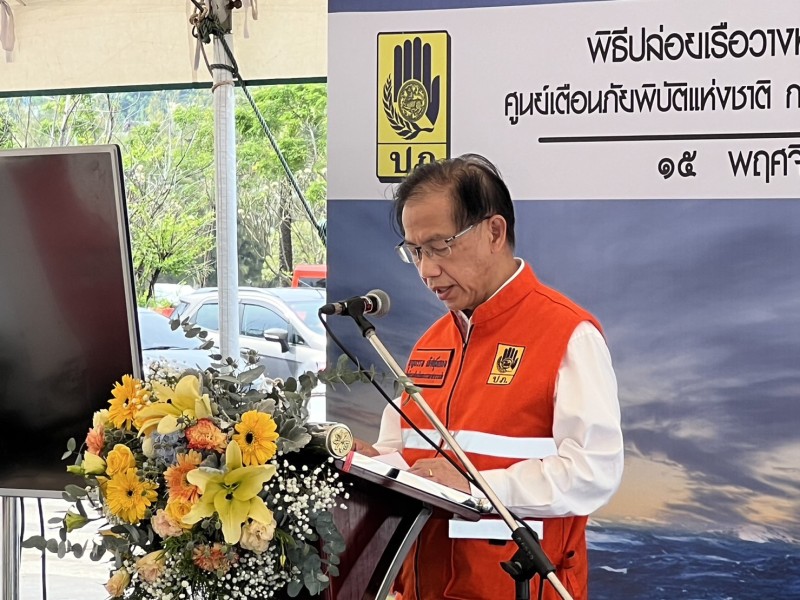
“The tsunami monitoring system in the Indian Ocean and the Andaman Sea is a mechanism for early warning of tsunamis to people so they are not alarmed by rumors and receive accurate information from government agencies, and to enable people to prepare for tsunami evacuation in a timely manner, to create safety for the lives of the people,” Mr Boontham said.
Mr Bootham highlighted there are 130 tsunami-warning towers posted along the Thai Andman coast, namely in Ranong, Phang Nga, Phuket, Krabi, Trang and Satun.
“The tsunami wave detection buoys being installed are a worthwhile investment to help reduce the loss of life and property of the people. However, I would like to ask government agencies, organisations, businesses, volunteers, networks, fishermen and the public to help monitor and maintain the tsunami detection system. This includes the warning towers and local warning devices so they are able to remain in continuous use and give effective warnings in advance,” he said.
Tsunami-warning towers will be tested every Wednesday at 8am, Mr Boontham continued. “If at any point there is a problem, staff will be sent to fix it immediately so they are ready to provide effective tsunami disaster warnings in risk areas,” he said.
Mr Boontham recounted the impact of the Asian Tsunami in 2004, which killed an estimated 230,000 people. Thailand’s official casualties numbered 4,812 with a further 4,499 people missing after the disaster.
Phuket officially suffered only 259 deaths with a further 700 people missing, but the resort area of Khao Lak north of the island suffered 3,950 confirmed deaths, with unofficial estimates placing the death count much higher, more than 4,500. Many of those killed in Khao Lak were Scandinavian tourists.
CONFIDENCE
Mr Boontham called on people to have confidence in the tsunami-warning measures in place to provide effective warnings in a timely manner.
The two buoys being deployed were to “replace” the buoys that are no longer functioning, Mr Boontham explained.
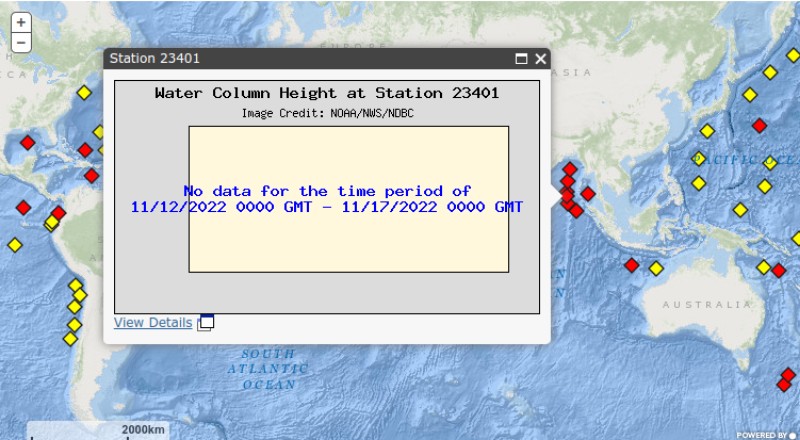
However, not mentioned was that the buoy designated Station 23401, installed as part of the multinational array in the bay of Bengal, stopped transmitting data in October last year. The buoy was confirmed as “missing” from its installed location, but later recovered.
Station 23461, installed in the Andaman Sea approximately 340km from Phuket, stopped transmitting data on June 7.
Mr Boontham’s call for confidence in Thailand’s ability to warn people of an impending tsunami comes five months after national state news agency NNT also called for people to not be worried about impending tsunamis, and assured that an operation had been launched to recover the buoy in the Andaman Sea.
The problem was with the buoy’s data transmissions not being processed by NOAA servers, the DDPM said at that time.
Mr Boontham yesterday explained that the warning buoys feed data to the tsunami-warning system monitored and operated by the US Government’s National Oceanic and Atmospheric Administration (NOAA).
Not explained was that the NOAA monitoring system has not been relaying data from any of the Bay of Bengal warning buoys for months.
The data is relayed in real time to the NOAA’s National Data Buoy Center (NDBC). However, the NDBC Webmaster confirmed to The Phuket News in July that data from any buoys in the Bay of Bengal array was not being relayed to the NDBC.
As of today (Nov 15), the NDBC is still not receiving any data from the Bay of Bengal array.
For accuracy. the NDBC also continues to report today that no data is being received by either of the two buoys owned and maintained by National Disaster Warning Center (NDWC), under the Department of Disaster Prevention and Mitigation of Ministry of the Interior, Thailand. (See Station 23461 live data here; See Station 23401 live data here.)
“I’ve tried to connect to the website used by the National Institute for Ocean Technology INDIA, who owns and maintains this network of buoys. The site is unreachable at this time and unfortunately, we are not sure of any other method to reach this organization,” the NDBC Webmaster explained to The Phuket News.
“Normally: http://www.niot.res.in/ would launch the website and there would be at the minimum a webmaster email similar to this one to contact. That is not the case at this time. I will pass along this concern, but there is no action that we can take as we do not govern this network of buoys,” the NDBC Webmaster noted.
Mr Boontham yesterday gave no explanation as to how Thai DDPM officials, and specifically the National Disaster Warning Center (NDWC), would be able to issue any tsunami alerts or warnings with the current lack of data being received from the Bay of Bengal array.
CEREMONIAL PROGRESS
Regardless, before the launch of the MS Seafdec at the Deep Sea Port yesterday, Mr Boontham led a grand ceremony at the Courtyard Marriott Hotel in Phuket Town to commemorate the signing of an Memorandum of Understanding (MoU) “on the Support and Integration of Thailand’s Tsunami Monitoring and Maintenance Network”
The MoU was signed by eight other government agencies, in addition to the DDPM. Phuket GovernorNarong Woonciew and the heads of “many other relevant government agencies” attended the event, noted official reports.
“By signing the Memorandum of Cooperation today, it is a part that will contribute and will help the tsunami measurement system and provide consistent availability and efficiency to give alerts to the public, and tourists, in the Andaman coast area of Thailand, including people in the region around the Indian Ocean, to be able to be ready to respond and evacuate in a timely manner,” Mr Boontham said.
“This is considered an important way to drive the policy ‘Safety Thailand’ and to build confidence in the warning system for people and tourists,” he added.
Why a new MoU was needed for agencies that were already supposed to be coordinating to provide effective tsunami warnings was not explained
Further, according to official reports, the MoU was dated to be effective for only two years from the date of signing. Why the MoU was given an expiration date remained unexplained.
While the DDPM was established in 2002, taking responsibility for disaster warning and prevention measures from five other government departments, the NDWC was not established until after the Asian Tsunami on Dec 26, 2004. The NDWC’s primary initial reason for existence is to provide effective tsunami alerts.
Additional reporting by Eakkapop Thongtub