


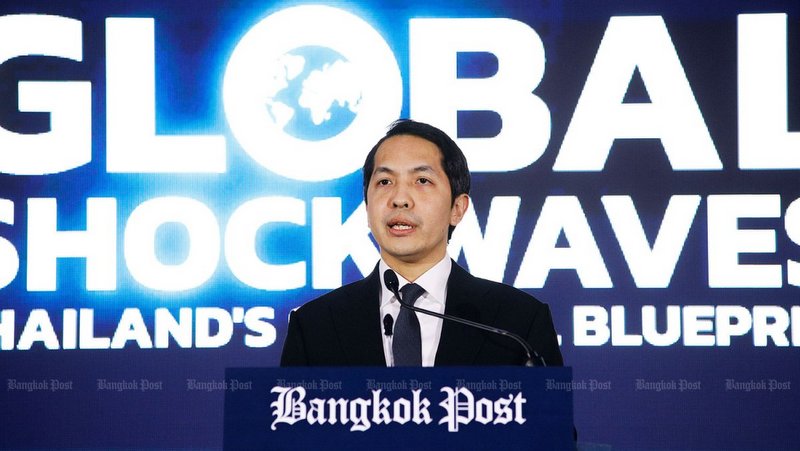
Speaking on the theme “Thailand in a Security-First World” during the Bangkok Post-hosted forum “Global Shockwaves: Thailand’s Survival Blueprint” yesterday (May 27), Mr Santitarn said the “global shockwaves are already here and are reshaping the world itself”.
For decades, the world prioritised low-cost production, just-in-time supply chains, and deep global integration. While this created enormous economic gains, it also produced hidden fragilities. The same networks that once accelerated prosperity are now transmitting shocks faster, further, and more intensely, he said.
“Today, the world is reorganising around a different principle - resilience, redundancy, and security,” he said. “We are moving from an efficiency-first world to a security-first world.”
For Thailand, these changes are no longer distant geopolitical developments. They are increasingly felt in everyday life - at petrol stations, in food and transport costs, and in the mounting pressures facing small businesses.
Mr Santitarn said disruptions will “cascade in waves”, in energy, affordability, and demand.
The affordability crisis occurs when rising costs begin to squeeze households and businesses. Workers have less money in their pockets, while companies face declining demand.
The demand crisis then follows with weakened purchasing power, a reduction of tourism, and stalled investment decisions.
“By the time the third wave arrives, many households and businesses may already have exhausted their buffers,” he warned.
He said Thailand is not necessarily facing another financial crisis or runaway inflation, but something different.
“In Thailand, the crisis is not so much on the balance sheet, but [presents itself] on the kitchen tables every day.”
Meanwhile, for SMEs who hire a majority of Thai workers, the squeeze also comes from higher costs and lower sales.
“Unlike large corporations, they do not have a lot of buffers to absorb the prolonged pressure,” he added.