


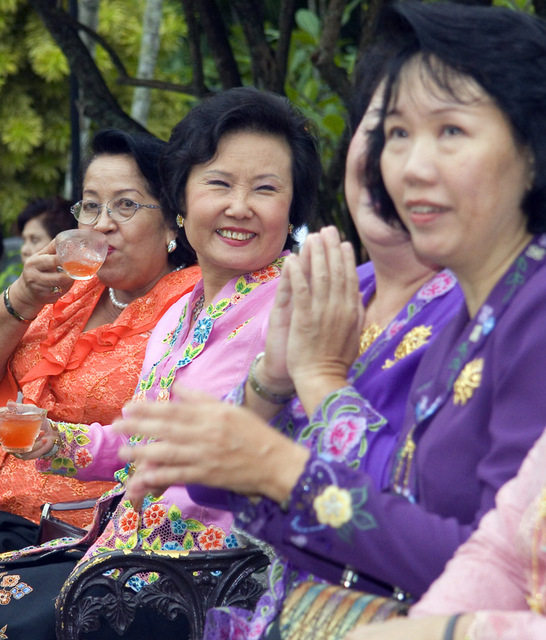


For Professor Pranee Sakulpipatana, founder of the Thai Peranakan Association of Phuket, which was established in 2006, events like this Sunday’s Baba wedding ceremony are essential.
“It’s about preserving the culture and paying homage and respect to our ancestors.”
Ajarn Pranee is, like many people of Baba heritage in Phuket, extremely proud and vividly aware of their past, as is Dr Kosol Taenguthai, the current President of the Thai Pernanakan Association.
“I am fourth generation Chinese in Phuket, my great grandfather came to Thailand about 100 years ago. During the Qing dynasty, there was lots of starvation in China, so many Chinese migrated to Malaysia.
“At that time, the governments of Penang and Phuket were encouraging migrants to come to Phuket to work in the tin mines, so my great grandfather ,who was 40-years-old at the time, and my grandfather, who was 7-years-old, moved here.”
Dr Kosol admitted that with each generation born here, it is increasingly difficult to maintain interest in their pure Chinese past – though intriguingly the opposite is true with the mixed Baba traditions.
“My children are not really interested in Chinese culture, but they are in mixed Baba culture, which of course is very different. I work on educating them on this – about the culture and food especially.”
Strength in the face of adversity
Despite repeated attempts at stifling it, Baba culture has evolved to be strong, distinctive and proud.
Although Chinese people during the 1920s and ‘30s were actively encouraged to migrate to Phuket, upon arriving many experienced prejudice, discrimination and extreme anti-Chinese sentiments.
Field Marshal Plaek Phibunsongkhram, who was Prime Minister from 1938 – 1957 (apart from 1944-1948) was actually the son of a Cantonese-speaking Chinese migrant, but despite this aggressively pushed for Thailand to resist Chinese influence in favour of more Westernised lifestyle.
One of his more nationalistic proponents Luang Wichitwathakan even compared the Chinese in Siam to the Jews in Germany. These anti-Chinese sentiments became more pronounced and extreme during the second world war, which affected more recent migrants as well as the longer-established Baba.
“During that time, it was very difficult. They [Chinese] could not go anywhere and had very little food. Japan occupied Thailand from 1941 to 1945, and it was difficult to be of Chinese origin then owing to the warring relationship between Japan and China,” said Dr Kosol.
He added, “Even when the Japanese government left, the Thai government still did not 100 per cent accept people of Chinese origin, either legally or really to their hearts.
“My grandfather got his first Thai ID card at 70-years-old, so from age 7 to 70 he wasn’t recognised as a Thai citizen. He wasn’t born one, but he finally died as one. I am at least happy about that.”
Dr Kosol’s grandfather and many Chinese people at that time experienced similar problems with regards to land ownership that people of European heritage are experiencing now in Phuket.
“He had to use nominees to buy land. In fact, my parents still had a few problems, but much fewer.”
During his long rule, Field Marshal Plaek was responsible for the closing down of Chinese schools, Chinese institutions and imposing what was effectively a ban on Chinese culture in Thailand.
It is all the more remarkable then that Chinese culture through the filter of ‘Thainess’ managed to survive, and become what is commonly known today as Baba, which celebrates the best of both.
“He [Field Marshal Plaek] tried to make everything one colour, and forced us to wear bland clothes and even change our names,” said Ajarn Pranee.
Forging a brighter future
Despite this adversity, the community continued to exist, as a walk today through the streets of Phuket Town shows. According to Dr Kosol, Phuket town has always been for the ethnic Chinese.
“During the 1930s, Thai people mainly lived in Thalang, and what is now Phuket town was still forest. Very few people actually lived here until the tin mine was built in Kathu.
“The opening of the tin mine had a knock-on effect, which led to the building of the Bang Yai canal which was used for trade between Penang in Malaysia and Phuket.”
“Chinese migrants then built a market to sell goods, and the town was kind of built around that. So Phuket town always kind of belonged to the Chinese and not Thai people,” said Dr Kosol.
Although Chinese language schools have since re-opened in Phuket town, a consequence of pre and post war anti-Chinese campaigns is that a whole generation of Baba, and most locals with Chinese heritage, have missed out on learning the language, including Dr Kosol Taenguthai himself.
“It’s been lost, my generation learned only in Thai. It’s caused a problem sure, but it’s not a huge one because we can still learn about our culture and history through other methods.
“The next generation [of Baba] will only speak Thai and English I suppose. My children, aged 10 and 15, didn’t want to learn Chinese. I wanted them to only if they wanted to, and they are not interested.”
Wilai Bumrungwong is not a member of the Peranakan Association, but refers to herself as Baba. Her family owns the Kopitiam (it means coffee shop in Malay) restaurant and cafe in the old town.
For her and her daughter Wiwan, who also works in the cafe, being Baba is incredibly meaningful.
“I cannot explain how important it is for me to maintain Chinese traditions, what they mean to our souls and way of life. We adopt and maintain them generation to generation, and we find that we are happy and successful.”
Baba Wedding festivities
There will be plenty of food, drink and entertainment this weekend, with Baba-Yaya or Peranakan Wedding festivities on September 8. The couples will spend the day and night at Sukko Spa, leaning how to cook traditional ‘Baba’ food, including Hokkien-inspired chicken curry.
On September 9, the brides and grooms, complete with traditional yaya blouses, skirts and white suits for the grooms will take part in a procession from the Governor’s Mansion in Phuket town to the beautiful private residence of Hongsyok Mansion.
“Once there they will pay homage to the heaven and forefathers,” said Ajarn Pranee.
After lunch, from 2pm, the couples will walk to the Thai Hua museum along Thalang Road – once the island’s main Chinese school – and be showered with confetti by the public.
New to this year’s event will be a huge flower float competition, with different schools and hotels on the island competing for prizes.
They will have a group photo at the Thai Hua museum before walking back to the Governor’s Mansion to have a huge Baba party from 6pm onwards.
The event is open to everyone, not just Babas, for just B300. It is likely to appeal to the majority of Phuket people, not least of all because Dr Kosol believes that 70 per cent of them are in fact Chinese.
“The rest [of the population] is Muslim, there are very few Thai people and of course now there’s the new generations of Thai-European children being born.”
But that’s another story, for another time.