


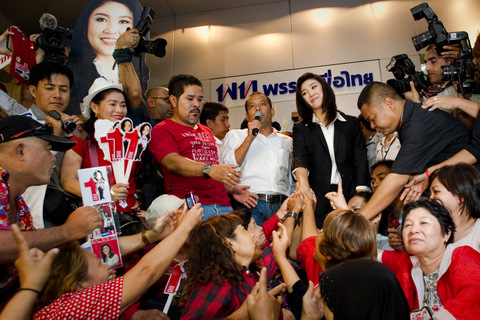
Will everything now calm down, or will there be a repeat of events that led up to the ousting of Yingluck’s abrasive no-nonsense brother Thaksin in the coup of 2006? Or something in between?
There will undoubtedly be a honeymoon period as Ms Yingluck settles in. The sheer weight of her win will silence many opponents who will have to ask themselves whether they really understand the mood of the country.
But the honeymoon is likely to be short. People in Thailand are notorious for wanting politicians to deliver results as soon as possible, preferably yesterday. And results are going to be hard to deliver.
THE RIFT
Much more important than people’s impatience, however, is the yawning divide in the country between supporters of the winning Pheu Thai party and their opponents.
This divide goes far beyond conventional dislike of the party in power. In Thailand Pheu Thai supporters not only loathe the Democrats; they also hate the people who have supported them, and vice versa.
This is not new. When Mr Thaksin was elected to a second term in 2005, some shopkeepers in Phuket refused to serve people driving vehicles with Phang-nga plates because a Thai Rak Thai (precursor to the Pheu Thai party) MP had been elected to one of the seats in that province.
But the animosity is a great deal worse now.
After last year’s Red Shirt violence in Bangkok, followed by the burning of government buildings in several provincial capitals, and the arrest of Red Shirt leaders, the divide is huge.
The Democrats under Abhisit Vejjajiva achieved little to nothing in mending this rift. Indeed, by holding Red Shirt leaders on treason and terrorism charges and blocking pro-Red Shirt radio stations and web sites, they probably made things worse.
The big question now is how – and how fast – Ms Yingluck can move to heal the rifts in society. It will take enormous skill and tact, and will probably be opposed by the more bitter of her supporters.
RE-EMERGING FORCES
If she does not move very fast on this, then all sorts of goblins will come out of the shadows again. Among these are the People’s Alliance for Democracy, or PAD, better known as the Yellow Shirts.
The Yellow Shirts were split before the election between hardliners who urged everyone to vote for “no candidate” in the general election, and the offshoot New Politics Party, who wanted (and failed dismally) to have people vote for them. The Pheu Thai victory is likely to reunite them in sheer disgust.
Then there is the Army. Five years ago they put an end to Mr Thaksin’s time in power, their bloodless coup sending him hurtling into exile.
But there are new people in control of the Army. They understand that the 2006 coup did not change the course of history; it only delayed its apparent inevitability. Will they be willing to try again? Unlikely at present.
RETURN OF THE EXILE
One stated policy of the Pheu Thai Party is to push through legislation forgiving those its sees as having been political victims of the Democrats and the law courts.
For the party’s opponents this is a transparent move to get a pardon for Mr Thaksin, to allow him to come back to Thailand without having to do jail time.
It’s a massively divisive policy which, if pushed, is likely to spark serious opposition, most likely led by the Yellow Shirts.
Even Pheu Thai’s supporters probably see the amnesty as being primarily aimed at getting Mr Thaksin back to Thailand, though in their case there will be nothing but applause.
BUSINESS APPLAUSE
The morning after the election the Stock Exchange of Thailand opened 35.63 points up. It dipped almost immediately as some investors took a quick windfall profit, but then climbed steadily.
There is no doubt that Mr Thaksin’s time in power was good for business. Foreign investors liked his “can do, and do it now” approach, and the domestic economy gained new life after he gave away B76 billion of taxpayers’ money in the “Million Baht per Village” scheme.
Mr Thaksin has described Ms Yingluck as his “clone”. Plainly, he believes they think along exactly the same lines. So Thailand can expect more of the same, and many ordinary people, not just big business, will benefit.
BACK TO VIOLENCE?
On the downside there are rumblings of a revival of the War on Drugs. In 2003, Mr Thaksin’s drive to eliminate drugs failed abysmally to do so, but resulted in more than 2,000 murders around the country over the first three months of its implementation.
Many of these were believed to be extrajudicial killings by police who believed they had carte blanche to wipe out anyone believed to be a drug dealer. Many others are thought to have been nothing to do with drugs, but simply people settling business disputes.
Some, also, were probably the result of big dealers taking out links in the chain that might otherwise lead police to them. It was a bloody and ultimately ineffective mess. And now it may happen all over again.
In the South of Thailand Mr Thaksin’s heavy-handed approach to Muslim unrest led to an explosion of violence, especially after the Krue Seh Mosque siege in which more than 100 Thai Muslims died, and the Tak Bai horror, when 75 Muslims jammed together in army trucks suffocated on their way to detention.
Since the Democrats came back into power, the violence has abated, thought the bitter resentment of Bangkok remains. A major test of Ms Yingluck’s abilities will be how she handles this almost intractable problem.
SETTLING ACCOUNTS
She will also face demands to settle accounts with the courts who brought down successive governments launched by Thai Rak Thai’s successor parties by declaring one politician after another to be in contravention of political laws, emasculating the party by sending all of its heavy hitters to sit on the bench for a few years.
Pheu Thai’s more forceful supporters are also likely to want legal action taken against Mr Abhisit and his deputy, Suthep Thauksuban, whom they have branded as murderers for their regime’s actions against the Red Shirts last year. They are already pushing for “the truth”.
And they will want the PAD leaders, including Democrat Foreign Minister Kasit Piromya, brought to book over the Suvarnabhumi Airport siege of 2008. While Red Shirt leaders were thrown in the slammer for occupying Rajprasong, no serious action has been taken against Yellow Shirt leaders for occupying Suvarnabhumi.
IIN THE SHADOWS
Another factor in this very complex equation will be the reaction of the Ammat, the coterie of old money that loathes and feels threatened by everything the Shinawatras and their new money stand for.
They may stay in the background but their pockets are deep and their arms are long, reaching – it is said – deep into the judiciary and the armed forces.
Politics in Thailand is about to become very interesting. And don’t forget, in China, “May you live in interesting times” is a curse.