


Sumet Ongkittikul, vice-president for internal systems and research director for transport and logistics policy at TDRI, said these concerns stem from his reading of the project report two years ago, though he is unaware whether an updated report has been published, reports the Bangkok Post.
Based on the earlier report, he said he has doubts regarding the project’s economic feasibility, particularly the revenue sources and cost structure, for which detailed information is lacking. The commonly cited investment figure of B1trn appears to be a rough estimate, with no clear breakdown of how much would be allocated to port construction or land reclamation.
The revenue sources remain unclear. Typically a feasibility study would specify where revenues come from and how much they are expected to generate. Mr Sumet said he assumes revenues are unlikely to be substantial, but he has not seen a full report clarifying whether income would be derived from transit fees or cargo handling charges.
"From what I’ve seen in the earlier report, the picture is still unclear as to how the project would be economically viable," he said.
Revenue from transit fees and cargo handling, such as loading and unloading goods from trains or trucks, does not appear sufficient to justify the investment, Mr Sumet said.
"If the project’s construction cost is estimated at B1trn, how much revenue will it generate? If the private sector invests, where would it recover that B1trn from, and over what period?" he said.
"Even with a 100-year concession, the project would need to generate at least B10 billion in revenue per year."
Regarding claims the Land Bridge could shorten travel time to the Andaman Sea and the Indian Ocean by three to four days, Mr Sumet said such time savings may be insignificant for maritime cargo. Shipping by cargo vessels typically takes weeks or months, and additional time is required for handling and logistics, drawing into question whether the time saved by using the Land Bridge would justify the cost.
If the project’s revenue is insufficient to justify the investment, the government may have to provide subsidies, he said.
For example, the proposed high-speed rail linking three airports is expected to generate income from fares, and even with a 50-year concession and rights to develop land for additional revenue, it remains financially unviable. As a result, the state has invested an additional B120bn in infrastructure construction.
"The key question for the Land Bridge is whether its revenue will be sufficient to justify the investment," said Mr Sumet.
"If it is not viable, what support will the government provide? Typically the state covers land expropriation costs, but what additional measures may be offered remains to be seen."
The project was initiated during the Prayut Chan-o-cha administration and continued under Paetongtarn Shinawatra, claiming to position Thailand as a "global gateway".
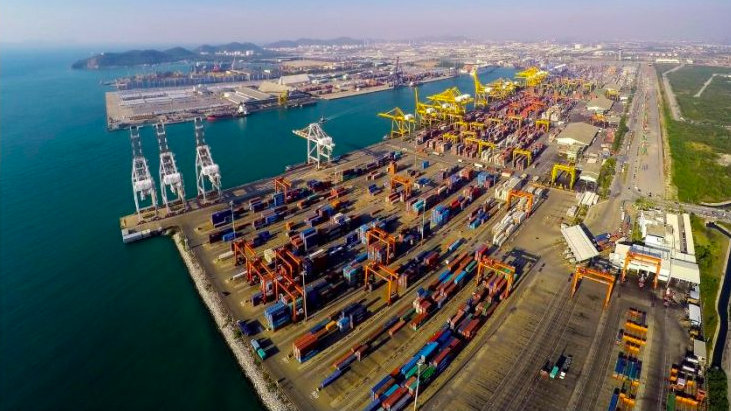
Two deep-sea ports are to be developed: one on the Gulf of Thailand in Chumphon province and another on the Andaman coast in Ranong province.
The ports are to be connected by a six-lane motorway and a rail system comprising four tracks: two metre-gauge lines and two standard-gauge lines.
According to the original study, the project would be developed in four phases. Once all phases are completed, it is expected to handle up to 20 million twenty-foot equivalent units of cargo per coast.
Mr Sumet said the most suitable investment model is a public–private partnership, granting private investors the right to finance, construct and operate the project for a period of 50 years.
The project is estimated to have a payback period of 24 years, while creating jobs on both coasts and contributing to higher GDP growth, as well as strengthening Thailand’s economic development.