


Both countries appear keen to position themselves as mediators in efforts to restore regional stability, reports the Bangkok Post.
Foreign Affairs Minister Sihasak Phuangketkeow has dismissed suggestions that Washington pressured Bangkok to agree to a ceasefire, stressing that any cessation of hostilities must be initiated by Cambodia.
He also said Thailand had never promised China it would halt military operations, maintaining its longstanding position on the conditions required for a ceasefire.
Speaking about a recent telephone call with US Secretary of State Marco Rubio, Mr Sihasak said the discussion was driven by international concern that fighting along the Thai–Cambodian border could escalate further, given the protracted nature of the conflict.
The United States, he said, sought to better understand the situation on the ground, explore prospects for de-escalation and express its readiness to assist.
Thailand has made clear that it is prepared to reduce tensions, he said, but a ceasefire cannot be implemented unilaterally. Cambodia would first need to demonstrate genuine intent by halting fire in practice before talks could proceed.
Clear mechanisms would also be required, including agreed measures on how any ceasefire would be implemented and verified. Such technical details, he said, would need to be discussed directly by the military authorities of both sides.
"A ceasefire cannot rely on intent or announcements," Mr Sihasak said. "It requires detailed discussions on implementation, format and supervision to ensure compliance."
He reiterated that Mr Rubio did not exert pressure on Thailand during the call, but merely conveyed concern. In fact, he said, the US side spoke very little and largely listened to Thailand’s explanation.
Thailand made clear that while it seeks to reduce violence, it cannot do so alone, he said, adding that any ceasefire proposal must come directly from Cambodia, not via a third country.
According to Mr Sihasak, Mr Rubio welcomed Thailand’s position. He added that the Thai–Cambodian border issue could be discussed further during a special Asean foreign ministers’ meeting in Kuala Lumpur on Monday.
Responding to remarks by Chinese Foreign Minister Wang Yi, who said he had discussed the issue with Thailand and that both sides were willing to ease tensions and enforce a ceasefire, Mr Sihasak clarified that Thailand had made no such commitment.
Thailand, he said, had only expressed its readiness to reduce tensions and its desire to avoid a prolonged conflict. Any ceasefire must be proposed by Cambodia and accompanied by concrete actions demonstrating genuine intent.
Assoc Prof Somjai Phagaphasvivat, a political economist, said both China and the United States were seeking to position themselves as mediators in easing tensions between Thailand and Cambodia.
In the case of the United States, he said, this approach has been explicitly articulated as part of its broader policy, with Washington declaring its intention to shape global outcomes, particularly on peace and security issues.
China, meanwhile, already enjoys certain advantages, having expanded its influence in recent years through trade and cultivated strong relationships with countries in the region, he said.
THAI FORCES PRESS ON
Thailand has intensified operations around Hill 350 near Prasat Ta Kwai in Surin, the fiercest flashpoint in the border clashes with Cambodia, explained the Bangkok Post in a separate report.
Army deputy spokesman Col Ritcha Suksuwan said Cambodian forces have continued heavy attacks along the frontier, concentrating artillery fire on Hill 350. The bombardment killed two Thai soldiers on Tuesday night, but troops have held their ground as fighting remains ongoing.
He said Hill 350 is a decisive tactical position fortified by Cambodian troops, making Thai efforts to regain complete control highly challenging.
Clashes have also persisted in Sa Kaeo’s Khok Sung district, where Thai units have pushed back repeated assaults.
Meanwhile, in Trat, Cambodian forces pressed on with counter-attacks early Friday prompting a strong Thai response after troops again attempted to retake the strategic Ban Sam Lang border area in Muang district.
Capt Thammanoon Wanna, commander of the Trat Marine Task Force, said Thai surveillance detected the movement of three to four Cambodian vehicles entering the Ban Sam Lang area in Ban Nong Ri during the early hours.
Thai forces immediately responded with artillery and mortar fire, forcing the opposing troops to retreat. Small-arms clashes followed, but Cambodian forces were unable to retaliate with heavy weapons, which had previously been destroyed, Capt Thammanoon said.
Since Thai forces seized Ban Sam Lang on Dec 14, Cambodian troops have repeatedly attempted to retake the position.
Royal Thai Navy marines are now using fortified bunkers originally built by Cambodian forces -- structures resilient even against F-16 air strikes -- to strengthen their defences, he said.
"We are determined to hold Ban Sam Lang. Cambodian forces are severely weakened, and morale is low," Capt Thammanoon said.
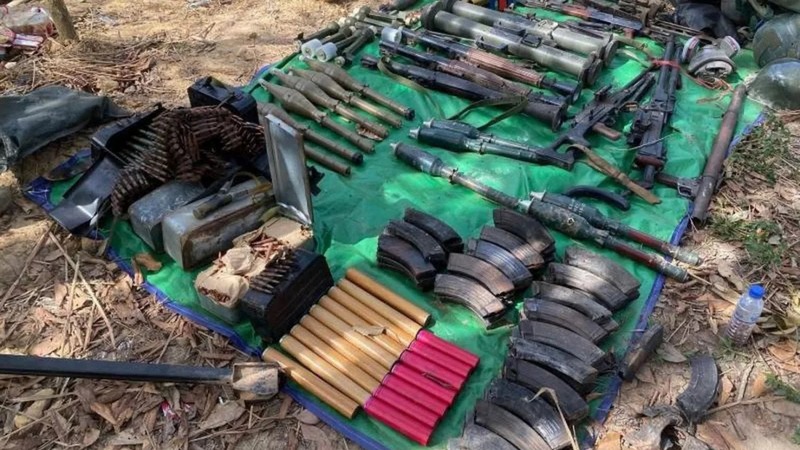
He added that evidence of a hurried retreat was found in the large quantity of abandoned backpacks and weapons left behind.
He said the repeated attempts appeared to be driven more by fear of disciplinary action than by actual combat readiness.
Royal Thai Navy spokesman RAdm Parat Rattanachaipan said the area, located along the Banthat Mountains ridge about 300 metres above sea level, had been encroached upon by Cambodia for around 40 years.
Cambodian forces cleared forested land for agriculture and eucalyptus plantations, built houses and established military bases, he said.
Despite Thai protests, they fortified positions, reinforced troops and dug trenches to control strategic border points.
Reclaiming the site reaffirmed Thailand’s sovereignty over its territory in line with international law and the principles of self-defence, RAdm Parat said.
He said the navy later discovered 16 anti-tank-adapted PMN-2 landmines and related training documents indicating systematic Cambodian instruction in their use.
The documents showed training conducted on Oct 7 last year, pointing to deliberate preparation to deploy mines against Thai forces.