


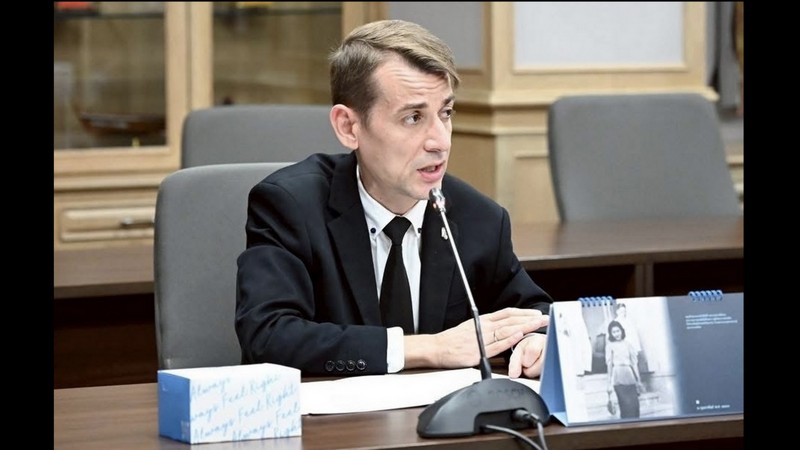
In the following article, the Chargé d’Affaires a.i. of Ukraine in the Kingdom of Thailand, Viktor Semenov, outlines Ukraine’s stance on security guarantees, sanctions and reconstruction, while also highlighting the growing economic and cultural ties between Ukraine and Thailand – particularly in Phuket, home to a significant Ukrainian community.
His article is published in full below without edit:
February 2026 marked the beginning of the fifth year of Russian full-scale military invasion and thirteenth year of Russia’s armed aggression against Ukraine.
Over this time Russia could not achieve any of its strategic goals. Still, it continues its armed aggression, violating the norms of international law, in particular, the UN Charter.
Over the last four years not a single day has passed without shelling, destroying civilian and critical infrastructure of Ukraine. This winter, as temperatures dropped to their lowest level in a decade, the Russian army attempted to freeze Ukrainians into submission by intensifying its campaign of energy terror.
Yet it has not produced the results the Russian leadership expected. With the support of international partners, including Thailand, and thanks to the resilience of our energy and emergency workers, Ukraine has endured.
We need a just peace, not a “freezing of the conflict”. The temporarily occupied territories remain Ukrainian. We are ready for an immediate and comprehensive ceasefire – but security guarantees for Ukraine must precede any peace agreement, not follow it. Instead, Russia continues to block any genuine peace process.
It is important to mention the importance of strengthening sanctions against Russia and preventing sanctions circumvention. There is not a single significant Russian weapon today that is produced without components, equipment or materials from other countries.
Yes, Russia has inflicted significant damage on Ukraine. Despite everything, Ukraine continues to defend its freedom and the order based on international law. And also, we continue to rebuild and develop under extremely challenging conditions.
I am deeply convinced that the war should not prevent us from the strengthening of cooperation with the Kingdom of Thailand. Ukraine considers Thailand a key trade and economic partner in Southeast Asia. We are firmly committed to intensifying bilateral political, economic, military-technical and cultural cooperation.
In 2025, total trade turnover between Ukraine and Thailand exceeded US$368.4 million. Ukraine’s exports were predominantly agricultural, including wheat, sunflower oil, starches and inulin, and residues from vegetable oil extraction. At the same time, imports from Thailand were largely industrial and high-value-added goods, such as passenger cars and motor vehicles, automatic data processing machines, electronic integrated circuits, and food products.
Ukraine maintains leading positions in global agricultural exports and plays a vital role in strengthening global food security by ensuring reliable supplies of grains and oilseeds to international markets.
In this regard, I would like to specifically caution against engaging in trade with the temporarily occupied territories of Ukraine and to stress the inadmissibility of purchasing grain or other agricultural products originating from these areas. Such goods may be of illicit origin and traded in violation of international law, including through re-export via third countries. To minimise risks related to the potential import of illegally sourced products ‒ which could negatively affect food security and consumer protection in Thailand ‒ we consider it advisable to prioritize agricultural products of Ukrainian origin.
I am confident that the current trade dynamics provide a solid foundation for further diversification of bilateral trade, expansion of value-added production, and the implementation of joint investment projects that will benefit both our nations.
We have tangible results, recently the Thai-Ukrainian Chamber of Commerce was established. This will serve as an additional practical instrument for strengthening bilateral economic relations and facilitating direct contacts between businesses.
Thailand, and Phuket in particular, has long been home to a significant Ukrainian community. It can become a distinct bridge for the development of economic ties between our two states.
It is important to understand that Ukrainians represent a distinct cultural identity, with their own perspectives and needs, and should not be viewed as part of a broader “Post-Soviet community”.
I am firmly convinced that the Ukrainian businesses in Phuket will have significant success, in particular, thanks to the Ukrainian community.
To date, our states have a huge but not fully realised potential. It is our task to take our relations to a whole new level.