


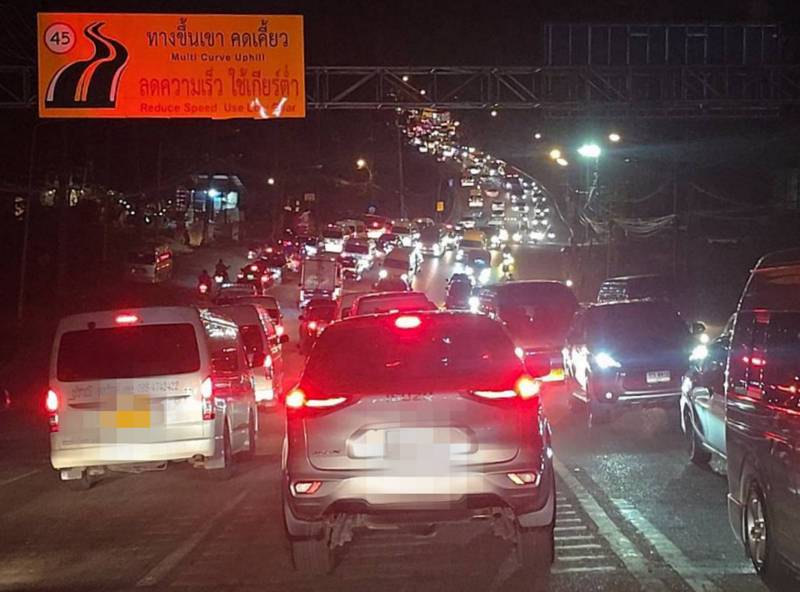
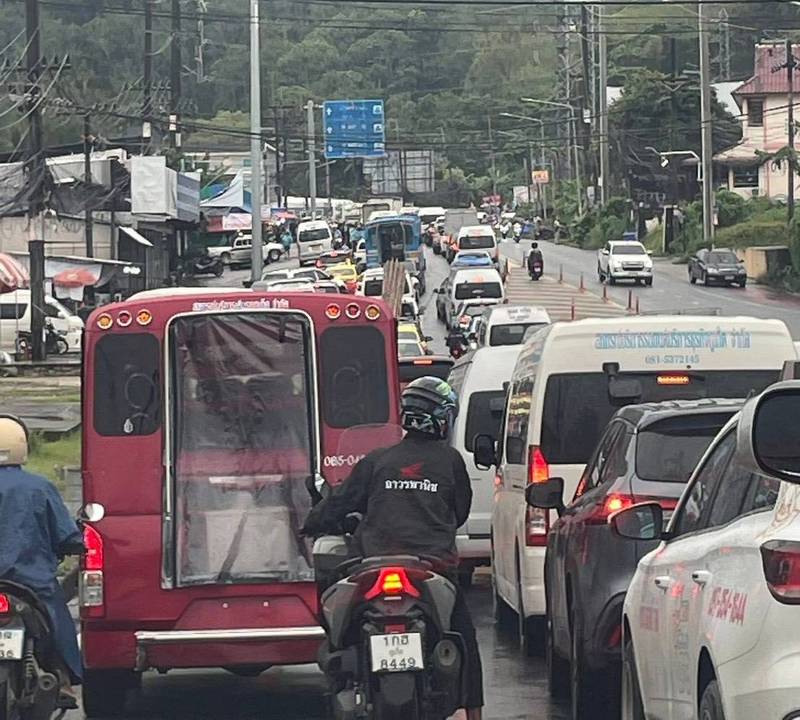
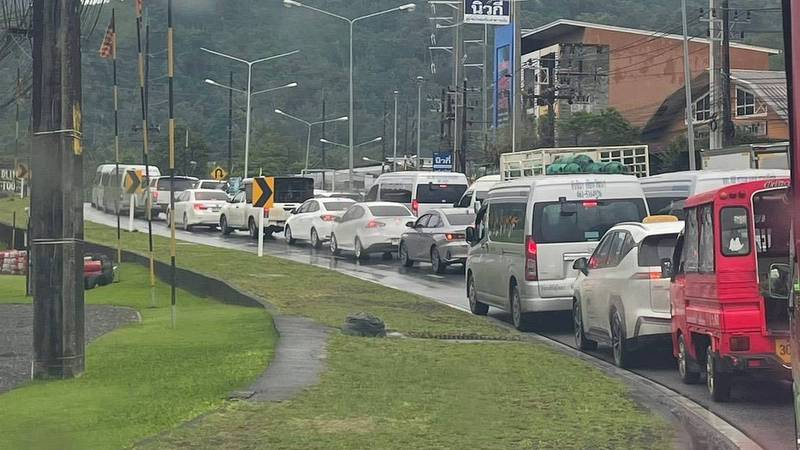
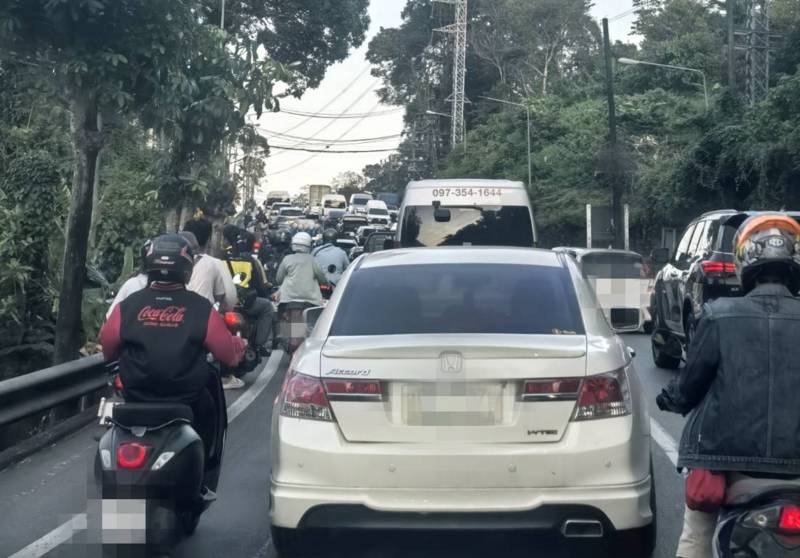
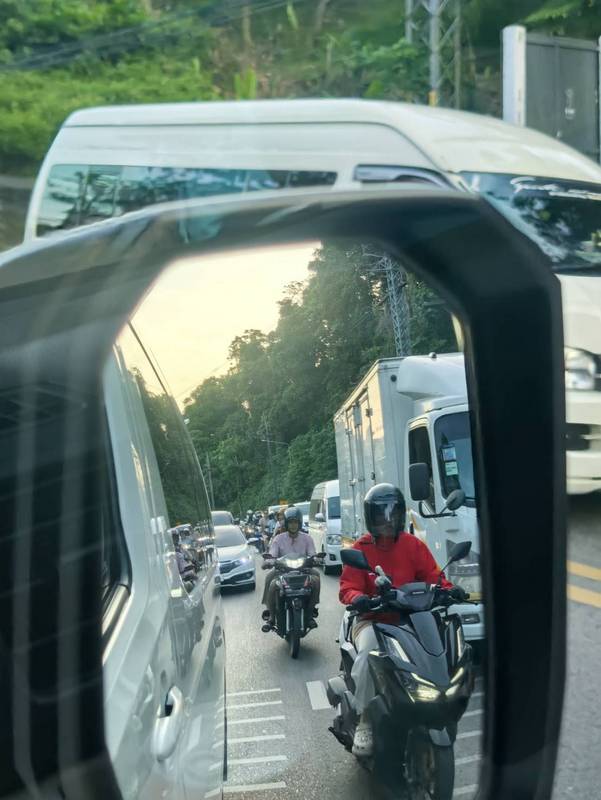
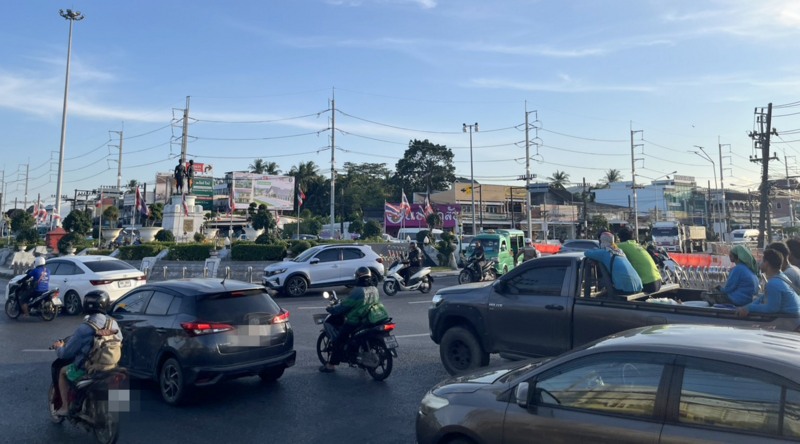
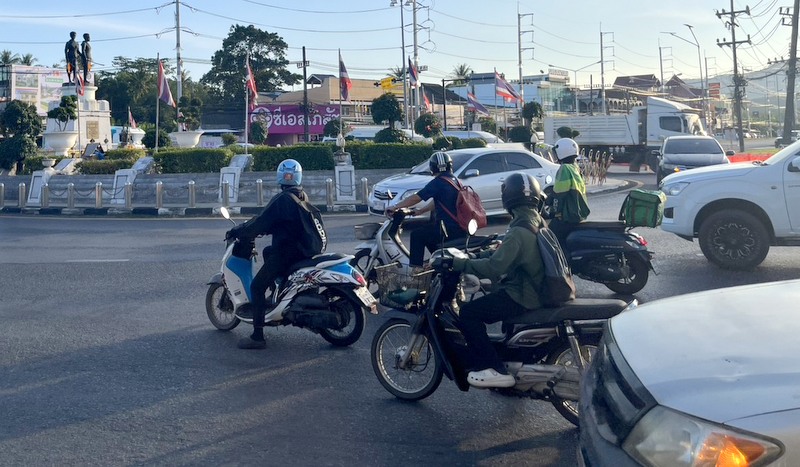
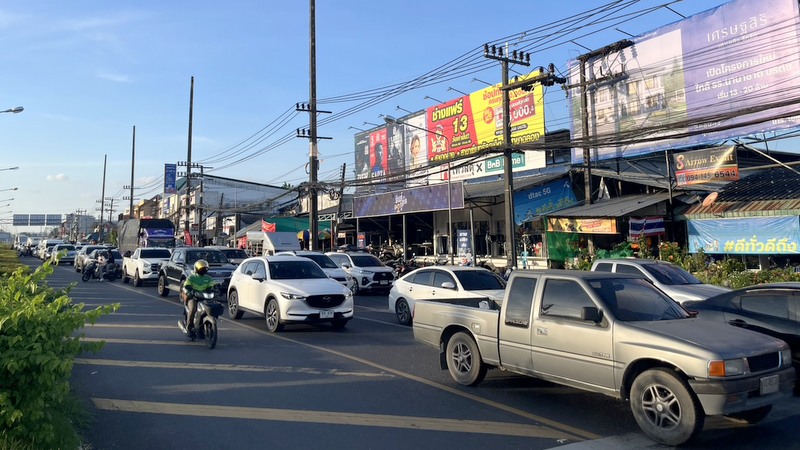
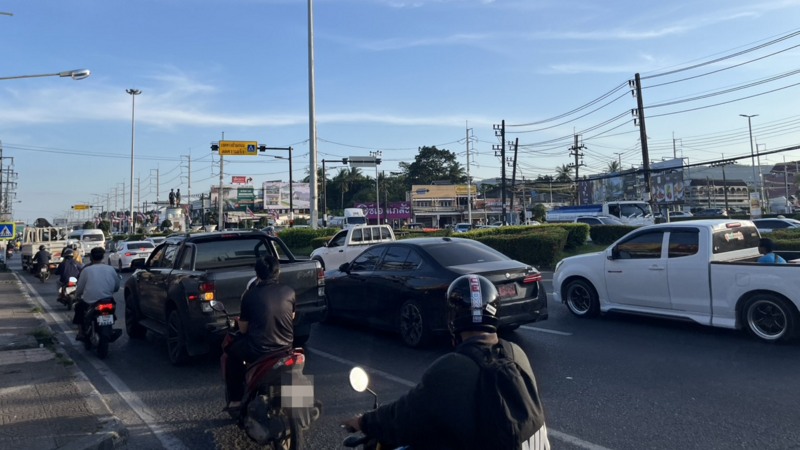
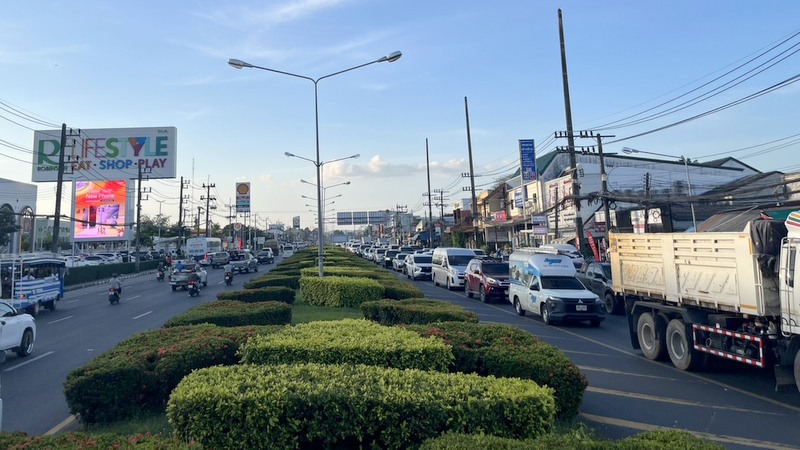
In Cherng Talay, which in recent years has become home to some of the worst ongoing traffic jams during the tourism peak season, police have no strategy for coping with heavy traffic ‒ except for the three days from Jan 16-18 that the Electric Music Carnival (EDC Thailand) is being held at Rhythm Park on the Baan Don Road.
Six island-wide pick-up and drop-off points will be established to disperse traffic flow and reduce congestion, while queuing systems and shuttle bus services are to be streamlined to cope with peak demand, Cherng Talay Police Chief Pol Col Ekkarat Plaiduang confirmed.
Traffic routes, diversions and access maps will be released before the event to help motorists avoid congestion hotspots, while more than 250 police officers, supported by an additional 300 security personnel from the event organisers, will be deployed for the event.
In total, 102 traffic police officers joined by 60 regular police officers and two companies of crowd control police have been assigned special assignments to control traffic and assist security for the event.
Event attendees are encouraged to use designated parking areas, including Coconut Grove next to PTT Pasak, accommodating up to 2,500 cars, and Blue Tree Water Park, with space for 500 cars (parking fees may apply).
The police have advised non-attendees to avoid traveling through event-adjacent routes during the festival period to minimize traffic congestion, was the best Cherng Talay Police could offer, while naming the affected areas as including the Baan Don-Cherng Talay Road, Soi Cherng Talay 4, Soi Cherng Talay 6, Srisoonthorn Rd and “nearby areas”.
The worst congestion point in the area remains at the main intersection in Cherng Talay, right in front of Cherng Talay Police Station, Cherng Talay Police Chief Pol Col Ekkarat admitted.
“This is where traffic from Patong and other routes converge,” he said. “Peak hours are bad enough, but traffic jams become worse when there is an accident.”
Officers rely heavily on CCTV to monitor traffic volume, allowing officers to slow, manage or release traffic in real time, Pol Col Ekkarat explained.
“However, there is still no long-term solution to permanently ease congestion. At this stage, we can only monitor conditions and make real-time adjustments manually,” he said.
Temporary stopping and parking restrictions are enforced to prevent obstruction, while more officers will be deployed to maintain flow, he said.
“Residents have repeatedly complained about heavy trucks worsening congestion during peak hours,” he said.
“The Cherng Talay Traffic Police order banning trucks during rush hour remains in effect, and we have warned operators of high fines for violations. I believe the measure will help ease congestion to some extent,” he noted.
However, Pol Col Ekkarat did not give any examples of any truck operators actually fined.
HEROINES
While Cherng Talay continues to suffer traffic congestion, Thalang Traffic Police Chief Pol Lt Col Surisak Leewijit stands strong in his opinion that Phuket’s most severe bottleneck remains the Heroines Monument.
“Daily vehicle volume typically ranges from 30,000 in low season and reaches to 40,000 cars during the high season, far exceeding the road’s design capacity,” Pol Lt Col Surisak said.
“During the rush hour in the morning, we have improved access to schools along Thepkrasattri Rd to help alleviate traffic from the main road, and traffic from Pa Khlok must turn left. They cannot enter the roundabout directly,” he added.
“In the evening, heavy traffic from Cherng Talay arrives around 5:30pm. Officers use turn-by-turn control, giving most of the time to north-south traffic, but then a dedicated period of time for traffic to directly cross the intersection to head to Pa Khlok.”
Even the traffic lights at Koh Kaew are timed to ease congestion at the heroines monument, Pol Lt Col Surisak said.
Pol Lt Col Surisak noted the recent improvements to secondary roads were valuable in alleviating congestion, including the widening of the road behind Wat Tha Ruea ‒ a shortcut linking Thepkrasattri rd to Srisoonthorn Rd, near GWM showroom. “Without this road, traffic congestion would be even worse,” he said.
PATONG
Patong is its own special animal, often with huge traffic tailbacks on the main roads leading to and from the busy tourism town ‒ and traffic within the town grinding along at a snail’s pace.
Lt Col Chamnan Sapsin of the Patong Traffic Police identified heavy congestion each day, particularly around Patong Hill, Rat-U-Thit 200 Pi Rd, Phra Metta Rd and Thaweewong Rd (the Patong beach road).
In the mornings, congestion builds rapidly along Phra Metta Rd and around Wat Suwankhirikhet School. In the evenings, traffic toward Kathu slows to a crawl, with vehicles backing up from the foot of Patong Hill all the way back along Rat-U-Thit 200 Pi to Bangla Rd, he said.
While officers are deployed to key points to help direct traffic Lt Col Chamnan noted that pedestrians constantly crossing the main roads pose a major obstacle.
“The biggest problem in Patong is uncontrolled pedestrian crossings,” he said. “Tourists cross anywhere they want, at any time. When one person crosses, cars stop, and suddenly a long queue forms. This happens all day.”
Push-button red lights installed near Jungceylon and Patong Hospital have also worsened peak-hour delays. “During busy times, tourists keep pressing the button even if they cross alone. Every press stops traffic for about 15 seconds, and then the next red light stops them again,” he said.
Vehicle breakdowns on Patong Hill remain a daily occurrence and a major reason for severe congestion. “Most breakdowns happen because vans or buses limit fuel to save costs. When they climb the hill, fuel cuts off and the engine stalls. Once one vehicle stops, everything behind collapses,” Lt Col Chamnan explained.
“Officers stationed on Phra Barami Rd now keep emergency fuel cans and ropes ready to tow vehicles off the hill quickly. Lime is also kept on hand for frequent oil spills that make the downhill stretch extremely slippery,” he said.
Lt Col Chamnan lamented that all officers can do about traffic is reactionary. “We can only enforce the law and respond quickly. The structural problems ‒ narrow roads, red-light timing, pedestrian management ‒ must be solved by the municipality and the Highways Department,” he said.
CHALONG
In Chalong, long tailbacks at Chalong Circle, especially from Kata to Chalong, are already becoming normal. Pol Lt Col Siriphong Suriyan, Deputy Chief of Chalong Police, told The Phuket News that almost all major traffic issues in the area stem from the busy “five-ways roundabout”.
“The primary issue is the small size of the roundabout and the heavy volume of vehicles entering from five directions,” Pol Lt Col Siriphong said.
“This often leads to drivers blocking the roundabout, and this is made even worse by the high number of tour buses and trucks during the high season.
“Traffic from 8-9am slows as tour buses begin arriving, while morning flows toward Chalong Pier remain steady and generally manageable, but evening rush hour sees the worst congestion, particularly for motorists coming from Kata,” he added.
Pol Lt Col Siriphong also highlighted how traffic police are limited in what they can do to ease traffic jams. “Long-term solutions,” he stressed, “must come through provincial-level engineering decisions rather than police intervention.”