


By Benjamin Reed
I didn’t seek out war in Southeast Asia. I came to Thailand for the opposite: a quieter life, the sort you find on the long, calm stretch of Bang Tao where tourists disappear into their sunset cocktails. But war has a way of finding me, even here. I fought in two of them: Iraq and Ukraine, and worked as a contractor in Afghanistan; I’d be lying if I said I didn’t feel a familiar tightening in my chest when the first reports came in this year from the Thai-Cambodian frontier.
Maybe it’s something inherited. My grandfather served as a surgeon in the Pacific during the war; my uncle operated in Vietnam as a Green Beret. Between the three generations of my family, there are eight deployments. Some families pass down heirlooms. Mine passed down campaigns.
This year’s clashes began the way border conflicts often do: with history presented as argument. Old French maps. A disputed temple. Patrols misreading each other’s intentions. On paper, the fighting flared over territorial claims near Preah Vihear. In reality, the border had been unstable long before a single shot was fired. What’s happening now has little to do with ancient stones. It is about the machinery of modern Cambodia grinding up against the sovereignty of a far more stable Thai state.
But the newest development is more troubling than any historical grievance. Thailand’s Second Army Area, responsible for securing the northeastern frontier, has stated publicly that it believes English-speaking foreigners are flying suicide FPV drones into Thai positions. As someone who has spent plenty of hours behind FPV goggles in a real war, I paid attention. I don’t rattle easily, but the technical descriptions in the Thai reports were not fantasies. They were the fingerprints of someone who knows exactly what they’re doing.
I will state this plainly: I served in the Ukrainian Armed Forces as a drone operator. I flew drones from Kharkiv oblast to the ruins of Avdiivka. I attended Ukraine’s suicide-drone school and completed more than thirty combat missions. I know what an FPV strike looks like and how trained pilots usually communicate. So when Thai soldiers report that they intercepted English-language commands during the attacks, steady and professional, I understand why their descriptions stand out. They match a pattern I have seen before.
The drones used against Thai troops were fitted with mortar rounds, likely 60mm, the same type commonly adapted in Ukraine, and flown with the precision of a practiced hand. One team carried out the strike; another provided spotting. This is not the work of conscripts improvising in the jungle. It takes training. It takes repetition. It takes someone who has already seen men die through a fisheye lens.
For readers unfamiliar with FPV warfare, these aren’t military drones in the conventional sense. They’re fifteen-thousand-baht racing quadcopters built from hobbyist parts, wired to an explosive charge, and flown manually through a video headset. No autopilot. No GPS. Just human skill, adrenaline, and a willingness to kill at arm’s length. In Ukraine, I watched teenagers with two months of training destroy tanks worth millions. The cost-benefit ratio is obscene.
PLAYERS
So if the Thai reports are accurate ‒ and I believe they are ‒ someone has put real money and intention behind this. Recruiting an experienced foreign FPV pilot isn’t cheap. Speaking for myself, you’d have to pay me at least B40,000 a day to pick up that job again on behalf of a government I have no ideological quarrel with.
Which brings us to the obvious question: who would want to prolong a border war that Thailand has no interest in escalating?
The answer is as uncomfortable as it is obvious. Cambodia’s government presides over one of the largest criminal-industrial ecosystems in the region: scam compounds, trafficking networks, casinos doubling as laundering operations. Foreign technicians locked in fortified buildings run multi-billion-baht cyber operations for syndicates intertwined with political elites. When a state tolerates an ecosystem like that, it inherits the darker skills that come with it.
Someone in Cambodia has the connections, the money, and the motive to hire foreign drone talent. And Thailand ‒ stable, orderly, governed by institutions rather than crime syndicates ‒ is now absorbing the consequences.
BORDER CONTROL
Cambodia’s borderlands are not shaped by ordinary governance. They are carved up by power brokers who answer to no one, men who operate casinos, timber routes, and scam compounds with the same indifference toward human life. These networks are not a footnote to the conflict but its operating system. The compounds along the frontier are fortified, staffed by trafficked labor, and protected by officials who know exactly what goes on inside. When a government allows entire districts to function as criminal fiefdoms, it should not surprise anyone that those same districts can field fighters, technicians, or drone teams on short notice.
Walk through Poipet or Banteay Meanchey and you feel it at once. The casinos tower over potholed streets and half-finished buildings. Money moves freely; people do not. Foreigners are recruited, trapped, and forced into cyber scams so profitable they rival portions of Cambodia’s legitimate GDP. These are not isolated incidents but a parallel economy with its own security forces and its own chain of command. If an FPV team needed a safe house, a supply route, or a discreet exfiltration corridor, they would not have to build anything from scratch. The infrastructure is already there, humming behind mirrored glass and neon signs. Thailand sits across from this, trying to secure a border that Cambodia long ago handed over to syndicates.
Up-to-date OSINT (open-source intelligence) paints an even sharper picture of how unstable the frontier has become. Satellite imagery from early December shows fresh impact craters within Thai territory east of Chong Sa-ngam, consistent with 122mm BM-21 rocket fire. Thai villagers in Si Sa Ket recorded the launches in the early hours of the morning, the flashes unmistakable; independent analysts matched the angles to Cambodian positions across the line. Footage circulating on Thai social media, verified through geolocation by several OSINT channels, shows Thai mechanised units moving north along Highway 224, suggesting a quiet reinforcement of defensive positions rather than any preparation for an offensive.
On the Cambodian side, the signals are harder to read. Phnom Penh continues to deny the use of foreign fighters, yet the videos emerging from Oddar Meanchey tell a different story. In one clip, filmed near Trapeang Prasat, the wreckage of a downed FPV platform shows a carbon-fiber frame and custom flight controller nearly identical to rigs used in Ukraine’s eastern theater. The battery configuration, antenna placement, and payload strap points are too specific to be coincidence. Someone brought a template into Cambodia and taught a team how to build and fly it.
Thai media reporting on statements from the Second Army Area noted that some Thai soldiers believed they heard English during the recent FPV attacks. None of this has been independently verified, and there are no recordings or confirmed intercepts. Even so, the allegation fits the broader reality of Cambodia’s frontier, a place where foreign technicians, trafficked workers, and men looking to disappear move in and out of criminal compounds with little oversight. Thailand, by contrast, has handled the fighting with caution, pulling civilians from danger and limiting its airpower to precise defensive strikes. Bangkok understands that escalation serves no one. Phnom Penh behaves as if escalation is leverage.
IN PLAIN VIEW
What the open-source picture shows is simple. Thailand is trying to contain a conflict; Cambodia is letting one metastasize. The frontier is no longer just a line on a map, but a pressure seam between a functioning state and a criminalized political economy that has made chaos its most valuable export.
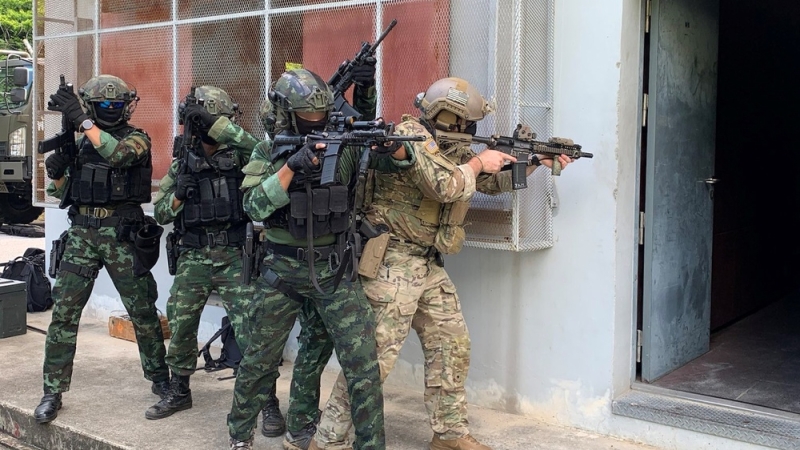
Thailand’s strength in this moment is not only its matériel but its discipline. It fields a professional military that understands restraint as a form of power. Its commanders answer to a chain of command, not to casino owners or traffickers. Its soldiers operate within a system that, whatever its imperfections, still believes in the rule of law. Cambodia cannot claim the same. What it presents as a national army is, in reality, a web of patronage and criminal interests wrapped in camouflage. Its border units answer sideways as often as they answer upward. Its war-making capacity is inseparable from its illicit economies; its crises are inseparable from the people who profit from them.
This is why the fighting feels so asymmetrical. Thailand is defending a border. Cambodia is defending an ecosystem of impunity. One side wants stability. The other thrives in the absence of it.
As the clashes continue, I watch from Phuket with a mix of familiarity and unease. I have seen border wars like this before, in places where governments lost control of their peripheries and allowed darker forces to fill the space. Thailand does not deserve that fate. It has handled this conflict with caution, professionalism, and clarity of purpose. Cambodia has answered with improvisation, denials, and the same toxic networks that have hollowed out its interior for years.
In the end, the difference between the two countries is stark. Thailand is a nation with a real military. Cambodia is a network of patronage, corruption, and human trafficking dressed up in fatigues. They are not the same.
I wish the Thai troops the best in their endeavours.
Benjamin Reed has lived in Phuket for four years. He served in the United States Army as a military police soldier in Iraq, later worked in Afghanistan as a contractor, and deployed to Ukraine in 2022 and 2023 as a drone operator. He is now a full-time writer represented by Writers House in New York for his forthcoming memoir War Tourist. Read more of his work at benjaminstuartreed.substack.com or follow him on Instagram @Benjamin_Based.