



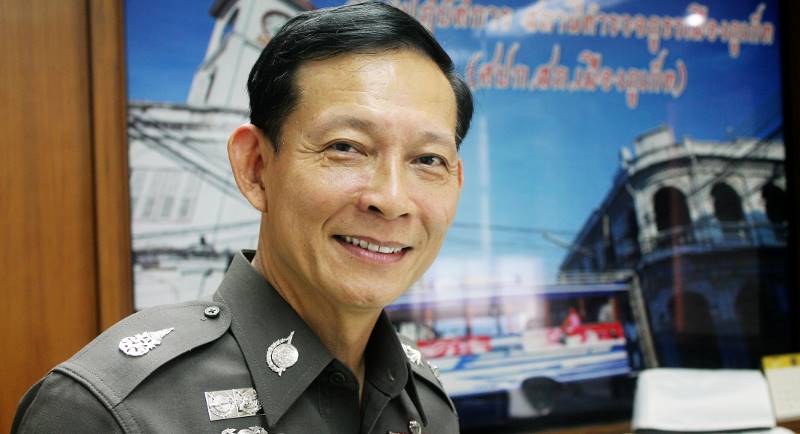

But Gen Paween’s history in Phuket goes much deeper. He was superintendent of Kathu Police Station in 2001 during which he was famously involved in pursuing a former mayor accused of hiring hitmen to kill an associate, with reducing rampant corruption and clearing sidewalks of vendors.
The ex-mayor, Anan Ananthanawat, was eventually cleared by the court.
Transferred to Phuket Town Police Station, he headed an investigation that resulted in the arrest of a gang of 13 car thieves and retrieved 33 cars.
In 2004 he headed an investigation that led to the arrest of another local politician, Omsin Aphichattakul, mayor of Rassada, on corruption charges.
And in the past few weeks, in his new role as head of anti-mafia activities, he has arrested another two politicians – Thawee Thongchaem, Mayor of Karon, and Pian Keesin, forrmer Mayor of Patong.
Gen Paween says he had a happy childhood as the child of market gardeners in Samut Sakhon. “I lived a typical local lifestyle. I loved to climb and play around. I was a healthy boy.” He was also bright; at the age of six the teachers promoted him from Grade 2 to Grade 4.
At the urging of his parents, he got a place in the Armed Forces Academies Preparatory School.
“At that time,” he says, “being a policeman was not my dream career.” But life took him in that direction and he found himself in Ranong in 1982 as deputy head of investigations.
It was a steep learning curve. Far from home he had to learn how to be a policeman, how to be an investigator, and to understand the local culture.
Luckily, he says, “I was surrounded by good policemen who were all like trainers in police work.”
After four years in Ranong, he was transferred to Haad Yai to the traffic police. “I was baffled why I had to be in the traffic police [with may background in investigations]. But, I agreed to do it.” Once again there was a learning curve.
In January 1991 he was back in investigations, this time in Satun – and was involved in his first inquiry in which a policeman was the suspect. (See The Hit Man, below)
Five years later he was in charge of investigation and interrogation at Singha Nakorn District in Songkla.
Here he began to be noticed by the public, who began talking about “Deputy Paween” -- though no one was quite sure what he looked like.
“In Singhanakorn district, there were a lot of norcotics and gun cases. I arrested many people, and it was noticed; people called me “Deputy Paween”.
One time, we were on patrol and stopped near Songkla Lake. A group of teenagers saw the police car and ran away into the lake.
“One of them was caught by my team. He would not get up. We asked him why not. He said, “My pants are full of s**t.” He was so afraid of me that he scared the c**p out of himself.
It was also in Singhanakorn that he solved a horrific case – the murder of a family of five by home invaders. (See A Family Murder, below.)
The murder and the investigation made national headlines, and Gen Paween – by this time a lieutenant colonel – found himself in the limelight, and his skills were noticed by senior police officers.
“Maj Gen Wannarat Kodcharat, rated one of Thailand’s top 10 investigators, asked me to join the Region 8 team in 1998. At first I turned him down, several times, because I was worried that he would send me to work in Nakhon Sri Thammarat, with its reputation for dangerous criminals.
“I had already been mobbed three times in the past. That was a time when local people opposed officers trying to arrest drug suspects.
“I ordered my officers not to use violence. As a result, and because they thought I looked skinny and weak, people didn’t respect me. They did not realise how tough I am.”
But finally, in 1998, he gave in to Gen Wannarat’s urging. Instead of being sent to Nakhon, he found himself deputy chief of investigation in Phuket Town and then, two years later, at the age of 42, he was promoted to colonel and sent to be superintendent of Kathu Police Station.
“I was at Kathu just seven months. I noticed that my officers had a hard time, having to drive across Patong Hill at the beginning and end of every shift, to their accommodation in Thung Tong.
I managed to find budget to build accommodation for them in Patong. I also improved Kathu Police Station.
“I had a hard time with Pian Keesin [the mayor at that time],” he says, hinting at an antagonism that lasts until today. At night, I did not sleep much because I wanted tourists to be safe.
“I cracked down on the dirty shows, illegal cigarettes and the wild animal trade.
“I was also curious why tourists insisted on walking along the road in Soi Bangla – at that time the road was open to traffic, but they walked in the road, not on the sidewalk. They were at severe risk of being killed.
“I discovered that the sidewalks had all been rented out to vendors. I arrested them. They told me that a small area cost B6,000 a month to rent. A big area cost B20,000. After they were fined and released they would go straight back to their rented pitch on the sidewalk.”
He was disappointed not to stay in Patong longer and do more to solve the problems there.
“But I had to move because someone else wanted to be superintendent in Kathu. I had no choice. I had to obey orders.”
He spent four years as Superintendent at Phuket Town Police during which he arrested Mayor Omsin (the case is still going through the courts).
In 2005 he was promoted to deputy commander of Surat Thani Provincial Police, a job that required a wider view of criminality. “It was a province with very powerful criminals,” he says. He decided to look at the underlying problems – why people became criminals.
“I looked at the basic views, using the Broken Windows Theory.” (The theory was first espoused in 1982 article by American social scientists James Wilson and George Kelling. Although still controversial, it proposes that there is a relationship between criminality and environment, particularly slums and vandalism.)
“I started from illegal possession of guns and vehicles with no licence plates or fake plates. We treated every case as serious and did not grant bail. No exceptions.
“At first, the culprits were not afraid to be arrested because they were the underlings of politicians. But I fined them the maximum allowed by the law, which hurt their pockets. This was not police intimidation; the evidence was very clear.
“The media started to write about me.
“I sent out many more patrols with the result that crime in Surat Thani province fell to levels not seen in five years.”
In 2013 Gen Paween, by now a major general, was appointed Commander of General Staff Division, Region 8, a job that entailed overseeing the paperwork for all nine sections of the police. It did not officially involve investigating or suppressing.
He was also put in charge of inspecting progress on the building of new police stations and accommodation in Region 8.
The investigator in Gen Paween quickly smelled a rat, and he began his own investigation into corruption in the construction contract (See The Bad Builders, below).
“People still thought I was a paper pusher. They had no idea that I was still a real policeman.
“A policemen’s life consists of making great efforts. It’s like a constant race.” As evidenced by the past few months, Gen Paween’s racing days are far from over.
THE HIT MAN
“I was notified that a businessman, Boonleu “Ko Seu” Phunphanit had been shot in the fresh market in Satun. Witnesses could not identify his killer, who was wearing a helmet and a scarf covering his face.
“There was not much evidence at the scene. But, some witnesses saw that the murderer had trouble starting his motorbike afterwards, and had actually fallen over before righting the bike and escaping.
One witness also noticed that the killer had used a pistol with a long barrel, possibly six inches. I had never come across a gun like that, so that was significant.
“I went to the scene. On the ground I spotted something that looked like a button. I could not figure out what it was, but I kept it.
“I asked my team if they had ever seen a gun with a long barrel. One of them handed me his Smith and Wesson revolver, which had a four-inch barrel. As he passed it over, butt first, I noticed the decoration on the grip, and I realised what the ‘button’ I had found was.
“We received information that a policeman had carried out the killing, and a name. I had him in for questioning and he denied it. I asked to see his gun. There was a hole in the grip where there should have been a metal Smith & Wesson logo.
"When I showed him what I had found at the scene of the murder, he realised I had conclusive evidence that he was involved, and he admitted to his part in the murder."
The policeman, it turned out, was having an affair with Mr Boonleu’s wife, and hired another man to carry out the killing, lending his gun to him for the job.
The policeman was sentenced to death and the wife got a life sentence.
“I was proud of the result although it saddened me that a police officer was involved.
“Many officers complained to me, asking me, “Don’t you like policeman?” I said, “Yes, I like police officers, but I am not going to help any who break the law.”
A FAMILY MURDER
The murders of the five members of the Boon Thawee family in Singhanakorn, Songkla, made national headlines in 1997.
The family were middle class, with both father and mother working for local health departments.
Four of the family – the father and three children – were found hanged by the neck along the banister rail of the staircase in their home. The mother was found upstairs with a broken neck.
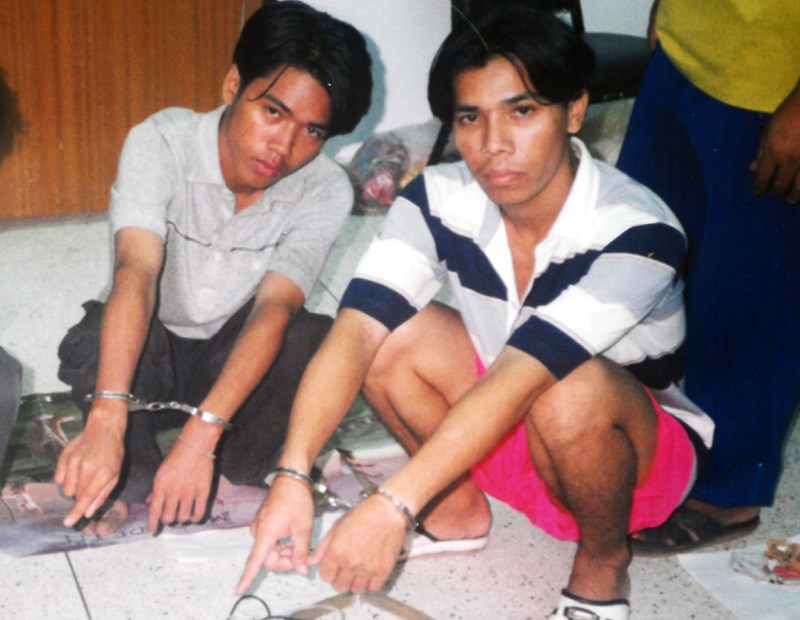
Gen Paween headed the investigation, which resulted in the arrests of two men, Reungsak “Sak” Thungkul and Songkran “Jong” Kaewubon.
“They were under the impression that this family were rich,” Gen Paween recalls. “They got into the house and found two of the children there. They tied them up and hid them on the second floor. The third child came home and was also tied up.
“Next, the father arrived. He was tied up and blindfolded. Finally, the mother came back to house. Terrified, she ran up to the second floor. Sak, a stocky man amnd the leader of the duo, tried to rape her but she fought back. He broke her neck.
“Jong tried to persuade Sak to release the family but Sak had other ideas. He decided to electrocute them. The pair cut power cables and tried to kill the family with them, but the safety cut-out worked, and killed the power.”
So the pair decided to hang them, using bit of clothing and sheets tied together.
“Sak asked, ‘Who wants to die first?’ The father put his hand up. The pair tied him to the banister rail and then pushed him over. The makeshift rope broke. The father tried to run away but Sak, small but stocky, caught him and subdued him. The pair took their time and hanged all four.
“We discovered that the killers had used a special knot. If the victim struggled, the knot got tighter. We had seen this used in previous murder cases.”
Having killed the family and ransacked their home, Sak and Jong left.
Sak went to Yala to seek out an uncle to sell some of the Buddha images to. But the uncle was in Pattaya. So Sak got together with a bunch of old friends.
As they drank together, he waved a newspaper with a report about the murders and told his pals, “This was me. But they’ll never catch me.”
One of the group, however, was a policeman’s niece. She noticed one of the items Sak was showing round was a badge with a caduceus (the health department symbol) and she believed his bragging. She contacted local police who passed the word to Gen Paween.
He was sent with his team by helicopter to Yala to arrest Sak. “There was a huge storm at the time, and I thought I might die,” he recalls.
But Sak was no longer in Yala. He was eventually tracked down to Kanchanaburi and arrested. He identified Jong and gave information that led to his arrest, too.
Sak was sentenced to death and Jong was sentenced to life in prison. Sak took his case up the ladder and the Supreme Court eventually commuted his sentence to life.
THE BAD BUILDERS
“Recently, I was given the responsibility of overseeing construction of police buildings in Region 8 after the awarding of a national contract.
“In total 396 police stations costing B5.8 billion and 163 police accommodation blocks costing B3 billion were to be built across the country.”
A huge construction company was the sole contractor. In Region 8 there were 26 police station and eight accommodation blocks to be built.
Gen Paween was suspicious. “I went to the Royal Thai Police to talk about the company. I asked, “How can only one company build it all?” Especially since the contract stipulated that sub-contractors could not be used.
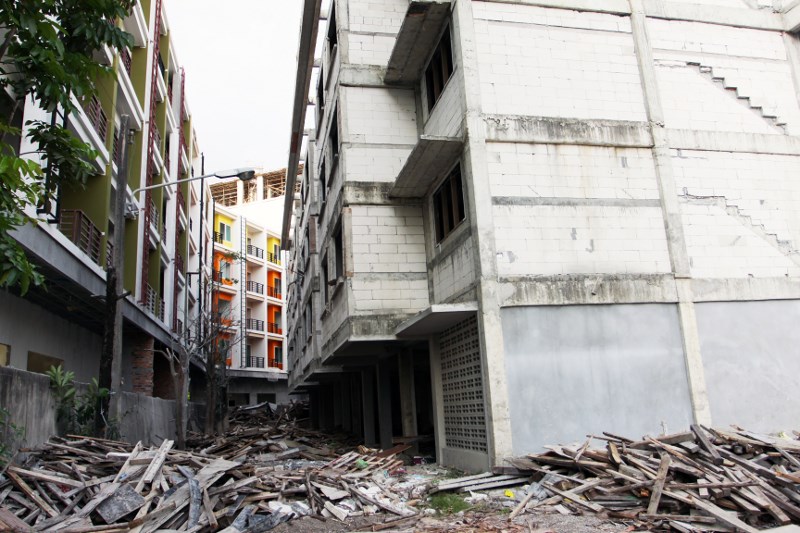
“I had a very good time investigating corruption in the buildings that were my responsibility. For example, a building that was supposed to cost B27 million actually cost B20 million. So ‘commission’ of about B7 million was paid. Then, the company would receive the contract for that building. That meant the quality would not be good enough.
“I was offered bribes but there was no way I could accept them after the years I had spent improving police buildings and accommodation. No way. A lot of people complained about me.
“I collected documents that showed sub-contractors had been hired [contravening the original contract]. I presented my findings to the Royal Thai Police committee in charge of the national contract, and was questioned about my investigation. But I had done my job thoroughly.
“Finally, the part of the contract that covered Region 8 was cancelled.
“Now all the details are with the National Anti-Corruption Commission. I believe some people will go to jail for this.”