


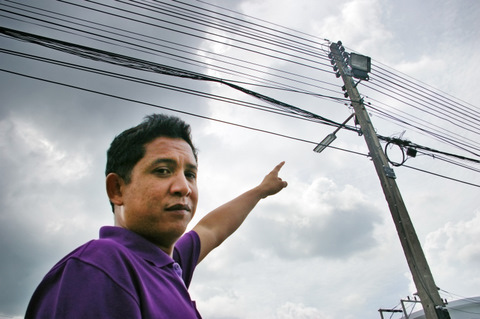
But following the recent death of a young British tourist during heavy rain in Patong, the question has to be asked: do adequate regulations about electricity supply exist on the island?
Phuket Provincial Electricity Authority (PPEA) engineer Permpon Tanasakun explains that most hanging cables are not in fact carrying electricity, but are in fact mainly telephone, internet, television or satellite dish cables.
But Phuket’s tangled mess of hanging wires is a regular topic of conversation on various internet forums. One posting on The Phuket News website by Kevin Wise last month detailed him being hit in the face by a hanging cable while riding his motorbike in Karon.
“That cable stayed there for months before it was removed properly. It was lucky that I was wearing a helmet or I would have been knocked out or killed. There will be more deaths if the government does not step in and fix this,” the post read.
Sirichai Bamrungchoo, a resident of Cherng Talay, has had similar near misses while riding his motorbike.
“There are so many messy cables around this island. I have to be so careful when I am riding. I don’t know where these cables are carrying electricity or not, but they are a hazard regardless and need to be tidied up.”
Mr Permpon said PPEA staff make an effort to monitor hanging cables, but rely on members of the public to alert the office of specific danger spots.
He said many buildings have been built too close to utility poles and cables. Often nearby trees grow too close to the cables, causing power outages or shocks when their branches touch or small animals climb up to the wires. That very reason forced the temporary closure of Patong Hill this week as maintenance crews tried to fix the cables.
But there are obstacles for crews working to make the electrical network safer.
Mr Permpon said it is the responsibility of landowners to ensure trees are not coming into contact with electric wires. The PPEA cannot cut down trees, even those that pose a direct safety threat, without the consent of the landowner.
The PPEA will help remove dangerous objects if asked to do so by landowners.
Trees in contact with utility poles in public areas, such as parks, can be dealt with freely by the authority.
High-voltage power lines are obviously the most dangerous as there is limited insulation and live wires can transmit 12 to 115 kiloVolts (kV) – a potentially lethal dose of electricity.
If it is raining heavily the electric cables can come into contact with buildings or trees which then in turn become live and can injure or kill people.
“When it is raining, the current from the power lines can escape down the pole, so it’s very dangerous if there are any people or buildings under the high-voltage pole,” Mr Permpon said.
By law, buildings must be 1.8 metres away from the base of any regular utility pole, and 2.3m from high voltage poles. The top of a building must be 4.6 metres away from power cables.
In reality, these regulations are rarely enforced.
“If there is new construction of a building or utility pole, there must be an electrical engineer present and monitoring the site. But many people will ask an amateur engineer to work on a small section, or additional features, which can make it quite difficult to control overall safety standards,” Mr Permpon said.
He added that construction of utility poles by the PPEA must comply with the Electricity Generating Authority of Thailand’s standards, which include installing a standard grounding system.
After an electricity pole is installed, it will be checked by the PPEA to check it is in good working order and that the grounding systems work before putting in the power supply.
All high-voltage poles (transmitting 33kV of current or greater) require equipment such as drop-out fuses, cut-out fuses, load-break switches or transformers, and must have a ground rods installed.
Low voltage poles (220 or 380V of current) require a grounding rod next to the transformer pole, and another to be placed every 200 metres along the lines.
In private homes, it requires a degree of personal motivation, and homeowners who want grounding systems for existing circuits must install them themselves. Since October 10, 2003, the law requires anyone installing new electric circuits to also install grounding systems approved by the PPEA.
“We are trying to develop a grounding system for homes as it is much safer to have a ground strip in their houses to protect them. Users also have to install their own earth leakage circuit breakers, especially for heavy electric equipment such as water heaters, freezers or air-conditioners,” Mr Permpon said.
These days, the PPEA and the Phuket Municipality are working on putting electricity cables underground along Phuket’s Old Town roads, including Thalang, Krabi, Dibuk, Phang Nga, Thepkrasattri and Rassada roads.
The changes are undoudbtedly aesthetically motivated, but will also help improve safety.
Mr Permpon explains that electric cables will be sheathed in high density polyethylene tubing, which is able to withstand a much higher impact than conventional wiring insulation.
“It will be more safe, even if more expensive. There will be no power poles for cars to crash into. Water can’t touch the cable so there is less danger of people being electrocuted,” he said.
“The PPEA will check the condition of transformers, cables and grounding rods yearly for safety. We don’t want anyone to die, but all agencies need to work together to educate people about the dangers of electricity, so they can protect themselves.”
To report any concerns about electricity cables, or to have someone come and inspect the wiring in your home, contact the PPEA on tel: 076 210 379 or call their hotline on tel: 1129.
– Sukunya Phoonpong