


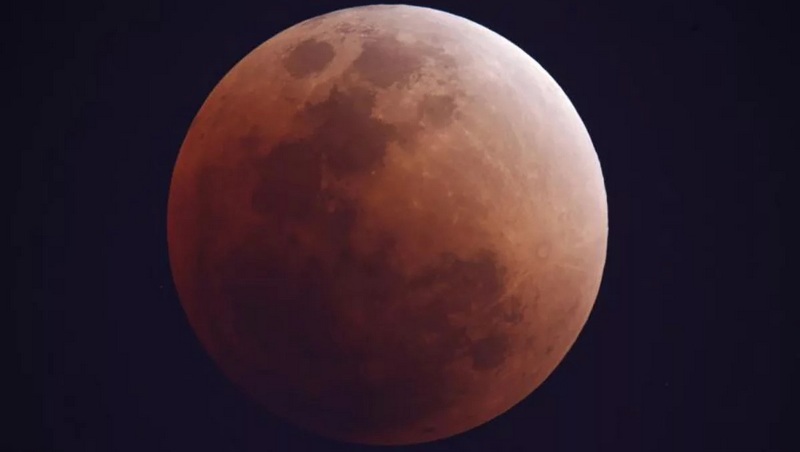
The total eclipse will be seen across the western United States and Canada, Australia and much of Central and East Asia, reports the Bangkok Post. It will not be visible in Europe or Africa, according to the National Astronomical Research Institute of Thailand (NARIT).
The total phase will fall at different local times worldwide: in the evening in East Asia and Australia, overnight across the Pacific, and before dawn in North and Central America and the far west of South America.
In Thailand, NARIT said the eclipse will last from 3:44pm to 9:23pm local time. The Moon will enter Earth’s outer shadow, or penumbra, at 3:44pm and move into the darkest part of the Earth’s shadow - the umbra - beginning a partial eclipse, at 4:50pm.
Totality - when the Moon begins to turn “blood red” - will last from 6:04pm to 7:02pm, making it the best time to see the astrological phenomenon. Afterwards, the Moon returns to a partial phase before exiting the umbra at 8:17pm and clearing the penumbra by 9:23pm.
The public will be able to start observing it once the Moon rises above the eastern horizon at about 6:23pm - coinciding with totality - offering a striking sight as a brick-red full moon lifts above the horizon.
Skywatchers nationwide will be able to witness the total phase of the eclipse for about 39 minutes, followed by the partial and penumbral stages. Exact times vary by location.
People can safely observe the eclipse with the naked eye, according to NARIT.
A lunar eclipse occurs when Earth aligns between the Sun and the Moon, casting its shadow across the lunar surface. As sunlight filters through Earth’s atmosphere, the Moon often glows a deep red or orange - the phenomenon known as a “Blood Moon”.
NARIT will host free public viewing from 6pm to 10pm at its five main sites: the Princess Sirindhorn Astropark in Mae Rim district of Chiang Mai, as well as regional observatories in Nakhon Ratchasima, Khon Kaen, Chachoengsao and Songkhla. The event will also be streamed live on NARIT’s Facebook and YouTube channels.
Tuesday’s event will be the last total lunar eclipse visible anywhere on Earth until New Year’s Eve 2028.
Makha Bucha Day falls on the full moon of the third lunar month. It commemorates the spontaneous gathering of 1,250 monks to hear the Buddha’s teachings at Veluvana in India more than 2,500 years ago.