


Caretaker energy minister Auttapol Rerkpiboon said the government plans to purchase crude oil from West Africa and the United States, with deliveries expected by the end of April, reports the Bangkok Post.
The move follows discussions between energy authorities and private companies after measures introduced in response to the US-Iran conflict, which included suspending oil exports.
Thailand has long pursued diversification of its energy imports. Between 1997 and 2007, the country reduced reliance on Middle Eastern oil, particularly from nations around the Strait of Hormuz.
A turning point came in 2004-05 when global oil prices surged, prompting the government and PTT, the majority state-owned energy company, to seek new sources.
By 2011, imports from Nigeria and Russia had risen significantly, cutting dependence on the Middle East from as high as 90% to 50-60%.
Mr Auttapol also said LNG purchases from the spot market would be diversified, with supplies sought from the US and Malaysia.
However, he warned that competition for LNG outside of the Middle East is expected to intensify, requiring careful management to avoid price spikes and reserve shortages.
Thailand still relies on Qatar for LNG shipments via the Strait of Hormuz. Seven deliveries are scheduled between now and the end of May, with two already en route and five awaiting dispatch.
The status of the latter is now unclear following Tehran’s warning that it would “burn any ship” attempting to transit the strait.
Natural gas remains Thailand’s primary fuel, accounting for 60% of electricity generation. Of this, 60% comes from domestic sources, 15% from Myanmar via pipeline, and 25% as LNG imports from the Middle East.
In January, PTT received its first LNG cargo under a 15-year agreement with the US exporter Cheniere Energy, marking a milestone in Thailand’s diversification strategy.
Officials are also exploring liquefied petroleum gas imports from Malaysia’s national petroleum company Petronas.
PUMP PRICE IMPACT
At the pumps, increases are widely expected in light of the rise of more than 10% in world crude oil prices since the US and Israeli strikes on Iran began on Saturday.
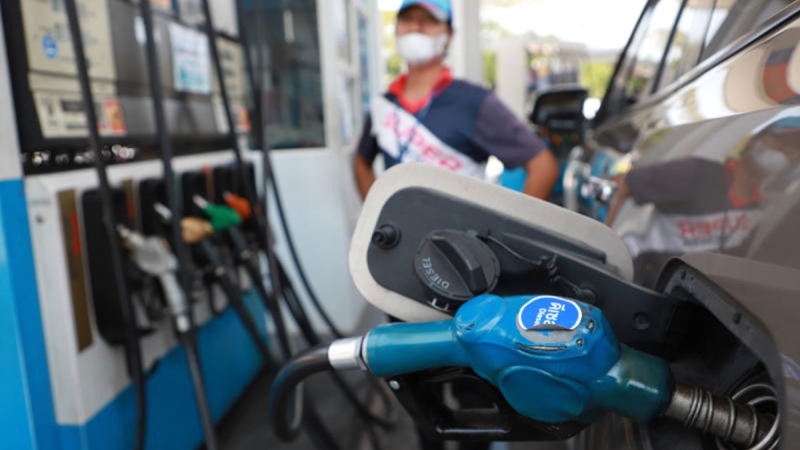
Prime Minister Anutin Charnvirakul on Tuesday night (Mar 3) ordered a freeze on the diesel oil price at B29.94 per litre for 15 days. After that, further measures to assist the public will be considered, he wrote on Facebook.
PTT Oil and Retail Business Plc (OR) said earlier in the day that it had not raised the retail prices of diesel and gasohol yet, citing stable oil reserves and logistics.
“Users should not buy fuels in panic,” the company said in a statement.
Rivals PT and Bangchak have also maintained fuel prices for now. Diesel B7 remains at B29.94 per litre, while gasohol 91 and 95 are priced at B30.18 and B30.55, respectively.
However, before the prime minister’s announcement, Shell raised its diesel prices by B4.20 per litre and gasohol by B1.50. Caltex raised diesel prices by B1.80 and most gasohol prices by B0.90 per litre.