


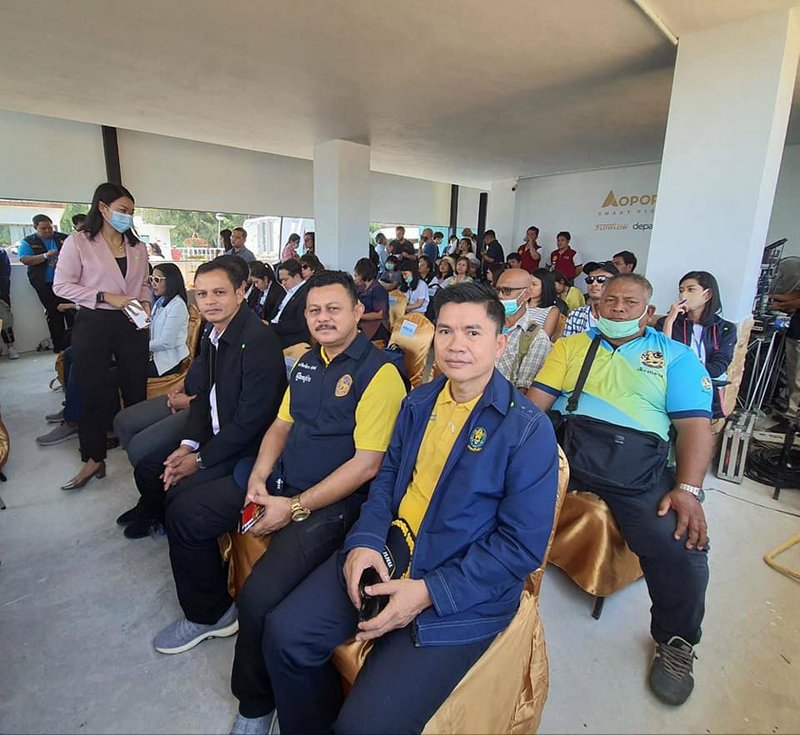
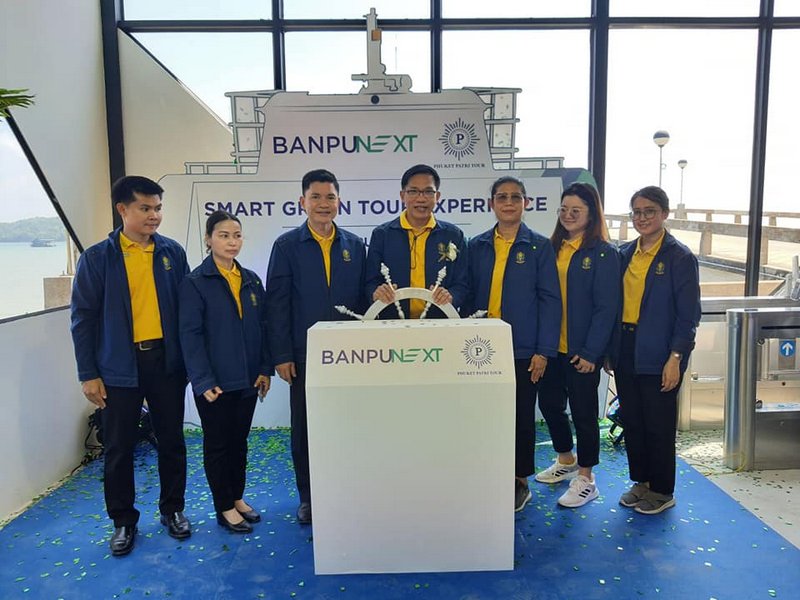
Present for the launch were former Phuket Marine Office Director Wiwat Chitchertwong, who is now the Marine Dept Region 5 Office director, along with the new Phuket Marine Office Director Nachapong Pranit.
Also present were Santi Pawai, deputy permanent-secretary of the Ministry of Tourism and Sports, and Capt Thammawat Malaisukkarin, Deputy Director of the Royal Thai Navy Third Area Command’s Maritime Enforcement Coordination Centre (THAI-MECC Area 3),, along with representatives of Bangkok-based design and development company Banpu NEXT.
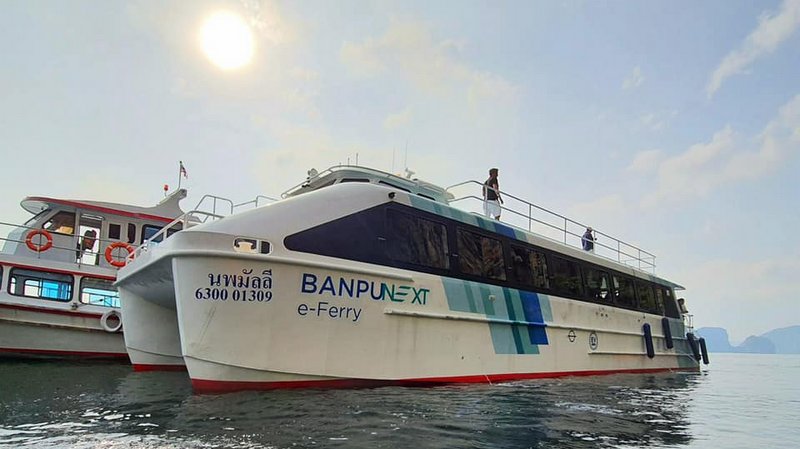
However, while the e-ferry ‘Nopmalee’ was presented with much fanfare yesterday, it has yet to be confirmed whether the e-ferry is actually in service.
Officers at the ‘Ao Por Smart Pier’ office were unable to confirm to The Phuket News whether or not the e-ferry has been designated to operate any particular route to a nearby island.
The ferry operator itself, Phuket Patri Tour Co Ltd, told The Phuket News that the ferry was in service but could not confirm exactly which route, or evne if or when the e-ferry might have departed Ao Por Pier.
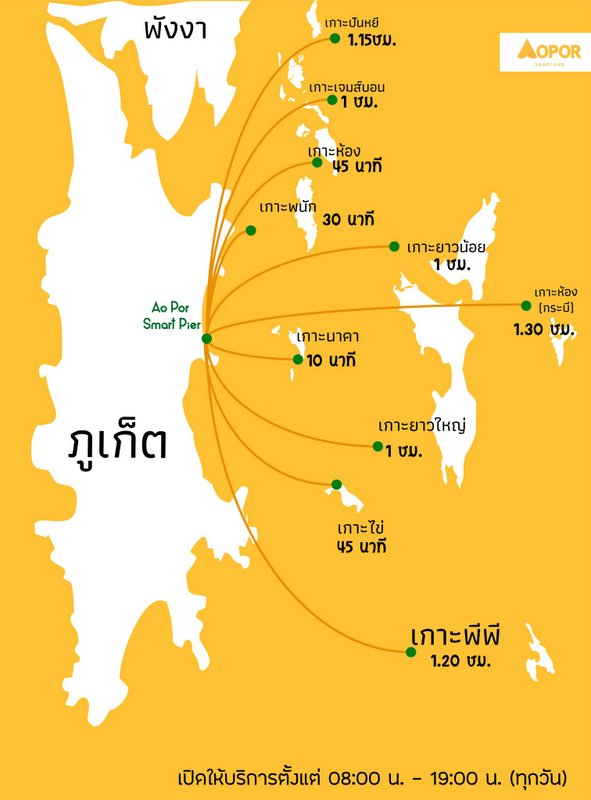
According to ‘Ao Por Smart Pier’ office, the e-ferries will, sooner or later, operate 10 routes to islands in Phang Nga Bay as follows:
- Naka Island – 10 mins
- Koh Panak – 30 mins
- Koh Khai – 45 mins
- Koh Yao Noi – 1 hr
- Koh Yao Yai – 1 hr
- Koh Hong (Phang Nga) – 45 mins
- Koh Panyee – 1 hr 15 mins
- James Bond Island – 1 hr
- Phi Phi Island – 1 hr 20 mins
- Koh Hong (Krabi) – 1 hr 30 mins
The e-ferries were built by Banpu NEXT in collaboration with boatbuilders Sakun C, based in Suphan Buri, and Phuket Patri Tour Co Ltd.
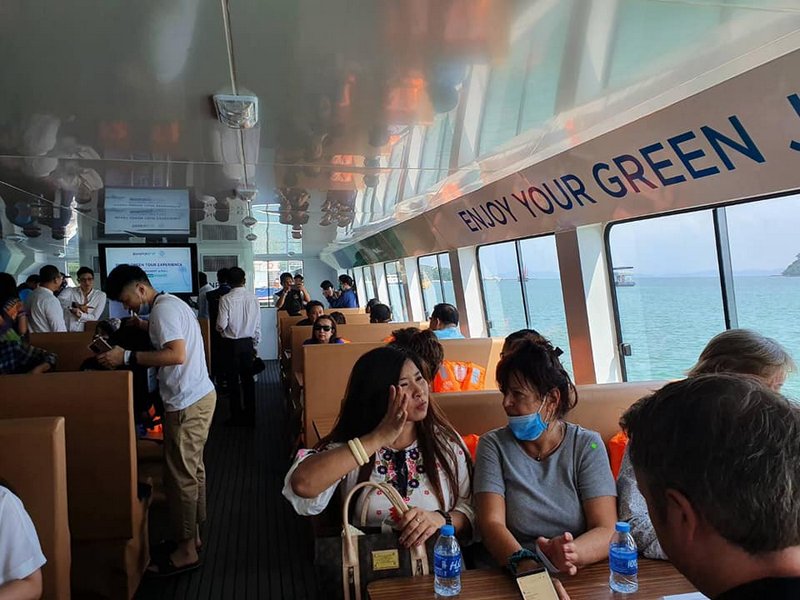
Each boat is 20 metres long and registered to carry 90 people on board, with seating for 74 passengers.
Powered by a 625 kWh Li-Ion (LiB) battery, the aluminium-hull e-ferries can travel at speeds of about 15 knots, and “are agile and still stable on water waves”, said a release announcing the launch.
The e-ferry service was developed under the concept of ‘Smart Green Tour Experience’ through a project by the Marine Department, which aims to help develop sustainable ‘green tourism’, said the release.
In launching the project in August. Namchai Sakunchoknamchai, President of Sakun C Innovation Co., Ltd., explained, “From an integrated collaboration among Sakun C, Banpu NEXT, Marine Department, and the National Science and Technology Development Agency (NSTDA), along with all Thai researchers, we have jointly developed the first Marine Tour e-Ferry in Thailand and taken it from a prototype to a fully commercial vessel.
“The challenge of this project lay in the design and development of an e-Ferry which could meet all needs from Phuket Patri Tour with reasonable price while maintaining international standard quality. Sakun C has designed the ferry structure for the tourism industry. We placed the battery storage at the middle of the hull (Design Balancing) in order to protect the energy source from any unexpected event.
“With the use of seamless boat assembly technology, including the use of materials and quality equipment such as using aluminum as the main material of the ferry, we have given it special features of light weight, enhanced strength, durability, corrosion-resistance, structural safety, and energy saving. The qualities of aluminum have advantages over steel, which is a popular material used to produce water vessels. We also chose a motor that is certified by IEC, using electric wires and conduit pipes specifically for water vehicles,” Mr Namchai said.
“Moreover, we also installed an insulation system to prevent sparks and short circuit, as well as installing temperature sensors to give alerts on battery heat and the cooling control system of the drive motor. These systems enable the e-Ferry to work efficiently and with maximum security. Various systems and technology used in the production of this e-Ferry have been tested by NSTDA. The ferry is 20 meters long, driving at a top speed of 17 knots and will be able to serve over 30 years,” he added.
Chaiya Rapuepol, Managing Director, Phuket Patri Tour Group Co Ltd noted, “Phuket has the second-largest income from tourism in Thailand. Each year, this province welcomes countless domestic and international tourists. As a leading tourism service operator in Phuket, we recognised the opportunities to raise the awareness on ‘Green Tourism’ which is in linked with the ‘Responsible Tourism’ initiatives of the Tourism Authority of Thailand (TAT), by means of using an e-Ferry to serve our clients.
“We started to look around for a leading organisation who could provide us a 100% clean energy marine vessel. As a result, Banpu NEXT and Sakun C joined hands to bring together expertise and technology advancement to respond to our business needs. From providing support for tourists, enhancing travel safety, promoting environmental friendliness by reducing air and noise pollution, restoring the aquatic ecosystem, to cost reduction on fuel and maintenance, this large-size e-Ferry will be able to accommodate a maximum of 90 tourists.
“Meanwhile, the ferry also responds to the social distancing needs during the outbreak prevention of COVID-19 because it’s spacious,” he added.
Somruedee Chaimongkol, Chief Executive Officer of Banpu PCL. and Banpu Next Co., Ltd explained that Banpu NEXT estimates the energy saving from using one e-ferry for one year at 26,250 litres of petrol, equal to a C02 emission reduction of 69.3 tons, or an equivalent of planting 8,700 trees.
“In addition to the collaboration, Banpu NEXT continues to lead the innovation and provide knowledge sharing of innovative clean energy technology for our business network. We join forces with leading partners in order to promote the ‘Betterment for All’ initiatives. We also planned a roadmap to continue the development of different electric water vessels. Information from the Marine Department showed that there are approximately 3,000 marine tourism boats today, with 2,000 serving in the Andaman Sea and the Gulf of Thailand in four provinces, including Phuket, Phang Nga, Krabi and Surat Thani.
“Therefore, our goal is to produce electric tourist ferries to serve the tourists in the Andaman Sea and the Gulf of Thailand covering all four provinces by 2025 in order to support the growth opportunities of the electric tourist vessels industry, as well as to leverage the ‘Green Tourism’ experience for tourists and people in the local community. These are our efforts in response to the growing trend of clean energy and to propel Thailand’s energy development into the Energy 4.0 era,” Ms Somruedee concluded.