


Nearly three years after Hamas’s Oct 7, 2023 attack, which killed 39 Thai workers and led to 31 others being taken hostage in Gaza, Thailand’s labour force in Israel has not diminished. Instead, it has grown, reports the Bangkok Post.
From about 30,000 workers before the attack, the number of Thai workers in Israel has expanded to around 50,000, spread across agriculture, construction, manufacturing and service industries.
The increase has come despite repeated tragedies. Twenty-eight Thai hostages were eventually released alive, while three died in captivity or during the conflict.
Four Thai agricultural workers were killed alongside their employers in a Hezbollah rocket strike in northern Israel in November 2024.
Earlier this year, a 34-year-old Thai farm worker became the first Thai casualty of the recent Israel-Iran conflict after being struck by shrapnel from an Iranian cluster munition.
For "A", a 43-year-old resident of Nonthaburi, Israel represents something stronger than fear: opportunity.
She has worked overseas since the age of 25, and Israel is her newest destination. Her younger brother-in-law has spent eight years working on a farm in northern Israel.
Through family connections, she learned about an opening with a retail company and immediately applied through Thailand’s Department of Employment.
The position offered a monthly salary of about B77,000 - several times what she could earn at home.
To qualify, she completed training courses, studied English and Hebrew, and passed a competitive examination.
"If applicants can greet employers in English and Hebrew, they have a better chance of getting hired," she said.
The financial commitment was substantial. She paid about B150,000 for contract-related expenses and processing fees. The contract runs for five years and three months.
But the calculation was straight- forward.
Her 18-year-old daughter has just entered university and tuition fees alone cost between B40,000 and B50,000 per semester. Although her husband contributes financially from Phuket, household expenses remain challenging.
"I just want my family to have a comfortable life," she said.
By the time her contract ends, she will be 48. She hopes the earnings will allow her to retire early and spend more time with her family.
Asked whether the conflict worried her, she paused briefly.
"I am not afraid of the current situation," she said. "Regardless of where we are, we could die anytime. The economy at home is unstable. I would rather come here and take the risk."
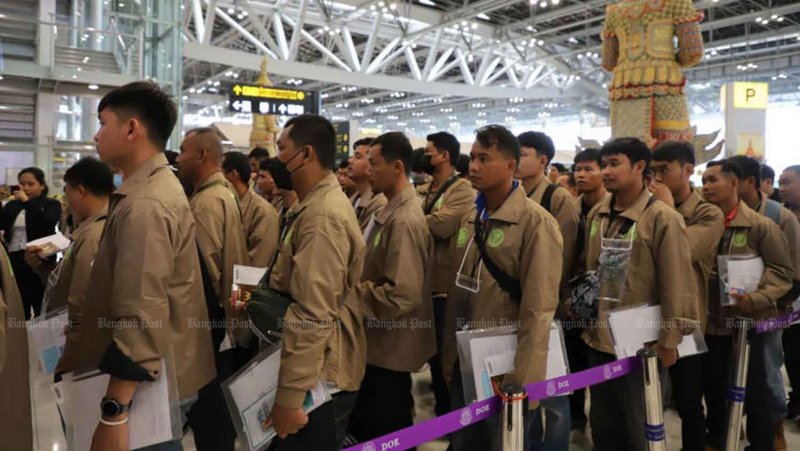
Around 40 Thai workers recently travelled alongside her under the same recruitment programme. Most are first-time arrivals in Israel.
Many will work in factories, construction sites and other physically demanding jobs. Among them is a 45-year-old single mother from Nong Khai.
With three children aged 24, 18 and two, she described her journey as one driven by necessity rather than adventure.
Her eldest son helps support the family, but university expenses for her middle child and the costs of raising a toddler have stretched household finances.
She first attempted to secure employment in Israel in 2023, but recruitment plans collapsed after the Hamas attack. When applications reopened in 2025, she tried again, knowing it was her last chance before hitting the programme’s maximum age limit of 44.
"I applied for jobs elsewhere, but employers kept telling me I was too old," she said. "I was so afraid I would not get this job." However, she ultimately secured a job.
"It is quite scary," she admitted, discussing the conflict. "But we pray that nothing happens. They told us the defence systems are strong."
For some Thais already established in Israel, the decision is no longer whether to come, but whether to stay.
A 33-year-old massage therapist from Mukdahan has lived in Israel for more than eight years.
She initially arrived after marrying an Israeli man and later settled in the Tel Aviv area. Although the marriage ended, she remained, building a new life and eventually starting a family with a Thai partner.
Today, their four-year-old daughter attends school alongside Israeli children. Her daughter speaks Hebrew and English fluently. At home, her mother insists on speaking Thai.
"I want her to remember where she comes from," she said.
Her income, approaching 10,000 shekels (about B111,445) per month before tips, provides financial stability she believes would be difficult to achieve elsewhere.
Still, stability has not meant peace. She vividly recalls the evening of Oct 7, 2023.
Working at a massage parlour in Tel Aviv, she initially believed the violence was confined to southern Israel.
Hours later, missile warnings reached the city. Explosions landed close enough to shake the neighbourhood.
"Our boss immediately told us to close and go underground," she recalled.
Since the outbreak of hostilities between Israel and Iran, mobile phone alerts have become a regular feature of daily life. Sometimes they arrive at three or four in the morning.
Years of experience have given her confidence in Israel’s security systems and emergency procedures. Following official instructions has become second nature, she said.
For many Thais in Israel, that confidence - whether in the country’s defences, their employers or simply their ability to endure hardship - helps explain why they remain.
The calculations are rarely political, but personal: university fees; children’s futures; household debt; retirement savings.
Behind the statistics of migrant labour and conflict zones are thousands of individual decisions shaped by economic necessity.
For workers like A, the dangers of war are weighed against the certainty of financial struggle at home. The balance, for now, continues to draw Thais to Israel.
"I have to work really hard," said A before beginning her new chapter abroad. "But for my daughter and for my future, I have to keep fighting."