


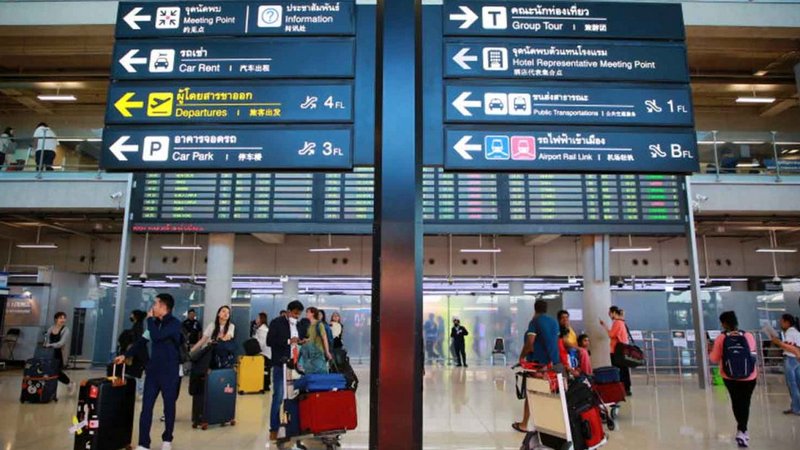
Natthriya Thaweevong, tourism and sports permanent secretary, said travellers from the Middle East and Europe have been greatly hampered by the airspace closure as many flights are unable to operate, reports the Bangkok Post.
Gulf carriers such as Emirates and Etihad Airways have only resumed limited flights.
The ministry evaluated the tourism impact using three scenarios: if the Middle East airspace is closed for three, four and eight weeks.
If the airspace remains closed for eight weeks or longer, foreign arrivals could drop by 595,874, resulting in a loss of B40.9bn.
Ms Natthriya said during that period, airlines are on the summer schedule and could potentially hike airfares due to increased oil prices and volatile currencies. This would impact tourists across all markets, though short-haul would see the smallest adjustment.
In addition, Europe is expected to register a higher inflation rate, which would hinder their spending power for travel, she said.
The decline would mostly stem from 429,809 fewer European tourists, with 146,419 fewer travellers from the Middle East and 19,646 from other regions.
Under the base-case scenario of a four-week airspace closure, Thailand could lose 334,084 arrivals, comprising 265,645 tourists from Europe and 68,439 from the Middle East, for a total tourist value of B21.5bn.
In this scenario, airlines would adjust their flight schedules, while oil prices would not significantly spike, said Ms Natthriya.
Long-haul flights will take longer than usual, leading to higher airfares, leaving only high-spending travellers to fly, noted the ministry.
If the conflict lasts three weeks or less, the impact would be limited to 210,973 fewer arrivals, including 188,129 European tourists and 22,844 from the Middle East. The revenue impact is projected at B13.1bn.
She said Thailand plans to focus more on short‑haul markets such as Malaysia, India and South Korea.
The conflict offers an opportunity to promote Thailand as an aviation hub, linking flights from Asia and Southeast Asia to Europe, said Ms Natthriya.
The ministry recruited volunteers to help officers at tourist assistance centres in major airports to facilitate travellers. Between Feb 28 and March 5, 409 flights to and from Thailand were cancelled, mostly from Suvarnabhumi airport.
OUTBOUND IMPACT
Some outbound trips were also affected by the Middle East conflict. Tour programmes to Busan in South Korea on March 7‑9 by True World Travel were cancelled after the airline withdrew the group’s seats due to overbooking, in order to accommodate stranded passengers.
Jaturon Phakdeewanit, director‑general at the Tourism Department, said the tour company is willing to refund affected travellers, and is open to customers changing the tour dates and keeping the same tour price.
Thai travel agents pessimistic about long-haul market recovery
Thailand’s tourism industry is struggling with the sudden impact from the Middle East conflict on long‑haul travel, with weekly arrivals down 13% due to flight disruptions, Bangkok Post noted in a separate report.
In light of emerging trends, the Association of Thai Travel Agents (Atta) says arrivals to Thailand from long-haul source markets could fall by as much as 50% this year.
Long-haul markets, which contributed 10 million visitors, were one of the few bright spots in 2025, when overall foreign arrivals to Thailand declined by more than 7%.
According to the Ministry of Tourism and Sports, weekly arrivals from Mar 1-8 fell by 9% from the previous week to 616,229, following the escalation of the US-Israel conflict with Iran that began on Feb 28.
Long‑haul markets recorded the steepest decline at 13%, with arrivals from Europe and the Middle East dropping by 18%. The largest decreases were among tourists from Germany, Russia, the UK, France and Israel.
From Jan 1 to March 8, foreign arrivals totalled 7.24mn, down 4.35% from the same period a year ago. China remained the largest source market at 1.18mn, followed by Malaysia (685,126), Russia (566,259), India (468,340) and South Korea (343,349).
Adith Chairattananon, honorary secretary-general of Atta, said the war is expected to significantly affect long‑haul markets.
The association forecast a possible decline of up to 50% for the entire year if the situation does not improve soon.
“We had a glimpse over the past week of what could happen to Thai tourism if flight connections in the Gulf region are disrupted and fuel prices surge, as briefly occurred on Monday,” he said.
“The new government must put more effort into maintaining long‑haul demand while accelerating efforts to stimulate short‑haul markets.”
Post-war caution likely
Mr Adith said that even if tensions are resolved, tourists are likely to remain cautious about spending, as airfares are expected to stay high, particularly for direct flights that bypass Middle Eastern aviation hubs.
Attracting more Asian visitors, particularly Chinese‑speaking and Southeast Asian travellers, could help to offset the sharp decline in European arrivals to some extent, he said.
Travellers within Asia are expected to refrain from taking long‑haul trips in the short term, instead pivoting to nearby destinations or opting for domestic trips, according to Atta.
Once a new government is formed, Mr Adith said its first priority should be to strengthen safety measures for tourists to reinforce Thailand’s image as a safe international destination.
Thai tourism is perceived as being costlier than in neighbouring countries, exacerbated by the strong baht, he said.
He suggested the government prepare both short‑term plans to respond to the immediate crisis and long‑term strategies to identify alternatives should long‑haul markets continue to be severely affected.
Mr Adith said he also agreed with a plan by the Bhumjaithai Party, the lead party in the incoming coalition, to merge the Tourism and Culture ministries.
Many countries have a similar structure, such as China’s Ministry of Culture and Tourism, as they want to promote tourism via the creative economy.
Thailand’s cultural and tourism products share common values that could be better integrated and presented together to generate greater economic value, he said.