


On Wednesday (Dec 17) alone, Cambodia fired over 120 rockets from its BM-21 launchers at civilian targets in the eastern province of Sa Kaeo, according to Rear Adm Surasant Kongsiri, spokesman for the Ministry of Defence Ministry.
“Many civilians’ houses were damaged. … It is cruelty for Cambodia to be aiming at civilians,” he said at the daily briefing yesterday.
Cambodia fired heavy weapons at the Sam Ta area in Si Sa Ket province at 3pm on Wednesday and a Thai soldier was killed there, he said.
At 4pm on Wednesday, more than 1,000 rai of Thai farmland was burnt after BM-21 rockets were fired into Ban Nong Chan and Ban Nong Ya Kaeo, two contested villages in Sa Kaeo that have been flashpoints for numerous confrontations in recent months, reports the Bangkok Post.
At 6pm on Wednesday, more Cambodian heavy weapons struck Ban Nong Chan and another Thai soldier was fatally hit by shrapnel. The death toll of Thai soldiers from 11 days of fighting now stands at 21.
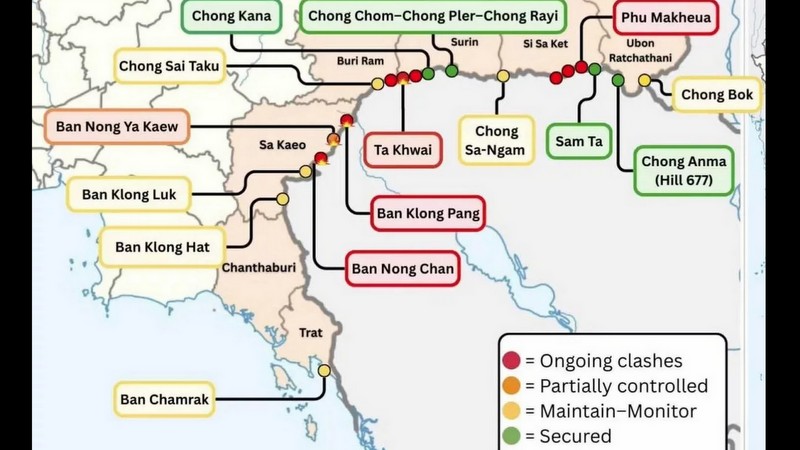
19 key battlefields
Col Richa Suksuwanon, deputy spokesman for the army, said the intensity of Cambodian attacks varied depending on the battlefield and objectives.
He said the Thai military now held control of four out of 19 key battlefields along the 800km frontier. They were Hill 677 in Ubon Ratchathani, Sam Ta in Si Sa Ket, and the Chong Kana and Chong Chom-Chong Pler-Chong Rayi communities in Surin province.
“Clashes were heavy at the Ta Khwai temple ruins (in Surin) where there is an important strategic location, which is Hill 350. Many Thai soldiers were killed there including two soldiers whose bodies have not been retrieved,” Col Richa said.
Intense clashes were also reported in the eastern province of Sa Kaeo, in Ban Klong Pang, Ban Nong Chan and Ban Nong Ya Kaew.
Thailand and Cambodia have been firing artillery shells and rockets at each other as each side attempts to take control in the three areas, Col Richa said.
“Hundreds of BM-21 rockets were fired, not at soldiers, but at farmland and civilian areas. This is not right and we will surely retaliate,” he said.
“Thailand will do its best to destroy the fire support and military bases that increasingly aim at Thai civilians whose hardship is escalating. The army will disable the military capabilities of Cambodia and stop the damage to civilians.”
In Trat, meanwhile, the navy retook Ban Nong Ri village after several days of fighting and found many anti-tank mines that had been modified to be anti-personnel ones, said Lt JG Napasakorn Thepso, assistant spokeswoman for the Royal Thai Navy.
The Chanthaburi and Trat Border Defence Command reported that 16 such mines had been found at a warehouse and many more were spotted in its vicinity.
The possession of anti-personnel mines violated international laws, said Lt JG Napasakorn.
Chinese Envoy
Meanwhile, China has sent a special envoy to Thailand and Cambodia to renew its attempts to restore peace between the two Southeast Asian nations.
Deng Xijun, special envoy for Asian affairs, travelled to Cambodia and Thailand yesterday to conduct mediation, the Foreign Ministry in Beijing said in a statement.
“China is closely following the ongoing border conflict between the two countries. In its own way, China has been working actively for deescalation,” said the statement, which was also released by the Chinese embassy in Bangkok.
Mr Deng’s trip also comes as Cambodia’s use of Chinese weapons comes into focus, following reports that the Thai military seized a large number of Chinese-made anti-tank missiles from Cambodian soldiers.
The embassy quoted the Chinese foreign affairs ministry as saying that China engaged in “normal defence cooperation” with both Thailand and Cambodia, and that it neither targeted any third party nor had anything to do with clashes along the border.
While Mr Deng has travelled to the two countries at least twice to seek mediation, yesterday’s visit is his first since the so-called Kuala Lumpur Peace Accords were signed.
The agreement was signed by the Thai and Cambodian prime ministers in the presence of US President Donald Trump and Malaysian Prime Minister Anwar Ibrahim, in his capacity as the chair of ASEAN.
Trump recently spoke with the two premiers - Anutin Charnvirakul and Hun Manet - and urged them to abide by the accord and get back to negotiating a peace deal.
Clashes along the 800-kilometre border resumed earlier this month, including Thai airstrikes on Cambodian military targets. More than two dozen people have been reported killed, including 21 Thai soldiers and 12 Cambodian civilians, and over half a million people have fled the area because of the fighting.
China has engaged with both sides since the start of the violence, but has kept a much lower profile than the US as Beijing generally avoids publicly intervening in conflicts, beyond seeking to facilitate discussions.
Mr Anwar said on Wednesday that he had been in contact with the Thai and Cambodian leaders as well, and that both told him they want to resolve their border clashes as soon as possible.