


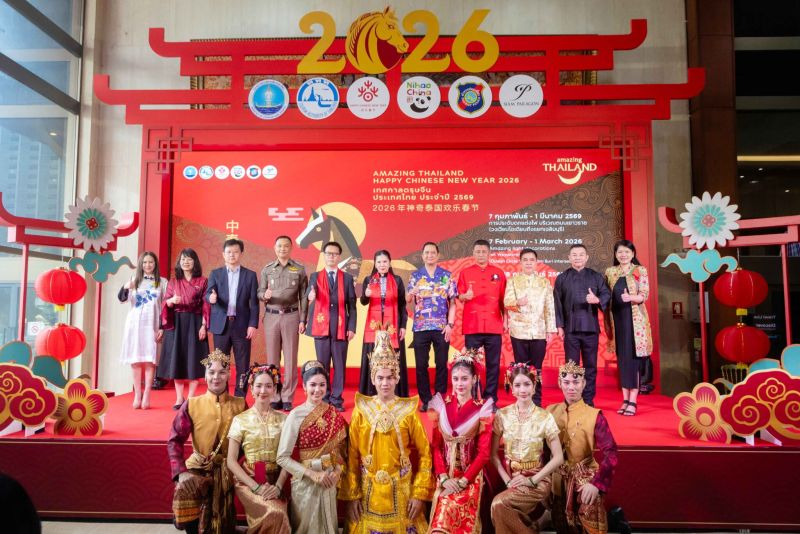
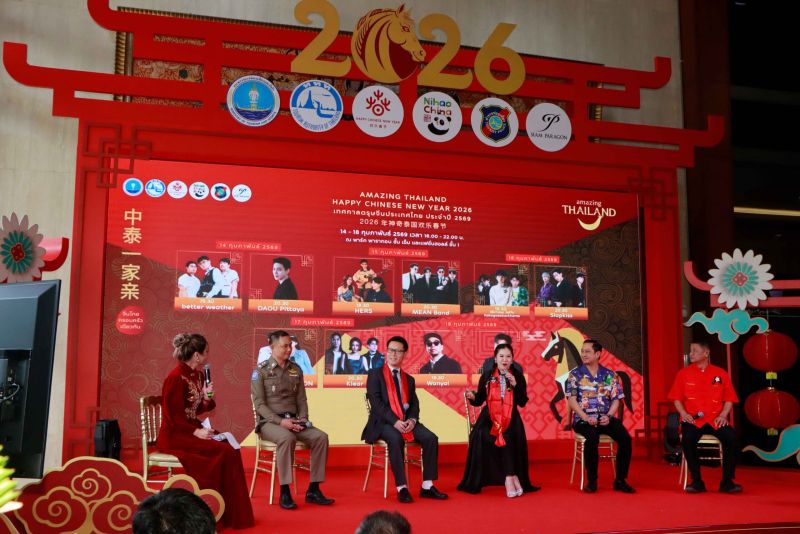



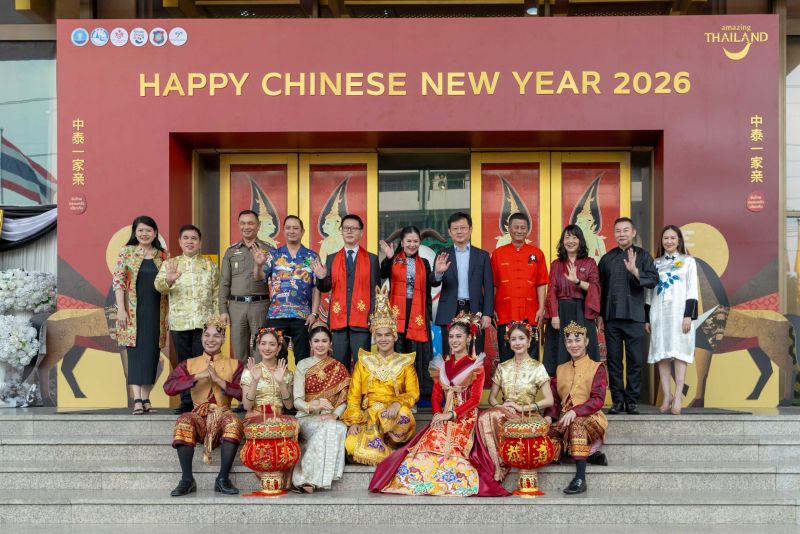
TAT is rolling out the ‘Zhongtai Yi Jia Xin’ campaign from January to March across five offices in China, partnering with major online travel agencies and airlines to sell discounted air-and-hotel packages to Thailand.
The campaign is designed to sustain demand beyond Chinese New Year into other peak holiday periods, including Qingming, Labour Day, summer holidays, Mid-Autumn Festival and China’s National Day, with targeted offers for families, Gen Z travellers and corporate groups, reported the TAT.
Deputy TAT Governor for Asia and South Pacific markets Phatranong Na Chiangmai said the authority is working with platforms including Qunar, Tongcheng, Fliggy, Klook and Tuniu, as well as Thai Airways and King Power, to bundle travel deals and retail incentives to stimulate bookings during the long holiday period.
The push comes as Chinese arrivals show a strong rebound. Between Jan 1 and Feb 5, 2026, Thailand welcomed 498,725 visitors from China. TAT forecasts around 241,000 Chinese tourists during the Feb 13-22 Chinese New Year period, with daily arrivals rising by about 20,000 as the holiday approaches.
To anchor demand on the ground, TAT is co-organising Chinese New Year events nationwide, including light installations along Yaowarat Road in Bangkok (Feb 7-Mar 1), the Thailand Chinese New Year Festival at Siam Paragon (Feb 14-18), and regional celebrations in Hat Yai, Nakhon Sawan and Suphan Buri. The events are aimed at boosting length of stay and spend in key urban and regional destinations.
India: fast-growing market, bigger trade push
At the same time, TAT is accelerating market penetration in India, which it describes as one of Thailand’s fastest-growing and most strategically important source markets. TAT Governor Thapanee Kiatpaiboon led a delegation of 36 Thai tourism operators to the Outbound Travel Mart (OTM) 2026 in Mumbai on Feb 5-7, a major B2B trade fair for South Asia and western India.
The Thai delegation comprised 17 hotels and accommodation providers, 11 tour companies, seven attractions and one airline, with the aim of securing new distribution partners, expanding product visibility and driving bookings for leisure travel, weddings and celebrations, wellness, luxury and sports tourism. TAT said the three-day event is expected to generate at least 5,000 business meetings and around B366 million in direct and indirect revenue.
India’s momentum is already evident. From Jan 1 to Feb 4, 256,782 Indian tourists visited Thailand, ranking India fourth among source markets. TAT expects more than 2.55 million Indian arrivals in 2026, contributing over B93 billion in revenue. The market is supported by dense air connectivity – more than 10 airlines operate direct routes to Thailand, with over 3.8mn seats annually – and by Thailand’s visa-exemption policy allowing Indian nationals to stay up to 60 days.
Indian travellers are increasingly diverse, with strong demand from millennials and Gen Z, destination weddings, wellness retreats, multi-generational trips and workation travellers. Average spending is estimated at B38,340 per trip with an average stay of just over seven nights, making the segment attractive for hotels, attractions and airlines.
Revenue focus for 2026
TAT said its 2026 strategy centres on deepening partnerships with airlines and tour operators, broadening demand to secondary Indian cities such as Pune, Ahmedabad, Amritsar and Lucknow, and promoting higher-value segments. The authority is also aligning campaigns with sustainability goals to lift value per visitor.
With Chinese New Year expected to deliver a near-term boost and India positioned as a year-round growth engine, TAT is betting that a dual-market strategy will underpin Thailand’s tourism recovery and push revenues past the B93bn mark in 2026.