


Such dishes are hardly worth labelling as Thai food, any more than egg rolls and fortune cookies can be considered authentic Chinese cuisine. Fact is, most Thais don’t consume much fried rice or stir-fried noodles (one notable exception being in Phetchaburi, where there are many famous B15-25 pad Thai joints popular among local residents and tourists alike), at least not nearly as much as foreigners.
So what are the real, everyday Thai favourites? It can vary by region of course: in Chiang Mai, you might find locals regularly gorging down bowls of khao soi – Northern style noodles with sweet curry; while a typical Thai lunch up in Isarn or the Northeastern region will most certainly comprise som tum plara, papaya salad with fermented fish. Down here in the South, locals tend to consume a lot of gaeng som (Southern orange curry), kua gling (spicy meat and herb stir-fried) and kanom jeen (Chinese style rice noodles with curry) – but more on those another week.
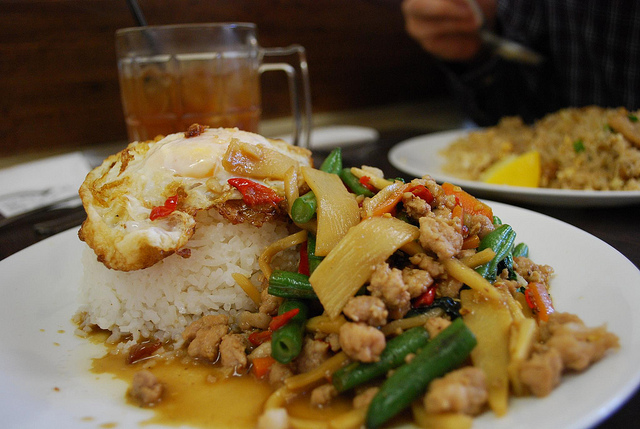
In this brief column, I would like to inform the uninformed about the one and only dish you’ll ever need to know about: no matter what town, village, city or province you happen to be in, all across the Kingdom, the local eatery will be able to cook you up a plate of pad kapao (pronounced “putt gra-prow”), which is by far, the most regularly-ordered dish in all of Thailand.
Commonly ordered with a fried egg, kai dao, Thais have nicknamed this dish as “Aharn Sin Kit” which roughly translates to “the dish you don’t need to think about to order.”
A Central Thai staple, and one of the healthiest all-around, pad krapao comprises four main ingredients: holy basil, spicy chilli, garlic and one’s preferred meat/protein base. Depending on what type of cooking and flavouring oils are used, the final product will vary at each kitchen, with cooks tending to add seasonal veggies and even MSG and other spices to give it more kick.
Some versions will be more saucy or chunky – in which all ingredients are tossed into a hot wok all at once without much preparation, while other variations require the ingredients to be minced and pounded in a mortar before stir-frying.
I personally like mine with the meat, chili and garlic finely minced into small pieces so that the flavour fuses more finely during the stir-frying process. A little sauce is okay, but not too much – it’s not supposed to be a soup or curry. And just a slight pan-fry taste.
So, next time you have lunch, try ordering like the ordinary Thai: “Putt gra-prao kai-dao krup!”