


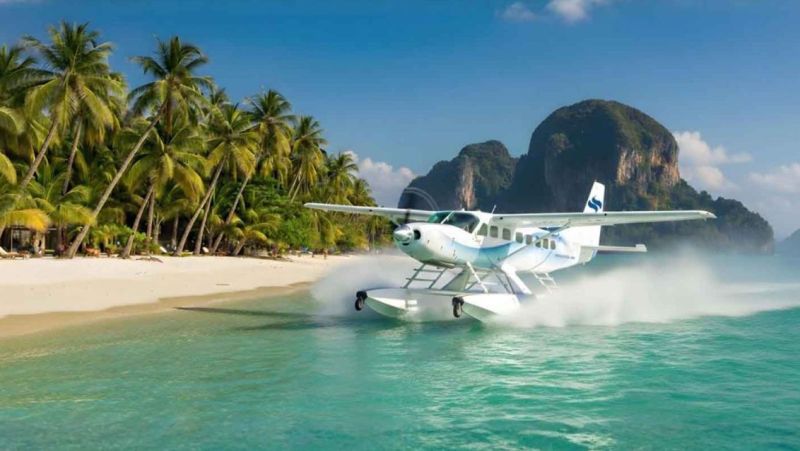
“Thailand has recorded strong demand for seaplane services, but the industry developed slower than regional competitors such as Vietnam and Indonesia,” said Worakanya Siripidej, chief executive of Siam Seaplane, reports the Bangkok Post.
“Our regulations have not been adjusted fast enough to catch up with new innovations and technology.”
Ms Worakanya said a 2023 notification from the Natural Resources and Environment Ministry states that certain types of project must submit an environmental impact assessment report. Temporary water landing sites or floating docks for seaplanes also require an initial environmental examination, which means an investment of several million baht, nearly matching the cost of a boat marina, she said.
This requirement is a burden for operators, and delayed the company’s seaplane launch. A regulation should not be "one size fits all" for operators, said Ms Worakanya.
The company registered in Thailand in 2019, and obtained an air operator certificate in 2024. Siam Seaplane is part of Seaplane Asia Group, which also provides seaplane services in Indonesia and Cambodia.
The company only operates land-to-land charter flights via a Cessna Grand Caravan plane across Thailand, such as Bangkok-Samui and Samui-Phuket routes.
Last year, the Civil Aviation Authority of Thailand (CAAT) issued a regulation for commercial seaplane operations and established standards for temporary take-off and landing areas on water.
She said this new regulation only covers temporary water landing sites or floating docks for seaplanes, but not larger covered facilities such as water aerodromes that can accommodate several aircraft, as seen in the Maldives, the world’s largest seaplane hub.
Seaplanes can also land on beaches, which the law has not yet covered. While issuing this law is the first good step, it would be better to plan ahead for further development, if Thailand wanted to be an aviation hub, said Ms Worakanya.
STRATEGIC COMMITTEE
Recognising this service as a new growth engine, the government and stakeholders have formed a strategic committee for seaplanes, chaired by the deputy transport minister.
Ms Worakanya said this committee would act as one-stop service centre, helping coordination between different organisations involving seaplanes operations and approvals, such as the Department of National Parks, Wildlife and Plant Conservation, as well as the CAAT and the Aeronautica Radio of Thailand (Aerothai).
Supported by the CAAT and Aerothai, Siam Seaplane proposed the Natural Resources and Environment Ministry ease some conditions in the environmental impact assessment report for seaplane facilities, which is expected to be completed by the fourth quarter this year.
She said public hearings with local communities in Krabi should be finished this year, enabling the company to begin construction of three temporary water take-off and landing sites in Tub Kaek and Koh Phi Phi.
Siam Seaplane also plans to develop facilities at Bangtao and Makham Bay in Phuket and Koh Yao Noi in Phang Nga, allowing the company to begin services as early as January 2027.
While global economic and geopolitical issues prompted the company to adjust the plan accordingly on a weekly and monthly basis, it has already received nearly 100 inquiries for seaplanes in January.
Ms Worakanya said the company ordered six additional Cessna Grand Caravan planes this year for a fleet of seven aircraft.
Siam Seaplane targets revenue of B70 million next year and B650mn within five years, with seven to 15 aircraft in total.
Some 70% of total revenue is projected to be derived from seaplane services, with the remainder from land-to-land charters.
A 30-minute seaplane flight from Phuket to Koh Phi Phi costs around B50,000, offering eight to 10 seats.
“Our business is highly scaleable, due to Thailand’s large tourism industry. There is opportunity across many destinations, such as faraway islands or dams,” Ms Worakanya said.
“Seaplanes are a means of logistics which creates accessibility to hard-to-reach waterfront destinations across Thailand.”
Looking ahead, the company wants to expand land-to-land flights overseas to Cambodia, Laos, Myanmar and Vietnam next year, as well as cooperate with the National Institute for Emergency Medicine in aeromedical evacuation services.