


What is your view on the current state of elephant/animal welfare in Thailand?
“There are two major issues concerning animal welfare in Thailand. First is the conflict between wildlife and humans. These days, humans and wild animals live in closer proximity than ever before due to the loss of wildlife habitat. Concerning factors include deforestation, climate change and the popularity of keeping wild animals as pets. In Asia, human behaviour like the illegal animal trade and consumption are also crucial factors. All together, these factors drive wild animals to conflict with humans.
Another issue is animal cruelty, which affects both society’s feeling and Thailand’s reputation. In the past, it has been much harder for us to investigate. But today, thanks to technology, Thai citizens and tourists can help report their suspicions of animal cruelty to the government via social media or to the Wildlife First Aid Coordination Centre’s call centre (Tel. 1362).
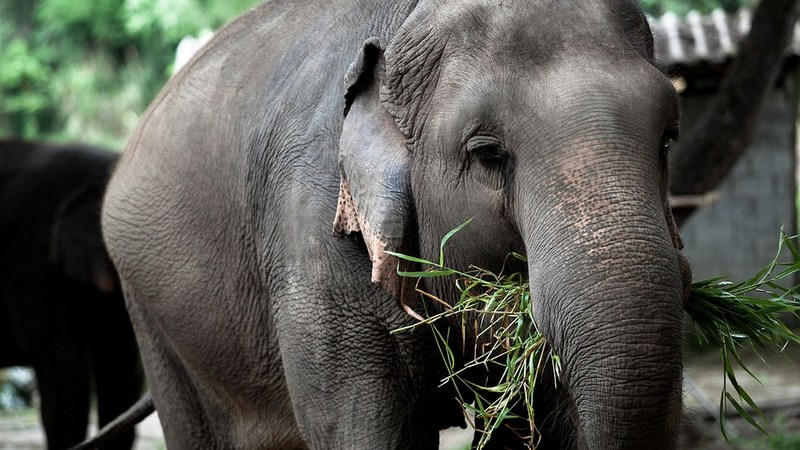
There is obvious social concern when people see elephants walking in cities, questioning if their feet hurt from walking on hot concrete. The fact is elephants have footpads containing fat which protect them from hot surfaces. They won’t feel the heat. But walking around the city increases the possibilities of getting hurt by stepping on nails or broken glass, getting hit by cars, stepping into an open storm drain or getting injured from an electrical shock. The reason why there are still some elephants in Thai cities is because by law the mahouts still have the right to do so. Thailand is the only country in Asia where elephants have two statuses: wild animal and working animal.
Wild elephants living in their natural habitat are classified as wild animals and protected by law. Domesticated elephants are classified as working animals just like other livestock. If owners have legal livestock identification certificates for a domesticated elephant, they have a right to walk it on the street. Very few of them mistreat their elephants. So, when images [of cruelty] appear online or in the news, it is more often than not a case of where one rotten apple spoils the whole barrel.
The relevant Thai government agencies are planning to remove elephants from the working animal list and give them special protective status in the near future, which might include new regulations on how owners can take care of and treat them.
People used to go to zoos or the circus to see so-called wild animals. But now, the old-style zoos and circuses, where animals live in stressful environments, or are forced to perform unnatural acts, are slowly disappearing. More people, both Thais and foreigners, are well educated on animal welfare, and they choose not to patronise these places. So they must adapt and change the way they do business, and this means no more animal shows.
Currently, Thai government agencies are promoting a new concept for animal tourism called ‘animal presentation’, which is relevant to zoological park organisations all over the world. Zoological parks now focus on animal welfare and how to replicate the animal’s natural environment as much as possible. We want them to live in a wide, enriched, natural environment, not in a small cage.”
Historically what has been the relationship between the Thai people and elephants?
“Historically, there has been a strong bond between the Thai people and elephants. They are also part of our culture and life.
Mahout elephant training uses a reward system. It is a process that requires patience and understanding of each individual elephant’s personality traits and characteristics. Just like the way people train their horses, they are not tortured. People have to realise that these trainers love their elephants.
Photos and videos [of cruelty], some are prior cases which were already investigated by government agencies. One photo can ruin a country’s reputation with the power of the internet and social media. So it is our duty to explain to the public, and people have to be aware before sharing news.”
How has the DNP been active in animal welfare in Thailand?
“Thailand’s government agencies have been trying to cope with the problem in many ways: policy-making, supporting research on wildlife, rehabilitating injured animals and eradicating the illegal wild animal trade. After long, sustained efforts on many fronts, our hard work has finally started to pay off. The effectiveness of our work is the number of animals we have in the wild, and today the number of elephants, tigers, bantengs and many other wildlife is increasing. There are currently an estimated 3,500 wild elephants and 4,500 domesticated elephants in Thailand.
In the past, it was not hard to make a fake animal permit. But now, every elephant is individually registered in our new electronic profile system containing each elephant’s photo, DNA and mahout profile.
Another strategy, which is very effective and plays an important role in protecting animals, is social boycotting. Travel businesses and individual tourists can help government agencies by boycotting businesses that do not take good care of animals.
Thailand has legislated its own zoo standard called the ‘Thailand Zoo Standard’. Thailand’s DNP also has its own veterinary team who regularly investigate every zoo to ensure they take care of animals properly.
In order to possess any wildlife in Thailand, one must have a Wild Animal Possession Permit. The animals have to be born from domesticated breeding, not ones caught in the wild.”
What role would you like to see the DNP play in promoting animal welfare in Thailand?
“I think we are moving in the right direction to promote animal welfare. What we are doing is collaborating with different organisations and sectors in Thailand to reduce and hopefully eliminate animal cruelty as much as possible. We are working with the Zoological Park Organisation (ZPO), a state enterprise that is responsible for wildlife living outside their natural habitats. In collaboration with the ZPO, our aim is to research, breed and release more wildlife back into its natural habitat.
I believe that cruelty to animals in Thailand has dramatically decreased. As animal welfare and protection has improved, so has the social consciousness of the general Thai public. While these are but a few very small steps in the right direction, they are the part of reason why I am very optimistic about the future of animal conservation and welfare in Thailand.”