


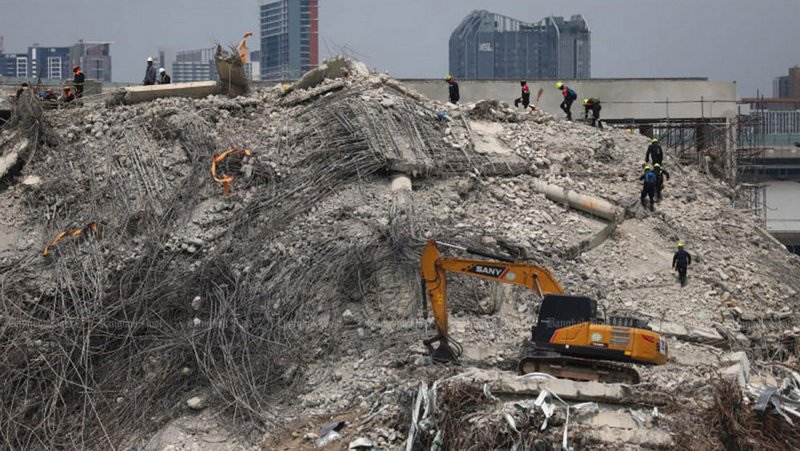
The details are in a progress report released yesterday (Mar 22) as legal action mounts against those responsible and compensation paid to victims already exceeds B129 million, reports the Bangkok Post.
The SAO said findings from multiple investigations pointed to serious flaws in design, materials and construction practices.
The building, a 30-storey structure under construction in Bangkok at a budgeted cost of B3.2 billion, collapsed on Mar 28, 2025, during an earthquake, killing 95 people and causing widespread damage.
Four key causes identified
Citing studies by leading engineering institutes - including Chulalongkorn University, King Mongkut’s Institute of Technology Ladkrabang, Kasetsart University and King Mongkut’s University of Technology Thonburi - the report concluded that the structure failed to meet required seismic resistance standards.
Investigators identified four main factors behind the collapse:
- The failure began on the lower floors (levels 1–4), where shear forces from the earthquake caused structural walls to fail.
- Concrete samples taken from shear walls were found to be below required strength standards.
- Construction plans did not comply with applicable laws, reducing the building’s load-bearing capacity.
- Reinforcement steel at critical joints, particularly between link beams and shear walls, was embedded at insufficient depth, weakening the structure.
The findings are consistent with earlier statements by then Prime Minister Paetongtarn Shinawatra, who cited deficiencies in both design and construction as the primary causes.
Compensation and legal action
Compensation totalling B129,855,093 has so far been paid victims or their families, covering fatalities, injuries and other effects of the disaster.
Legal proceedings are ongoing on several fronts:
- Criminal cases: Prosecutors have filed charges against 23 suspects, individuals and companies, over substandard design and construction, as well as alleged document falsification.
- Special investigation: The Department of Special Investigation (DSI) has forwarded a case related to the use of nominees to prosecutors.
- Anti-corruption probe: The National Anti-Corruption Commission (NACC) is examining the possible involvement of state officials, with the SAO providing requested documents.
- Procurement review: The Comptroller General’s Department is investigating compliance with public procurement laws.
The report reflects systemic problems in public-sector construction, including material standards, work supervision and law enforcement. Legal proceedings are still under way and may be expanded to include additional parties in the future.
Meanwhile, relevant agencies are preparing to apply lessons learned from the incident to improve building safety standards, particularly in earthquake-resistant design, to prevent similar incidents in large-scale government projects.