



It is not made of the usual glass and steel, though a built for purpose, 365-day stadium in Cherng Talay is very much part of the blueprint being built by the club and the local municipality. Instead, this project is being built on the more volatile foundations of identity, community, and a radical departure from the “benefactor” model that has long acted as both the engine and the anchor of the Thai game.
For too long, the Thai football landscape has relied on a fragile, almost feudal model: the benefactor owner. It is a system where a club rises quickly through localised spending and vanity, only to collapse into ignominy the moment the owner’s enthusiasm, or political capital,
fades. Across Asia, the pattern is wearyingly familiar: short bursts of success followed by a hollow, ringing silence.
Phuket United is being built specifically as the antithesis to the vanity project. It is an attempt to create an institution that is woven into the daily life of the island, rather than one that hangs precariously on the whims of a single ego.
Brazilian DNA
Phuket United enters the fray via the Thai Semi-Pro League (TSP), the fourth tier of the national pyramid that serves as a regional proving ground. But the club’s competitive edge isn’t just a local matter; it is deeply entwined with a global powerhouse. The project represents a movement for the island, anchored by a deep-rooted partnership with the Cruzeiro EC Academy Phuket.
This isn’t a fresh-off-the-plane sponsorship deal. The owner of Phuket United is the same visionary who brought Cruzeiro to these shores over twelve years ago, establishing and running the academies Asia-wide, an operation now widely considered the premier football academy system in Thailand. They have built one of Southeast Asia’s strongest football cultures, powered by the DNA of the Brazilian giants, the same roots that produced legends like Ronaldo and Rivaldo.
This partnership is moving from the academy pitches to the professional stage. The coaching reins for this inaugural season have been handed to Eder Diniz, the Head Coach of Cruzeiro in Phuket. By bringing the Brazilian coaching team to guide the first team, the club is injecting a specific mentality and technical level that has been missing from the island’s senior game. It is a philosophy that prioritises the “mentality of the movement” over the transient results of the week. This isn’t theory; it’s a proven conveyor belt of real pathways.
Ending the Island Diaspora
The most significant challenge facing Phuket football hasn’t just been a lack of coaching – it has been the historical “brain drain.” For years, the island’s most prodigious talents have had to flee the nest to find a top-level professional game. We see the fruit of this diaspora everywhere.
There are the success stories of the academy like Ben Davis at Uthai Thani and Siam Yapp, a Thai international now plying his trade with K2 side Paju Frontier in South Korea. Then there are the Duchowny brothers, Micah and Jonah, who have progressed through Buriram United to the Mexican La Liga with Los Cabos United.
Phuket United exists to ensure these pathways lead back to the island as much as they lead away from it. The track record is already there: Pedro at Benfica in Portugal, Nicolai at Sporting Lisbon, and Sachin at Johor FC in Malaysia all carry the Phuket-Cruzeiro DNA. The goal is to create more access and more pathways for every boy and girl on the island, moving from Phuket to the world stage.
This commitment to heritage is a core pillar, albeit one with a pragmatic lens. While the club holds a long-term ambition to eventually field a team comprised exclusively of players with island heritage, the current reality is one of transition. The squad is a living testament to this homegrown philosophy: 19 players are born-and-bred Phuketians. This includes the veteran leadership of 40-year-old goalkeeper Worawut Seetaput and 38-year-old centre-back Sophon “Tum” Patkor, alongside the raw potential of 16-year-old winger Kunanon “Kunkun” Sittikarn.
The remaining three players – such as the 27-year-old goalkeeper Krisawat Kongkot from Suratthani – all herald from the surrounding Southern provinces, ensuring the team remains a regional fortress. Adding to this local surge, three of Cruzeiro’s “BIP” (Brazilian Integration Program) kids, all under 17, are in the squad for the season. They return from holiday to join training next week, with one having recently received a prestigious call-up to the Thailand U17 national squad.
The Srisuntorn Nucleus: A Hub for the Mosaic
The “Island Identity” of 2026 is a complex and kaleidoscopic thing. To truly represent Phuket today is to cater to a global mosaic: local Thais, a massive and burgeoning Russian community, the vital Burmese workforce, and a world of different expats. The club’s headquarters on Srisuntorn Road, known as the Siam Space Program, is an ambitious work in progress. Currently a bold “coming soon” project, it is designed to be the community’s nucleus – a hub where football, street culture, and imagination meet.
The ambition for Srisuntorn goes far beyond a clubhouse. It is envisioned as a 24/7, 365-day entertainment company that gives back to the community. This isn’t just about winning promotion; it is about creating a space for Phuketians of all stripes – whether Thai, Burmese,
or Russian – to find a common ground. The club is launching an island-wide initiative to work with all international and local schools, integrating them into the Phuket United x Cruzeiro Academy network. The aim is simple: keep the island’s best talent on the island and provide a higher level for everyone. When a child in Kathu wears the shirt because the striker once attended the same school, the loyalty becomes unbreakable.
Ambassadors and Outreach
To bridge the gap between this local vision and the wider football world, the club has made the ambitious appointment of official ambassadors to promote the club and its charitable identity. These figures aren’t just for show; they are tasked with promoting the club’s identity and its extensive charity work, also supporting and offering holistic and professional guidance in clubs endeavours for young players to further their careers in Thailand and beyond. Initial appointments include Buriram United Captain’s Thai-Australian Kenny Dougall and the former Buriram and Port striker Lonsana Doumbouya. These high-profile names provide the professional “seal of approval” to a project that is as much about social engineering as it is about 3-5-2.
The Stadium as a Stage
In Phuket, football doesn’t just compete with other teams; it competes with world-class beach clubs and an international culinary scene. The matchday experience must, therefore, be more than ninety minutes of football. While the club is working toward building a full “festival of football” atmosphere – with music, entertainment, and local markets planned for every matchday – the inaugural season at Surakul will be the foundational step.
The long-term vision remains the development of the Cherng Talay Stadium – a venue inspired by the Tottenham Hotspur model, designed to host hospitality, retail, and co-working spaces every day of the year. But before the “Space Program” reaches orbit, promotion to T3 is key. But it is a long term journey and whatever happens off the pitch is of equal importance to results.
The first home game of the season at Surakul Stadium will be the ultimate litmus test for this vision. It is a gamble on the idea that authenticity, the deep Brazilian DNA of Cruzeiro, and a permanent home on Srisuntorn Road can triumph over the short-termism of the benefactor model. If Phuket United succeeds, they won’t just have a football club; they will have an island that finally sees itself reflected in its team.
Viva la Revolution!
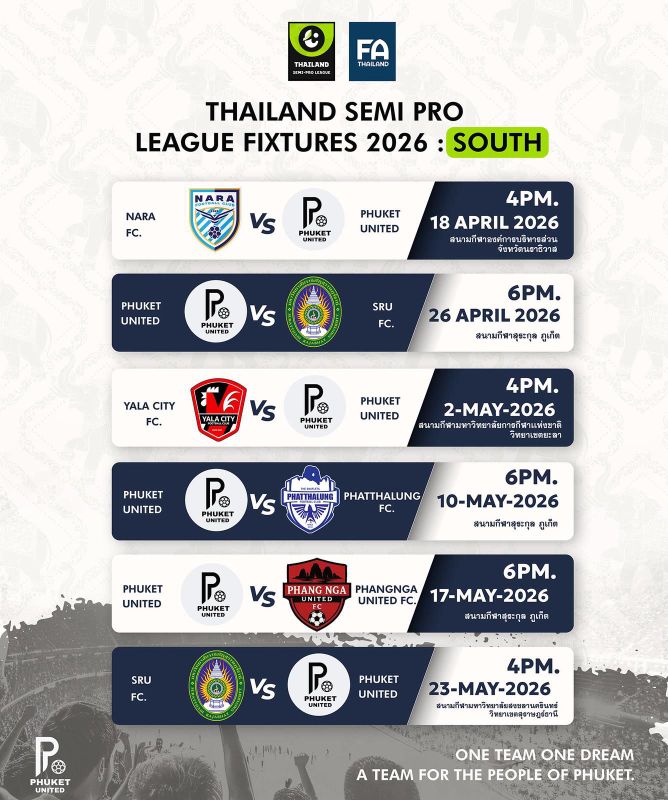
The mission begins at Surakul Stadium on Sunday (Apr 26) at 6pm, as Phuket United host SRU FC (Surat Thani Rajabhat University FC).
For more information about tickets and season tickets visit: