



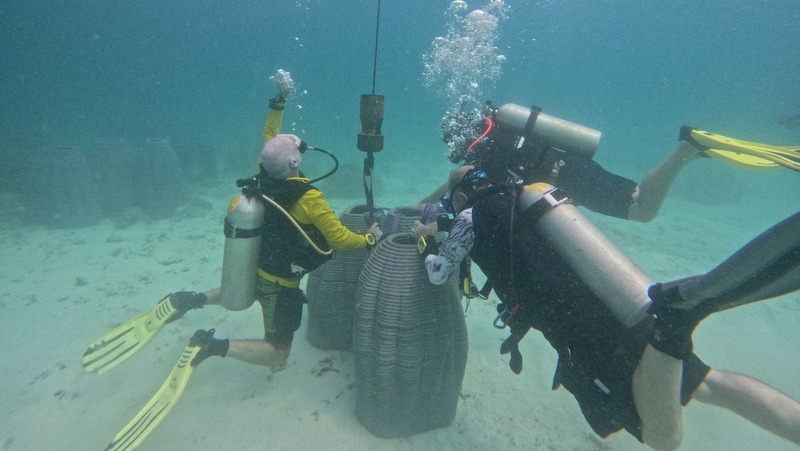
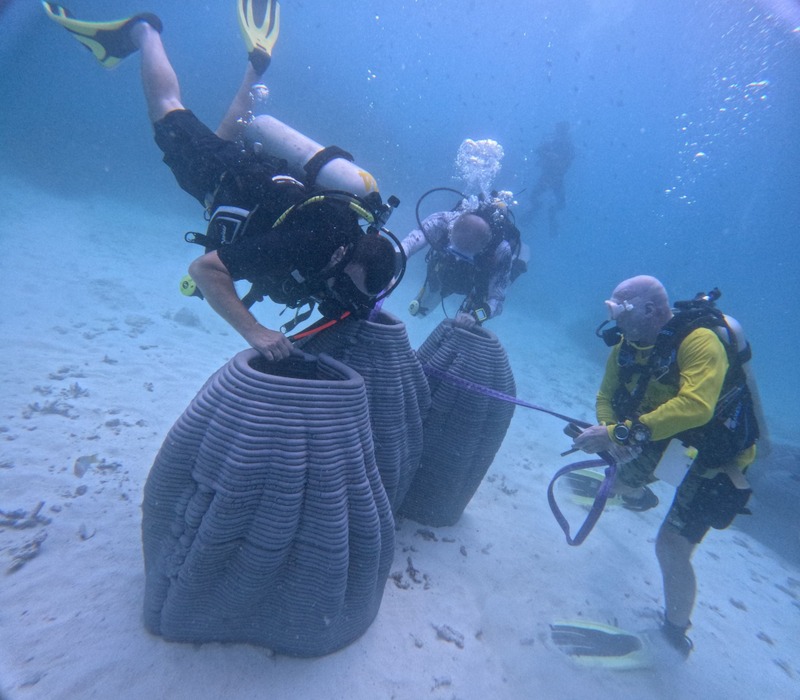


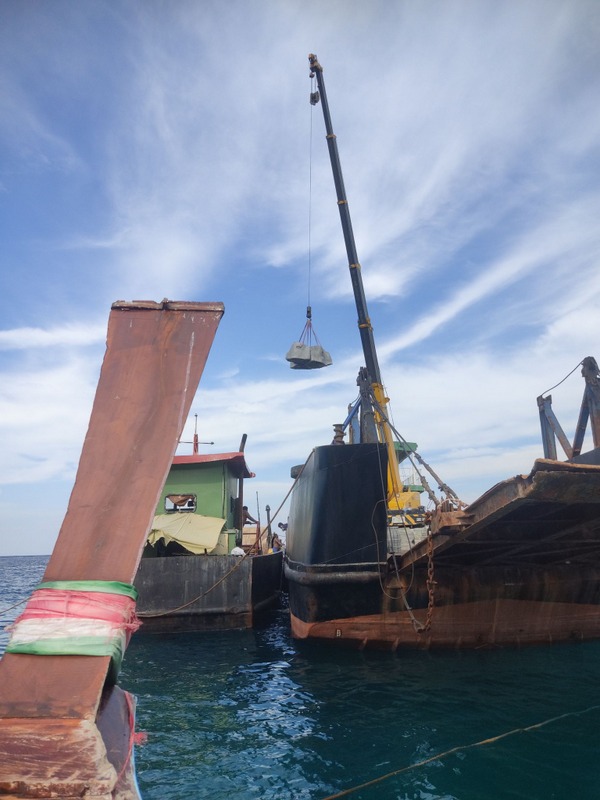
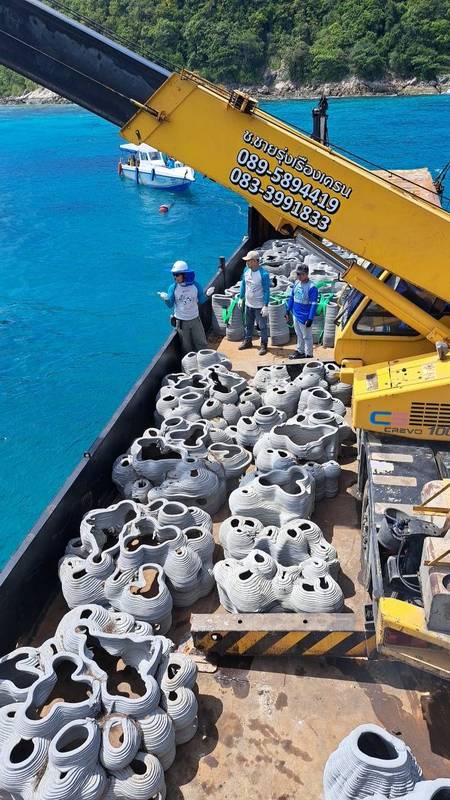
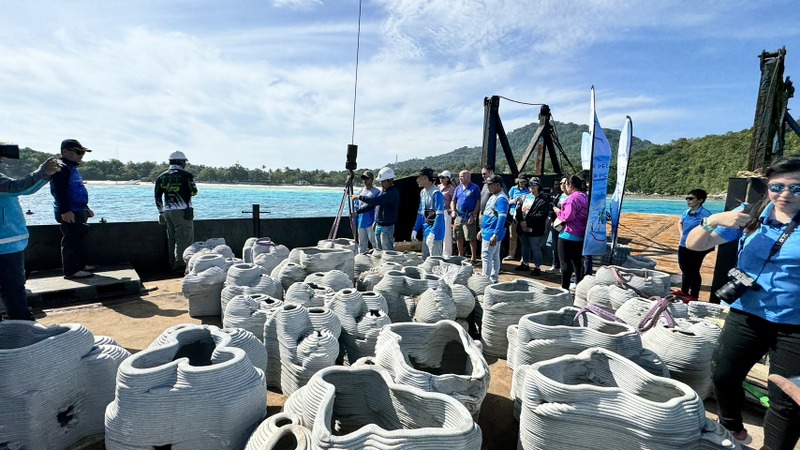
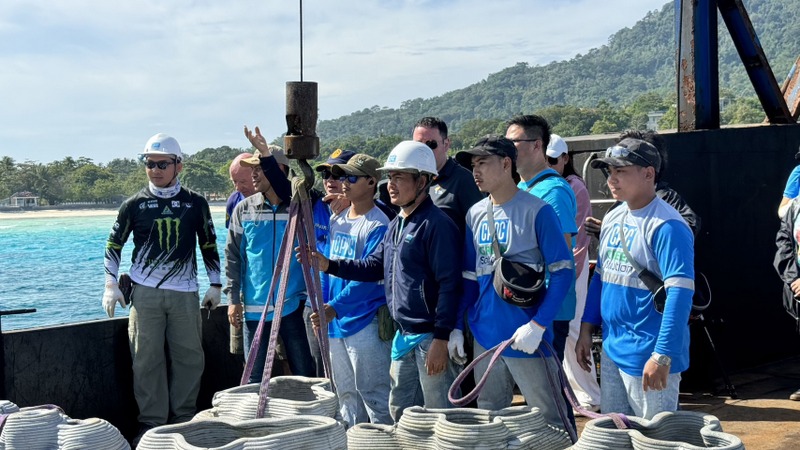
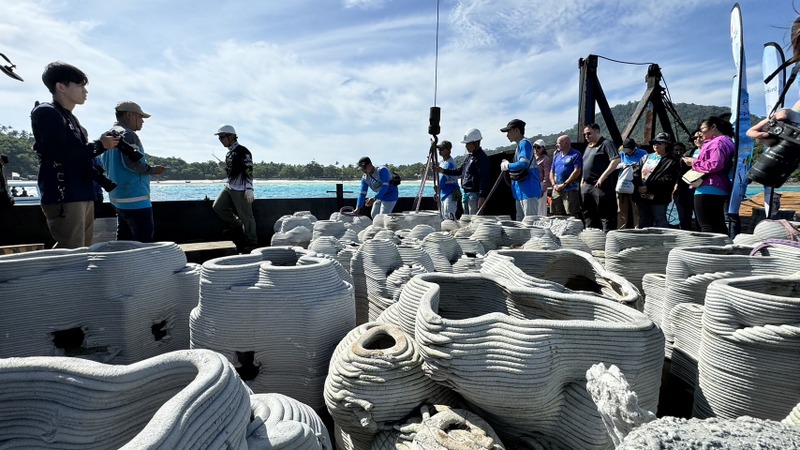
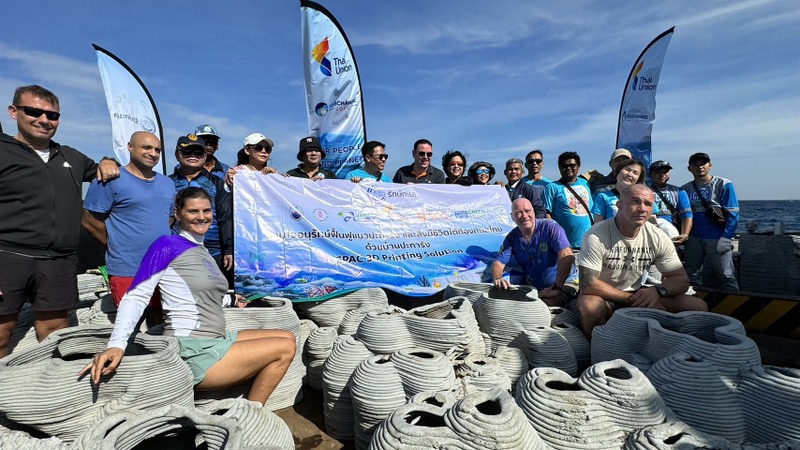
Leading the inaugural installation yesterday (Nov 21) was Weeraphan Thongmak, Director of the DMCR’s Marine Resources Restoration Division. Also present was Adam Brennan, Group Director of Sustainable Development at Thai Union Group Public Company Limited, which is funding the project.
Sukthawat Pattawarakorn, Director of Natural Resources and Social Mission at SCG (Siam Cement Group), which created the 3D-printed forms to be installed at the reef site, was present to represent the ‘CPAC Green Solution’ initiative.
Construction Products and Materials Company Limited, or ‘CPAC’, operates under SCG Cement, which was founded by a royal decree of King Rama VI (Vajiravudh) in 1913. The company’s major shareholder is His Majesty King Vajiralongkorn, who owns 30% of Siam Cement’s shares.
Present to actually install the 3D-printed forms were volunteers from Phuket’s dive community.
Paitoon Panchaiyaphum, Director of the DMCR’s Conservation and Resource Management Department, explained that the reef area covers about 50 rai.
“From surveying the general conditions in many areas, most of the corals were found to be in deteriorated condition. Some areas were damaged and lost permanently. Only the sand remains,” he said.
“This has happened because of many reasons, including tourism and diving activities, boats dropping anchor on the corals and natural bleaching of corals, which in itself creates difficulty for the corals to recover by themselves,” he added.
“Tourism activities in the area are increasing, causing disruption to the recovery of the corals. In particular, this area was previously home to staghorn corals and other fragile corals Interspersed throughout the reef,” Mr Paitoon said.
“It was found that when these corals die, limestone remains are left and over time decay and break down into small fragments. Normally, these coral remains serve as a base for naturally occurring coral larvae to colonise and continue to grow, but it takes many years,” he explained.
“When the larvae do not settle or coat the coral remains, waves wash them up on shore or off the reef into deeper waters. This leaves the area with coral fragments that turn into sand, which is not suitable for coral larvae to land on because it must be a hard surface area,” he added.
Tourism activities were a key concern, Mr Paitoon noted. “The Racha Yai Island area, especially the bays such as Siam Bay [Ao Siam], are used as a diving teaching spot.
“Scuba diving teachers dive with many tourists every day. Areas that were previously covered with coral reefs or sand containing coral larvae are constantly disturbed, meaning larvae are unable to attach and grow,” he said.
“Therefore, it is necessary to adjust the sea floor with these ‘shelters’ that are suitable for the larvae to attach to,” he added.
Previous similar projects have been successful, but reef restoration at Koh Racha poses its own challenges, Mr Paitoon said.
“In the past, the DMCR has carried out other reef restoration projects, including planting corals and placing bases in various forms, such as domes, squares, or placing bricks in the area. The results have been satisfactory.
“However, because the Racha Island area is a tourist attraction, this causes the materials placed to be unattractive compared with the coral reef. Therefore, we have thought about finding a way to find materials that are harmonious, beautiful, or similar to natural coral reefs to place.
“This is the origin of the development of the base material for coral larvae to attach to, with the Marine Resources Conservation Division working in collaboration with SCG CPAC Green Solution and the Faculty of Veterinary Medicine at Chulalongkorn University.
“The result was concrete material created using 3D printing technology, which used designs to model the shapes of various types of natural coral with the idea of being in harmony with nature,” he explained.
“It is strong, durable and friendly to the marine environment. It is complex and can be used as a home for aquatic animals. And most importantly, it doesn’t weigh much. It can be easily installed and transported.
“Divers can move it underwater, which saves money. and the project included the participation of divers to help install the concrete modules, which is in accordance with the DMCR’s guidelines to emphasise the participation of all sectors,” he said.
Thai Union Group Public Company Limited has provided the budget for the project within Phuket, Mr Paitoon added.
“The company will provide continuous support operations for a period of three years, from this year onwards. After this placement, it is expected that it will take one year for the corals to begin colonising the modules,” he said.
“After this placement, there will be continued activities by the DMCR, with volunteer divers in the area collecting broken coral fragments that are still alive and attaching them to the base. It’s called coral planting. This will allow the corals to settle on these bases and will cover the material faster,” he explained.
“There will be periodic follow-ups,” he added.
“In addition, the DMCR will encourage dive shop operators in the area with divers who have undergone training from the DMCR to hold activities to bring tourists to grow coral. in the area. This will continue to be under the supervision of the relevant officials,” Mr Paitoon concluded.