


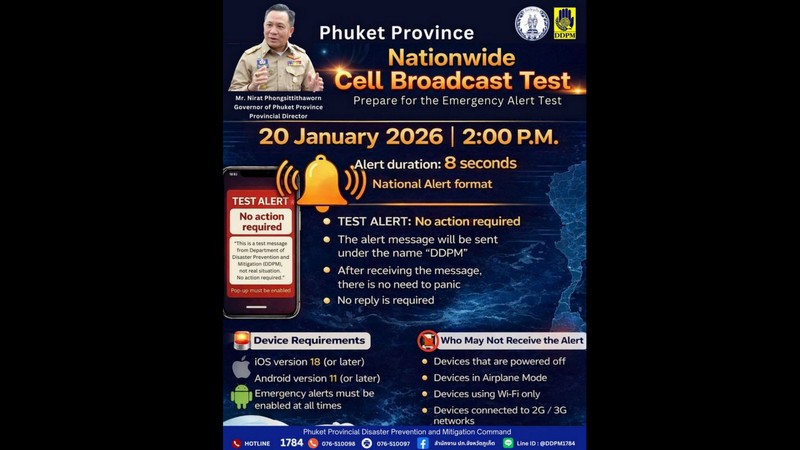
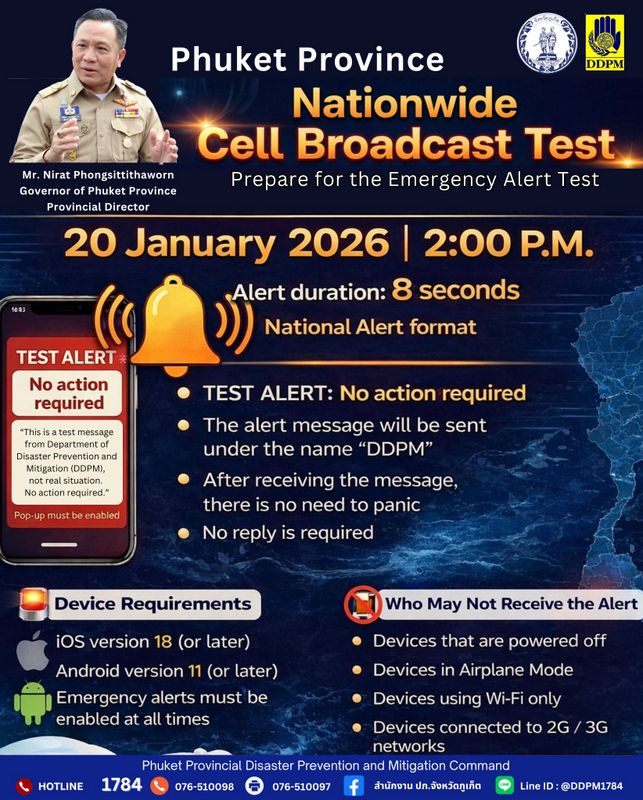
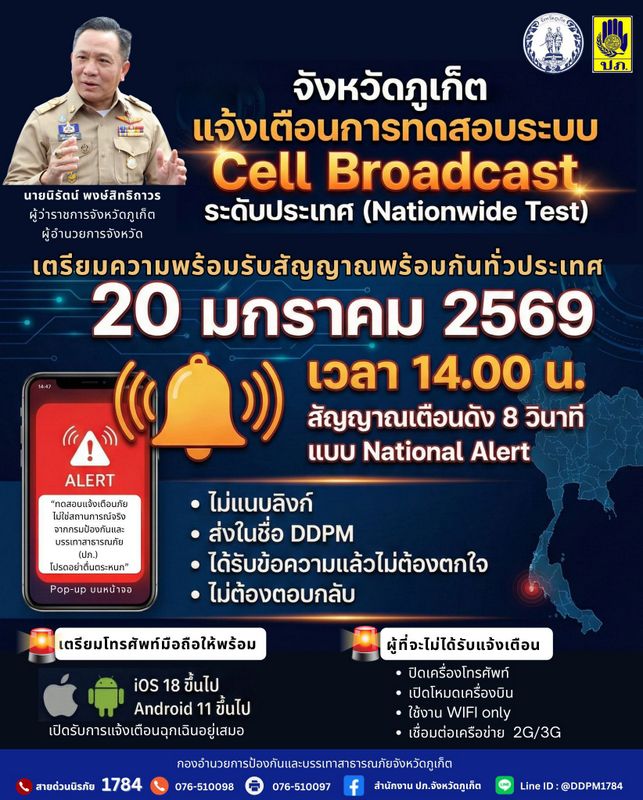
The alert test will see alerts sent to mobile phones across all 76 provinces and Bangkok, officials have confirmed.
The DDPM has urged the public not to panic, stressing that the alert is only a system test and not linked to any real emergency.
According to the DDPM, the test will be carried out by the National Disaster Warning Center in cooperation with the National Broadcasting and Telecommunications Commission (NBTC) and mobile network operators. The alert will be sent simultaneously to compatible mobile phones nationwide via ‘Cell Broadcast’ technology.
Mobile users will receive an automatic audio alert and on-screen message, even if their phones are on silent, locked, or set to vibrate. The message will read:
“Disaster warning test. This is not a real situation.
This is a test message from the Department of Disaster Prevention and Mitigation (DDPM), not a real situation. No action required.”
The alert will last about eight seconds and will disappear automatically. No links will be included, and the message will only be sent under the name DDPM, authorities said.
DDPM Director-General Theerapat Khachamat said the nationwide test follows the successful development and phased testing of the Cell Broadcast system over the past year.
He explained that the system was jointly developed by the DDPM, NBTC and mobile operators, with three previous tests conducted in 2025: a small-scale building-level test on May 2, a district-level test on May 7, and a provincial-level test on May 13 last year.
Following those trials, the system has already been used in several real-world situations, including flood warnings in northern and southern Thailand, border security alerts related to the Thailand-Cambodia border and PM2.5 air pollution notifications.
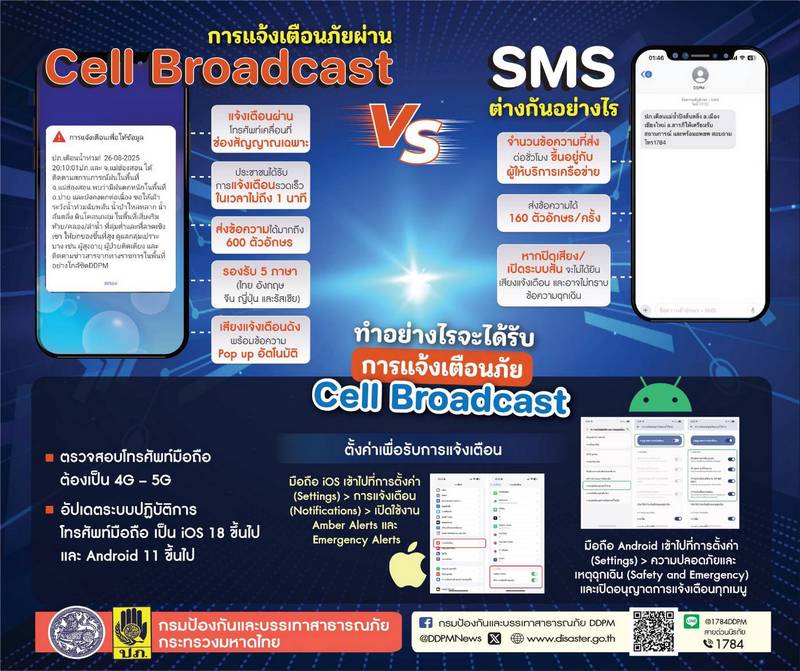
The DDPM noted that the Cell Broadcast system differs significantly from traditional SMS alerts. Cell Broadcast messages are delivered instantly and simultaneously to all compatible phones in a target area via a dedicated channel, without relying on mobile data or internet connections.
Messages can contain up to 600 characters, support five languages ‒ Thai, English, Chinese, Japanese and Russian ‒ and include text-to-speech functionality, allowing the alert to be read aloud automatically. No application download is required, and there is no cost to users.
By comparison, SMS alerts are limited by network capacity, message length, and phone settings, and may not trigger an audible alert if a device is muted.
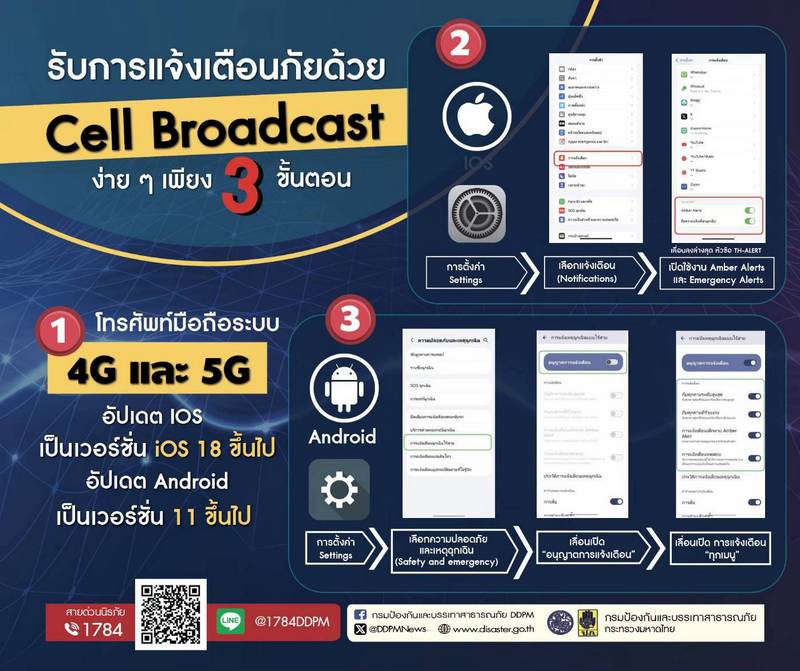
To receive the test alert, mobile phones must support 4G or 5G networks and be running iOS version 18 or later, or Android version 11 or later.
The DDPM advised the public to check that emergency alerts are enabled on their devices. On iOS, users should go to Settings > Notifications and enable Emergency Alerts and Amber Alerts. On Android, users should go to Settings > Safety and Emergency and ensure all alert options are switched on.
The DDPM reiterated that no action is required when the alert is received at 2pm today, emphasising once again that the message is only a test.
“The alert on January 20 is not related to any real disaster situation,” the DDPM said. “Please do not panic.”