


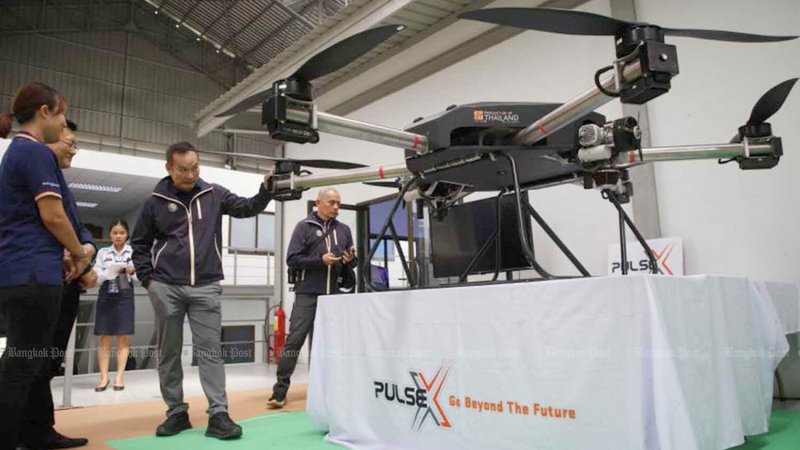
The regulations aim to unlock beyond visual line of sight (BVLOS) drone operations by permitting control through mobile telecommunications networks, reports the Bangkok Post.
The hearing focuses on modernising spectrum management, improving technical standards, and enabling wider commercial drone adoption under enhanced safety and security measures.
The public consultation is open for comments until July 3.
AM Thanapant Raicharoen, NBTC commissioner for broadcasting and chairman of the subcommittee on spectrum management and technical standards, said the existing regulatory framework, introduced in 2020, allows drones to operate only within visual line of sight using unlicensed spectrum bands.
However, rapid growth in drone applications across multiple sectors has prompted the regulator to revise the rules to better align with evolving technologies and international practices.
The four draft NBTC notifications under consultation include those on rules and conditions for spectrum use by unmanned aerial vehicles, and on technical standards for radar telecommunications equipment installed on drones.
The other two drafts cover technical standards for ground stations and satellite-based mobile communication systems used with drones, and spectrum and radio communication equipment authorised for general use.
The proposed reforms focus on four key technology areas. First, the NBTC plans to expand the availability of unlicensed spectrum by opening additional frequency bands at 72-72.475MHz and 920-925MHz.
The move is intended to reduce congestion in existing bands currently used for drone communications: 433.05-434.79MHz, 2.4-2.5GHz and 5.725-5.850GHz.
Second, the regulator aims to unlock BVLOS drone operations by permitting control through mobile telecom networks across all assigned International Mobile Telecommunications spectrum bands, except the 2600MHz band.
Satellite-based drone operations will also be permitted in allocated bands at 1518-1559MHz for downlink and 1610-1660.5MHz for uplink communications.
The NBTC said the framework would support advanced commercial use cases such as logistics and delivery services, smart agriculture, infrastructure inspection and disaster relief operations.
Third, the regulator is expanding the spectrum available for anti-collision radar systems by adding high-frequency bands at 57-64GHz and 76-77GHz, in addition to the existing 24.05-24.25GHz range.
The additional bands are expected to improve obstacle detection accuracy and automated collision-avoidance capabilities, helping to enhance aviation safety.
Fourth, the draft regulations introduce Remote ID requirements, enabling drones to transmit identification and location data in real time.
Authorities said the system would improve transparency, strengthen public safety, support law enforcement operations and enable more effective monitoring of drone activities.
The NBTC emphasised that drone operators will still be required to obtain flight permissions from the Civil Aviation Authority of Thailand, while the NBTC will continue to oversee drone possession registration and spectrum authorisation procedures.
AM Thanapant also stressed the importance of national security considerations amid growing concerns over inappropriate drone usage.
“Unsuitable drone operations may pose threats to national security. Therefore, the NBTC has revised its regulatory approach by requiring drones capable of BVLOS operations to obtain possession approval before use and to be equipped with Remote ID systems to ensure effective monitoring during flights,” he said.