


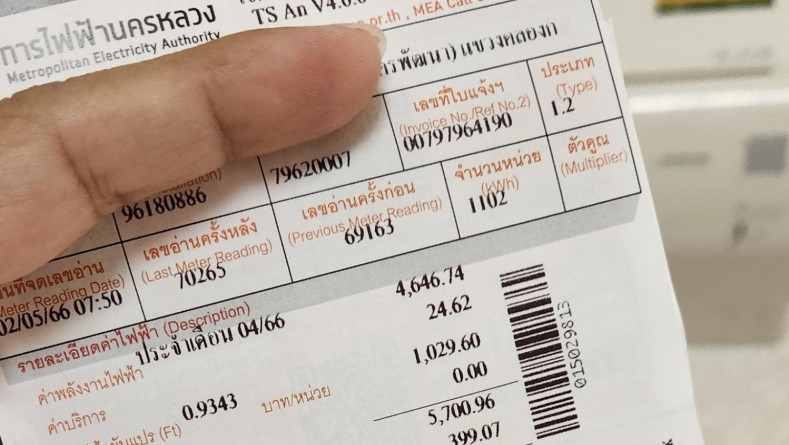
Part of the power tariff, which is now B4.15 a unit, is spent to support the renewable energy policy, a key factor keeping power bills high for households and businesses, according to the regulator.
“If the Cabinet or the National Energy Policy Council agree to consider adjusting the expense under this policy, we can reduce power bills immediately by B0.17 a unit,” said ERC Secretary-General Poonpat Leesombatpiboon, reports the Bangkok Post.
This means the current power tariff, which is used to calculate power bills, will fall to B3.89 a unit, he said.
Prime Minister Paetongtarn Shinawatra said earlier the government can keep electricity prices at less than B4 a unit to ease the financial burden on individuals.
Her father Thaksin Shinawatra, also considered the de facto leader of the ruling Pheu Thai Party, suggested lowering the rate to B3.70 a unit, a rate she said should be possible.
“We plan to propose the ERC’s B0.17 reduction measure to the prime minister,” said Mr Poonpat.
Whether the lower tariff rate will be applied from May to August this year depends on the process to adjust the expense of the renewable energy promotion, he said. The current power tariff rate applies until the end of April.
According to the ERC, Thailand is expected to consume 195 billion units this year.
“If we can reduce the power tariff by B0.17, we can save up to B33.2bn on power bills," said Mr Poonpat.
Government spending on the renewable energy promotion, which is known as the feed-in tariff and adder tariff, together with spending on other purposes under state policy, comprises 4% of the power tariff.
This policy expense refers to money spent for state policies, including the promotion of clean energy and support for the Energy Development Fund.
State electricity agencies agree to pay feed-in and adder tariffs when they sign power purchase agreements with power companies in the small power producer and very small power producer categories, with maximum generation capacity of 90 and 10 megawatts, respectively.
The tariffs force officials to buy electricity from these companies at prices much higher than power generation costs. The tariffs are meant to promote investment in renewable energy, but they also increase power bills.
Some 533 projects with a capacity of 3,940MW are granted the tariffs.
If the government approves the ERC’s measure, the tariffs granted to companies carrying out these projects will be adjusted, said Mr Poonpat.
The adjustment is needed because the companies’ financial status should surpass the break-even point, and many that operate solar farms pay less to buy solar panels as they have become cheaper, he said.
The government implemented the policy to promote renewable energy investment in 2004.