


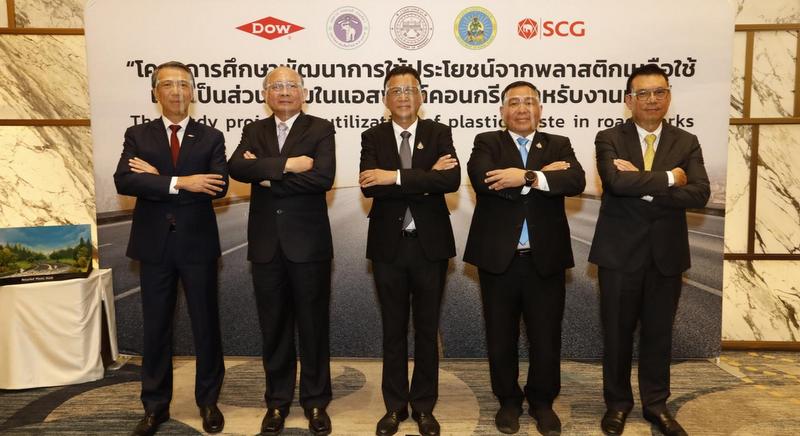
The partnership aims to set a new standard for state roads while achieving a goal to promote effective waste management and resource efficiency, in line with the Circular Economy principle and follow the government policy of BCG (Bio-Circular-Green Economy).
This partnership’s focus is to provide resources and support on the academic and managerial aspects of the project.
Based on their experience and know-how from the recycled plastic road project initiated in 2018, SCG and the Dow Thailand Group plan to further their research and development through laboratory-based experiments and on-site testing on private land such as RIL Industrial Estate in Rayong and Amata City in Chon Buri.
Chiang Mai University will also join the research study and focus on the production process’s academic and environmental impacts. At the same time, the Department of Highways and the Department of Rural Roads will provide support and consultation on the standardisation of plastic waste use as an ingredient in asphalt.
About 3 tonnes of plastic waste, equivalent to nearly 900,000 plastic bags, is estimated to be used for every 1 kilometre with a 6-metre road width. To date, through the partnership of SCG, the Dow Thailand Group, and other companies from the private sector, 23 tonnes of plastic waste have been used to construct a 7.7km prototype asphalt road.
Department of Highways director-general Sarawut Songsivilai said: “It will be an important starting point for the future of utilising waste plastic in construction and maintenance of the routes under the Department of Highways that will benefit the economy, society and the environment to achieve the aim of jointly developing the nation to create stability, prosperity and sustainability under the 20-year national strategy.”