


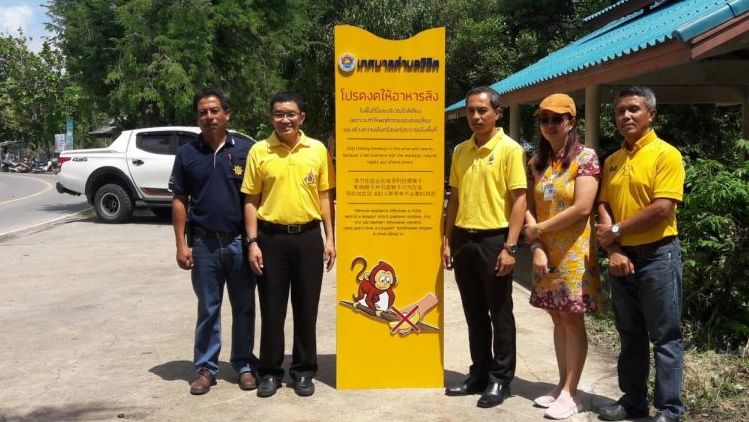
Pongchart Chouehorm, Chief of the Nature and Wildlife Education Centre at Khao Phra Thaew in Thalang, led a team to the canal on Thursday (June 27) to inspect the new signs, along with Chanwit Sudjadet, Director of Wichit’s Public Health and Environment Division, and local village head, Manas Samad.
Mr Pongchart told The Phuket News that there are currently seven key areas where the macaques and southern pig-tailed macaques are found in Phuket: Khao Rang Hill, Khao To Sae (Monkey Hill), Soi Thachean, King Kaew Soi 9, Koh Siray, Bang Rong Pier and Yamu Village.
The purpose of the signs being installed at Mudong canal is to prevent the area from becoming problematic like the other seven, according to Mr Pongchart. The advisory is displayed in four different languages: Thai, English, Chinese and Russian.
In November last year, the Department of National Parks, Conservation and Wildlife (DNP) issued a pamphlet for tourists warning of the dangers of interacting with local wild monkeys and advising on what rules to follow to protect the tourists and the monkeys. (See story here.)
The pamphlet warned tourists not to feed monkeys outside of designated areas, not to tease monkeys with food and not to aggravate them, with a specific warning to beware of aggressive monkeys that may bite.
The pamphlet also explained that serious diseases that can be contracted through contact with wild monkeys include herpes B, rabies, tuberculosis and hepatitis A and B.
Earlier in 2018, hundreds of monkeys were removed from areas where residents complained that they had become a nuisance and were presenting a health threat, with entire troupes moved to Koh Thanan and Koh Payu – both small islands off Pa Khlok – after being sterilised to control the population.
However, many of the monkeys were released back into the areas where they were living when residents approved for the wild troupes to stay.