



The report was presented to Phuket Governor Sophon Suwannarat and other high-ranking officials at the ‘Vision to Action’ sustainable future seminar held earlier this week.
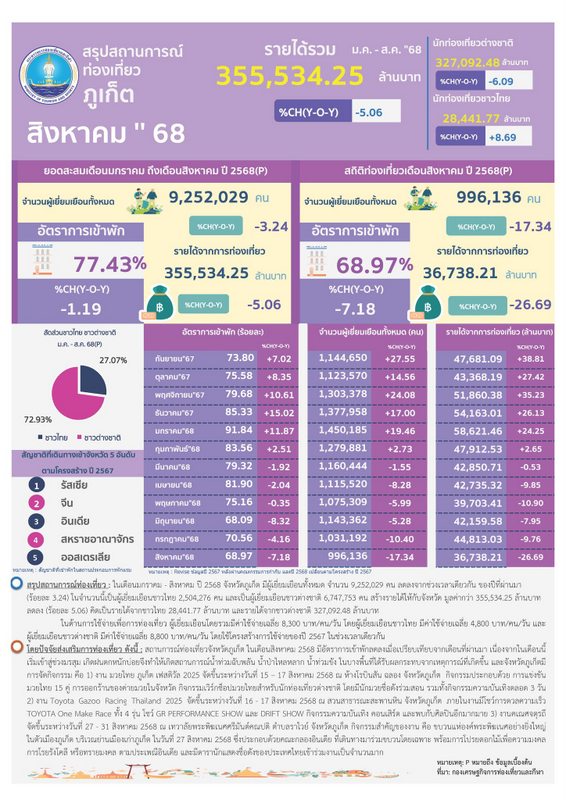
From January to August 2025, Phuket welcomed 9,252,029 visitors, down 3.24% year-on-year. Total tourism revenue for the period stood at B355.53 billion, a decline of 5.06%.
Hotel occupancy averaged 77.43% for the first eight months of the year, slightly down by 1.19% compared with the same period in 2024.
Foreign visitors continued to dominate Phuket’s market, generating B327.09bn in revenue (down 6.09% year-on-year), while domestic tourists contributed B28.44bn, an 8.69% increase.
The slowdown was most visible in August alone, when arrivals plunged to 996,136, a sharp 17.34% drop from August last year. Tourism income for the month fell to B36.74bn, down 26.69%.
Average hotel occupancy in August stood at 68.97%, down 7.18% year-on-year.
From January to August this year, the island welcomed 6,747,753 foreign visitors, compared with 2,504,276 Thai visitors. Foreign tourists generated B327.09bn in revenue, while domestic travellers contributed B28.44bn.
The top five international markets were Russia, China, India, the United Kingdom and Australia.
Officials reported that average hotel rates in August were B8,300 per night. Foreign guests spent an average of B8,800 per night, while domestic travellers spent around B4,800.
Key events credited with attracting more visitors included sports competitions, cultural festivals, and the Toyota One Make Race.
Despite the August dip, Phuket remains on track to welcome millions more visitors in the coming months as the island gears up for the year-end high season.
NATIONAL PERFORMANCE
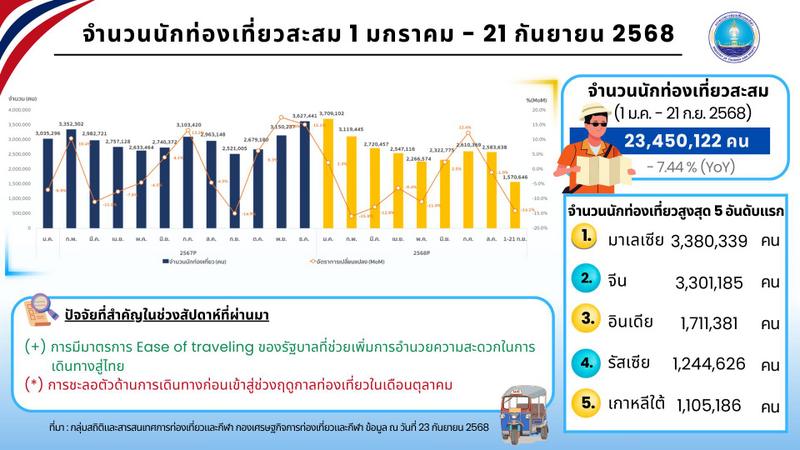
Thailand welcomed 23,450,122 international visitors from Jan 1 to Sept 21, 2025, down 7.44% compared with the same period last year, according to the latest data from the Ministry of Tourism and Sports.
The report shows that monthly arrivals fluctuated throughout the year, peaking at 3.71 million in January before easing during the traditional low season. August recorded 2.58mn visitors, followed by 1.57mn in the first three weeks of September.
Officials attributed the slowdown partly to a seasonal lull ahead of the October-March high season, despite government measures to make travel to Thailand more convenient.
Malaysia remained Thailand’s largest source of visitors, contributing 3,380,339 arrivals, followed closely by China with 3,301,185. Other key markets were India (1,711,381), Russia (1,244,626) and South Korea (1,105,186).
The ministry noted that while government ‘Ease of Traveling’ measures have helped attract visitors, travel momentum typically dips before the start of the high season in October. Tourism operators are expecting a strong rebound as cooler weather and year-end festivals draw more long-haul travellers in the coming months.