


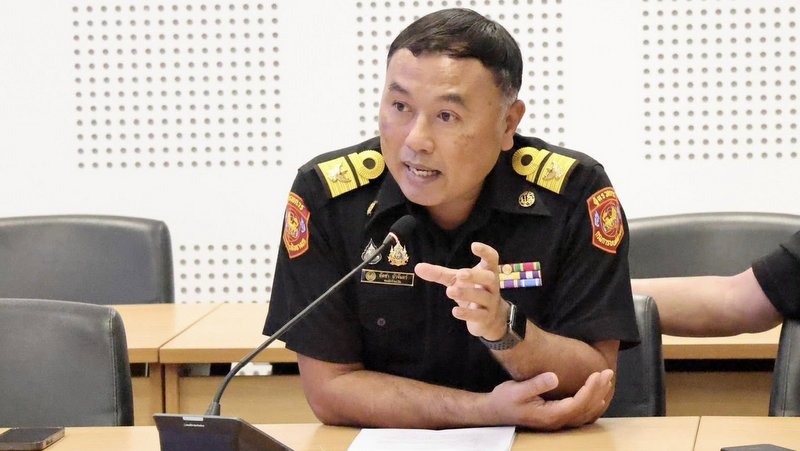
Phuket Land Transport Office (PLTO) Chief Adcha Buachan said on Monday (Apr 6) that the island’s metered taxi fleet has shown resilience amid volatility in global energy markets, largely due to its heavy reliance on electric and liquefied petroleum gas (LPG) vehicles.
According to PLTO data, Phuket has a total of 1,798 registered metered taxis. Of these, 742 are electric vehicles (EVs), while more than 979 run on LPG or LPG–gasoline hybrid systems. Only around 70 vehicles ‒ about 3.9% of the fleet ‒ depend solely on gasoline or diesel.
Mr Adcha noted that inspections carried out in key areas, including Phuket Town, Patong and Phuket International Airport, found no disruption to services. Taxis were operating as usual, with sufficient vehicles available to meet demand from both residents and tourists.
“Public transport services remain stable, and there are no shortages affecting travel across the island,” he said.
The assurance follows concerns raised on social media about the potential impact of rising oil prices, driven in part by tensions in the Middle East, on local transport services.
Officials emphasised that Phuket’s transition towards alternative energy sources has helped insulate the taxi sector from fuel price fluctuations, while also supporting environmentally friendly transport initiatives.
However, Mr Adcha’s comments were limited to registered metered taxis. He did not address the much larger number of independent taxi operators, who make up a significant portion of Phuket’s overall transport network and serve the majority of passengers.
Mr Adcha reiterated that Phuket’s transport system remains fully operational and capable of supporting the island’s tourism-driven economy, with agencies continuing to monitor the situation closely.
Meanwhile, at the national level, the Ministry of Energy is considering extending the current price freeze on LPG for a further two months, until May 31, in an effort to ease the burden on consumers during the ongoing energy price crisis.
The price cap, currently set at B423 per 15kg cylinder, was due to expire on Mar 31. The Energy Policy Administration Committee is expected to decide on the extension, after which the Fuel Fund Management Committee will determine subsidy allocations.
At present, the Oil Fuel Fund subsidises LPG prices by B1.17 per kilogram, keeping the retail price at about B25 per kilogram. Without the subsidy, prices could rise to around B26 per kilogram.
As of Mar 29, the fund had spent B37.3 billion on LPG subsidies from a total allocation of B50bn. The fund is currently running at a deficit of B42.1bn, including B37.3bn from the LPG account and 4.8 billion baht from the oil account.
Despite the financial strain on the fund, global LPG prices have remained relatively stable at around US$542.50 per tonne.
Officials said the continuation of subsidies would play a key role in maintaining stable transport costs, particularly for sectors such as taxis that rely heavily on LPG, helping to ensure continued service reliability for the public and tourists alike.