


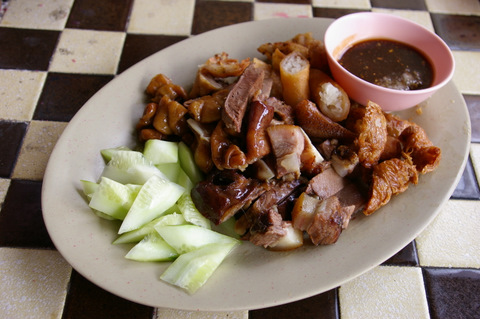
Despite having an ingredient list that will make most foreigners cringe, loba is a famous local snack in Phuket.
The main ingredients of this dish are all the parts of a pig you wouldn’t normally eat, including the head, ears, tongue and other innards.
Those parts are stewed with palo powder (a Chinese spice), then blanched in a dark soy sauce soup before being deep fried. The result is that it will be crispy on the outside, soft on the inside, and bursting with flavour.
Loba is originally a Hokkien Chinese food, but, like many other Chinese foods, has become firmly entrenched in Phuket cuisine.
The word ‘lo’ comes from palo (Chinese herb), while ‘ba’ is the Chinese word for pig. Combined, it translates as ‘deep fried pork gravy’.
Other local foods are often eaten alongside loba, including tao kua (deep fried tofu), tao kua jee (deep fried tofu stuffed with bean sprouts and shrimp), hae jee (fried flour with bean sprouts and shrimp), kien (pork with shrimp or crab and yam bean wrapped in tofu, steamed, then fried). These are the best options for those turned off by the idea of eating innards.
Each dish will then be served with fresh cucumber and sweet, sour and spicy sauce.
The price depends on what you select and how many pieces you order, but at between B5-10 a piece, a usual meal will come to around B100.
One old restaurant still serving up loba can be found opposite Chao Maeyanang shrine on Krabi Road, Phuket Town.
Manee Wongchatjen developed the restaurant’s original recipe about 20 years ago, but has since passed it to her daughter, Boonjit Wongchatjen, who now runs the shop.
The little restaurant opens every day from 8.30 am until mid-afternoon or when everything is sold out. It is closed on Buddhist holidays.
Loba is enjoyed daily by Phuket locals for brunch or lunch, and farang are always welcome to try it too.