


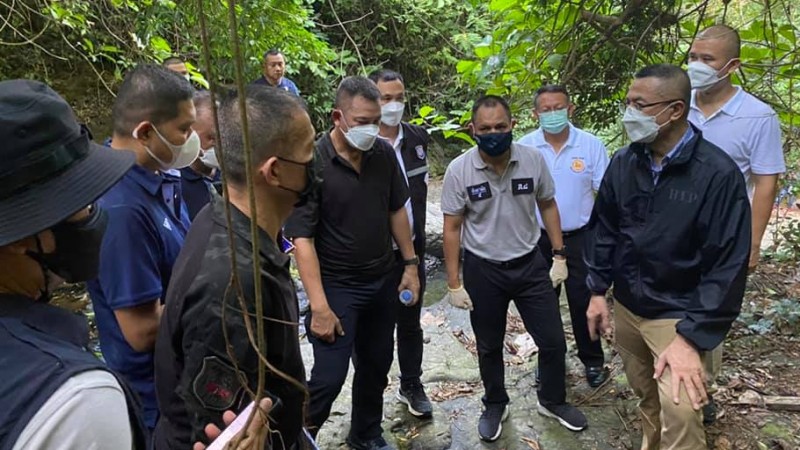
The murder of 57-year-old Swiss tourist Nicole Sauvain-Weisskopf shocked the international community, and every person on the island. An outpouring of outrage and anger vented online after news of her body being found broke on Thursday afternoon. Yet 48 hours later officers had their killer in custody, now identified as Thai national Teerawat Thothip, 27, from Pa Khlok, on Phuket’s east coast.
The difference between how this investigation was handled and that of the Koh Tao murders of British tourists Hannah Witheridge and David Miller in 2014 is immense. The message from the top was clear, and this time it was not just words. Senior, experienced police investigators were immediately dispatched to the island to take command of the investigation and ensuing manhunt. The task was not left to local police until it was clear that the task was beyond their capabilities.
Some comments online claimed that the level of importance given to hunting Ms Sauvain-Weisskopf’s killer was only out of respect of her position as Deputy Chief of Protocol at the Federal Assembly of Switzerland. Other comments claimed that the response was only out of fear of the repercussions her death would have on any potential tourists thinking of coming to Thailand under the Phuket Sandbox scheme.
The Phuket News respectfully disagrees. Both are clear factors, but any person making those claims has been obviously unaware of how deeply Ms Sauvain-Weisskopf’s death affected the Phuket community. In general, it was perceived as an attack on local people’s sensibilities and was branded for exactly what it was, a crime against life. Bhummikitti Ruktaengam, President of Phuket Tourist Association, in expressing his condolences to Ms Sauvain-Weisskopf’s loved ones was exemplary in his choice of words: “We will not tolerate any incidents like this.”
For all their issues and shortfalls, and there are many, Phuket police over the years have a good track record in bringing perpetrators of heinous crimes on the island to justice. To be fair, though, Teerawat’s chances of escaping were not good. He was on an island that is essentially under lockdown, where police track down even petty criminals through CCTV and arrest them at their homes. Worse for Teerawat, his registered address is in Pa Khlok, indicating that his where his family call home. Anyone familiar with Pa Khlok will know, his chances of hiding in that community were small, never mind when an entire island is looking for him.
National newspapers have called the level of safety for tourists in the country “shameful” and a “disgrace”. Many foreigners living in Phuket could easily argue that it is much safer here than some places in their home countries. Regardless, Tourism Minister Phiphat Ratchakitprakarn this week to his credit openly admitted that much more needed to be done to improve safety, with Thailand ranking 110th out of 150 countries in an international survey last year, though it would easily be believed that such surveys included Thailand’s most dangerous aspect, its roads. Even then, in Phuket historically it has been far more dangerous for a tourist to get caught in a rip current off Phuket’s west coast during the southwest monsoon than being killed in a traffic accident. That horrific statistic belongs predominantly to Thais.
Regarding the hunting of criminals wanting for taking the life of another person, what is shameful is how the same level of endeavour in bringing perpetrators to justice is not applied in other cases that have embarrassed the country.