


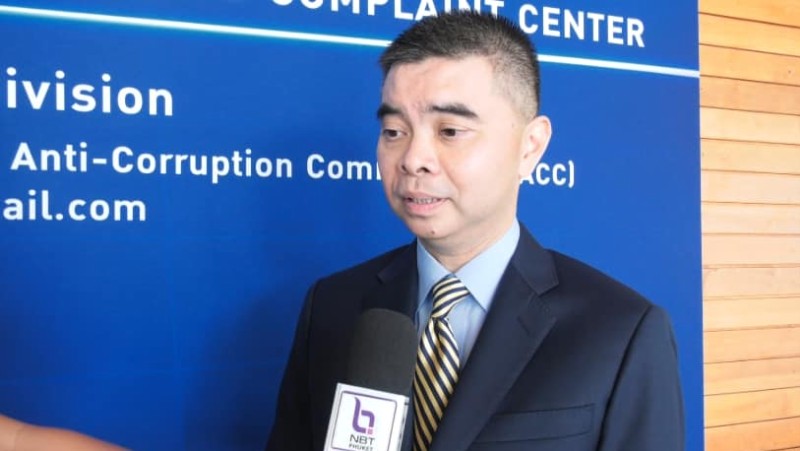
The meeting, held at the Wyndham Grand Phuket Kalim Bay north of Patong on Thursday (Sept 24) to launch the “Complaint Center for Foreign Investors”, with a special lecture on the topic “Roles and missions of the Office of the PACC for foreign investors”, aimed to inspire confidence that Phuket, and Thailand, was a safe place to invest their money.
Present to hear the message were foreign investors and representatives from the private sector doing business in Phuket as well as representatives of foreign consulates in Phuket, including those representing Estonia, France, Germany, the Republic of Korea Switzerland and the UK.
Also called to be present for the occasion were representatives of the relevant government agencies in the area, including provincial officials and officers from the Provincial Commercial Office, Customs, Immigration, the Provincial Ombudsman’s Office, the Provincial Office of the Ministry of Justice as well as local police and municipal officials.
At least the right people were in the room, though perhaps the message to remind people that complaints against corruption could be filed was for the latter, not the former.
Surely foreign consuls and foreigners doing business in Phuket are aware that complaints against corruption can be filed, foreigners just don’t. There are many good reasons for this, first and foremost is that it is pointless, and second doing so only exposes the person filing the complaint to retribution by the very people the complaint is being filed against. When the allegedly corrupt person is a uniform-wearing official, it would be safer to just deal with the problem yourself.
The move to try to instill some confidence among foreigners to bring their money to Thailand comes as the Immigration Bureau tries to balance its two faces of policing foreigners in the country with providing a fees-based service to people wanting to stay in the country. This they have not achieved well.
A sharp warning earlier this week spelled out that any foreigners who have not reported themselves to extend their stay by the end of the visa amnesty yesterday would see them face a daily fine B500 overstay for each day they remain unreported comes after months of making it clear that tourists will be welcome to stay – but not one word of any support for foreigners who have invested in setting up a business in Thailand has arrived. Every foreigner who has set up a business in Phuket and who is now suffering due to the COVID-19 economic meltdown now finds themselves unable to satisfy the Immigration Bureau’s requirements in order for such foreigners to stay. These foreigners, exactly the same type of people Mr Bhumivisan is hoping to lure to Thailand, are facing dire, uncertain futures at the hands of immigration regulations.
To paint a picture of how trustworthy this situation is, by wonderful coincidence former Immigration Bureau chief Surachate Hakparn this week filed his legal plaint against the prime minister for illegally having him removed from his post and transferred to an inactive post at the Prime Minister’s Office.
How are these connected? Simple, Pol Maj Gen Surachate was transferred hot on the heels of him ordering immigration officers to no longer accept “tips” from foreigners at airports to facilitate their entry to the country.
The practice of immigration officers “accepting tips” from international tourists in order to “fast track” their processing at airports started gaining speed in 2013, as the Chinese hordes started to flock to Thailand. The practice hit its peak by 2017-18, when at Phuket airport it was finally admitted that officers were accepting “tips” of B200 cash “per person”. The payments were accepted “in baht or yuan” – as if any other nationalities than Chinese nationals happen to be carrying yuan when they landed in Thailand.
To put that in perspective, Airports of Thailand themselves estimated that more than 60,760 passengers a day passed through Phuket International Airport over the New Year period for 2017-18, arriving on some 360 flights a day at the airport.
Now factor in that this was standard practice at each airport in the country, and carried out throughout the whole year.
In October 2018, Mr Surachate put an end to this income stream, then he was shunted to the Prime Minister’s Office. No official reason was given, but considering the immediate history, it was not a surprise to anyone. The Immigration Bureau had built a multi-billion-baht money-making machine with no reason to explain to anyone exactly how much money had been made or where that money went.
The PACC launched no investigation into this, and now the PACC wants people to believe that complaints against corruption will be treated seriously. Seriously, foreigners already know that complaints against corruption in Thailand are nothing more than a political weapon – nothing more. Recent headlines prove that to be still true.
Mr Bhumivisan wants to help improve Thailand’s general “corruption perception index” ranking. Well, the problem is that the general “perception” is that any problem can be “fixed” for a price, unless the problem becomes political.
As always, what is needed is a culture shift from the ground up and the formalisation of any extra revenue streams for any officials – and the public publishing of officials assets at each so-called “transfer” so people can see how much money was made during the officers last posting.
Most people anywhere do not trust politicians, but in Thailand the truth is that most people do not trust officials, including Thais. Of course there are good people working for the government, the problem is that to protect yourself from exploitation you have err on the side of caution, and very few of the honest officials climb the ranks to any position of authority because they simply are not corrupt enough to afford their next promotion. Corruption tends to win at every turn.
With that, we wish Mr Bhumivisan the very best of luck in convincing anyone that corruption is being taken seriously in Thailand.