


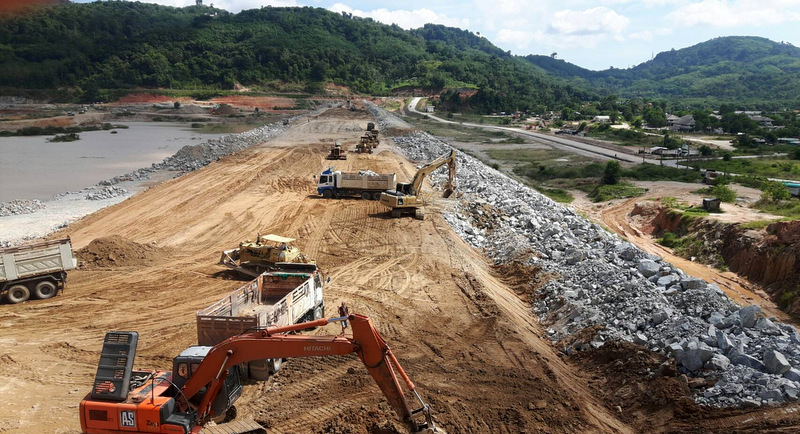
Also locally called the “Chalong Dam”, the B480-million project is located near Srisupharam temple among the foothills at the end of Chao Fa West Rd Soi 69 and funded by the Royal Irrigation Department (RID).
The reservoir will be used to supply tap water to homes in Chalong, Rawai, Kata and Karon, and Pichet Pakkasat, Director of the RID’s Construction Division’s regional office, confirmed to The Phuket News this week.
“It will take not more than one year to fill up the reservoir and use it to begin supplying water,” Mr Pichet confirmed.
“Currently, it is 87% complete.”
The reservoir is up to 927 metres long and in parts up to 23m deep, with a maximum water storage capacity of 4.3 million cubic metres, Mr Pichet explained.
When ready for use, the reservoir water will be treated by the Phuket Provincial Waterworks Authority (PPWA), which supplies and distributes 70% of water in Phuket, he added.
“Water to be distributed will be treated by filtration installed alongside the reservoir and managed by the PPWA, and then the water will be distributed from there to the target areas, by PPWA pipelines,” Mr Pichet said.
“The filtration system is already installed at the same site, right beside the reservoir.”
In case of any danger of water levels breaching the dam wall, overflow will be drained into an emergency spillway and reserve, which will store a further 200,000 cubic metres of water.
“The highest water capacity is 4.5 million cubic metres with emergency storage,” Mr Pichet explained.
The Chalong Dam capacity is nearly 3 million cubic metres less than that of Bang Wad Dam, Phuket’s main reservoir supplying tap water, which holds about 7.3 million cubic metres.
“Comparably, it will supply less water than the other dams in Phuket. It is expected to supply only about 14,000 to 15,000 cubic metres of water per day, as it is the smallest of the reservoirs,” the PPWA Chief Pisak Choyalut told The Phuket News.
Nonetheless, the reservoir is expected to greatly alleviate the ongoing problem of water-supply outages for “about 100,000” people in the Chalong, Rawai and Kata-Karon areas, said Mr Pisak.
“We have finished setting up the water-treatment facility. It is now only a matter of waiting for the Royal Irrigation Department to complete the drilling process to connect the water supply,” he said.
“Once that is done, the long problem of water shortages in these areas will finally be improved.”
Although actual construction of the reservoir has been ongoing since 2010, talks of building it had begun around 2003 in a bid to resolve major issues of water shortages.
Initially intended to open in 2015, several architectural, logistical and financial setbacks arose, prolonging the project into a nearly 15-year-long endeavour.
“There were many delays over the years. The three main ones were that firstly, the design of the dam was flawed – it did not work practically and had to be redesigned,” explained Mr Pichet.
“Secondly, some of the required equipment was lacking or inadequate – and, finally, the budget itself was insufficient. The whole budget for the project was miscalculated and had to be increased,” he added.
The deadline was moved many times, most recently to April 20 of this year, but reported floods due to rain became another obstacle to completion.
Phuket Irrigation Department’s Head of Engineering, Narong Natevongsa, told The Phuket News, “Klong Katha Dam was not finished on this deadline because of some problems in the construction process. As Klong Katha Dam is in a residential area, it is not easy to carry on with construction when excavating the rock.
“The rainy reason also makes this more difficult and delays it further,” he added.