


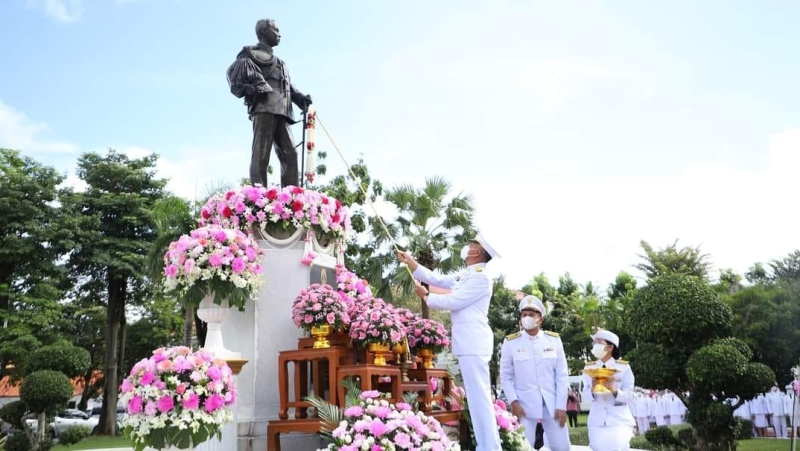
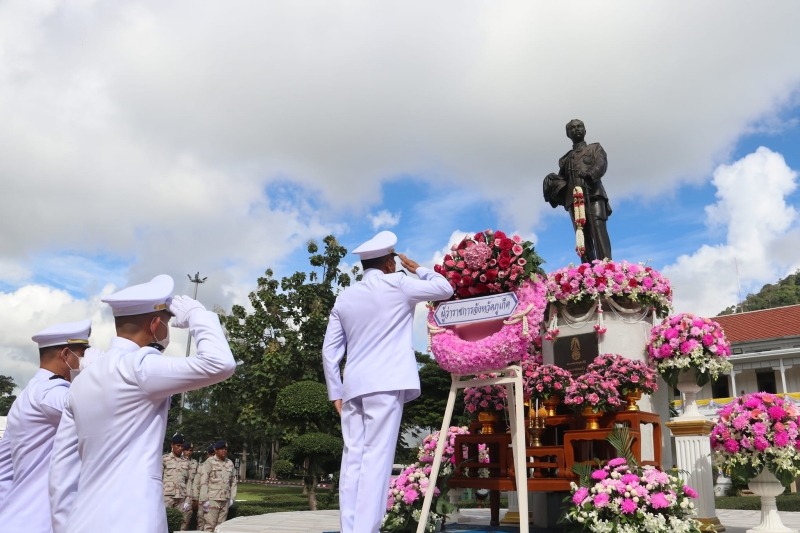
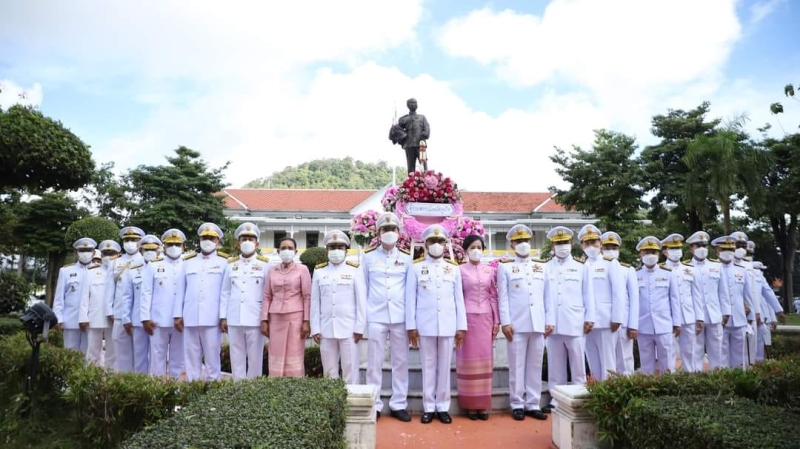
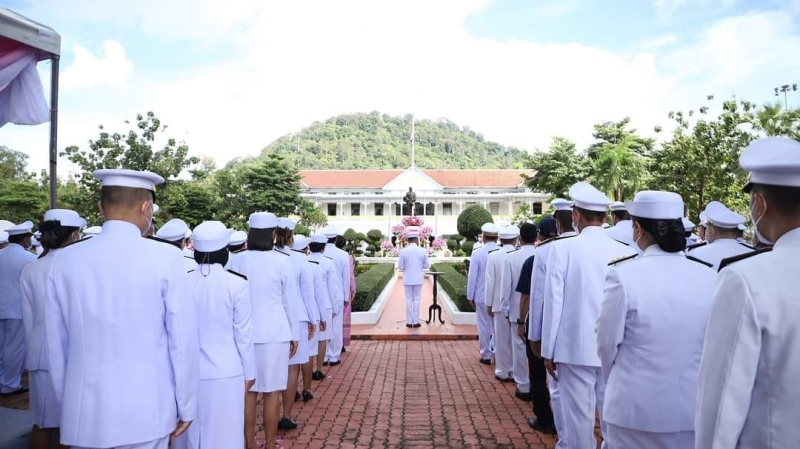
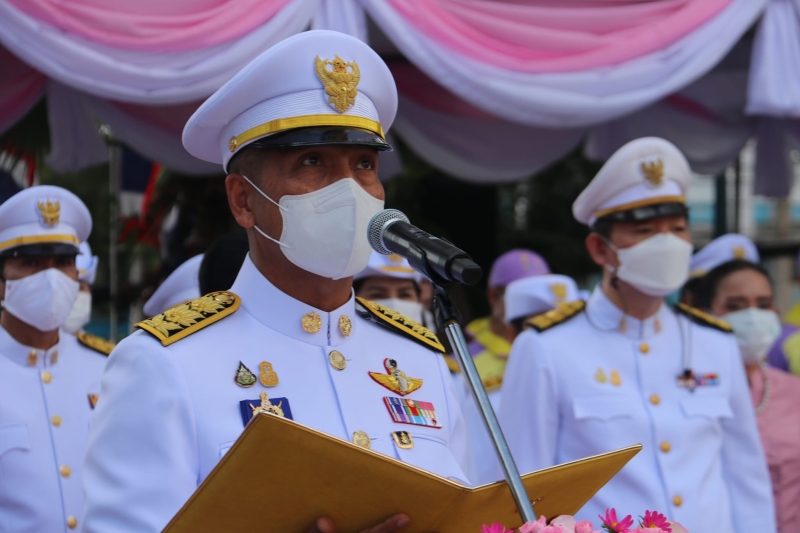
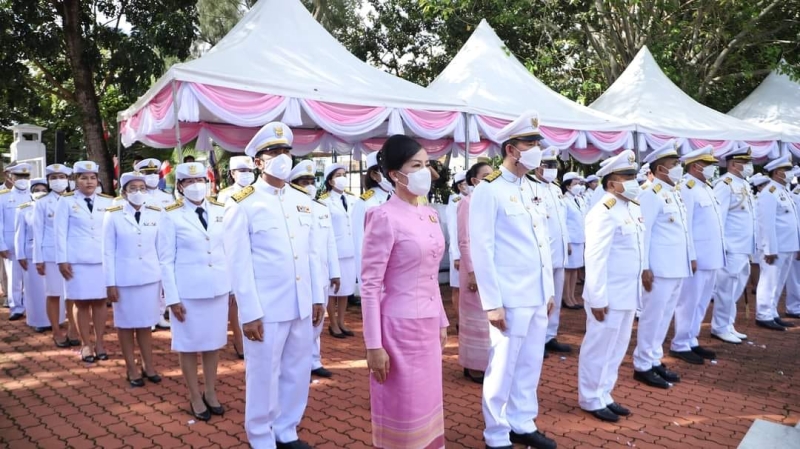
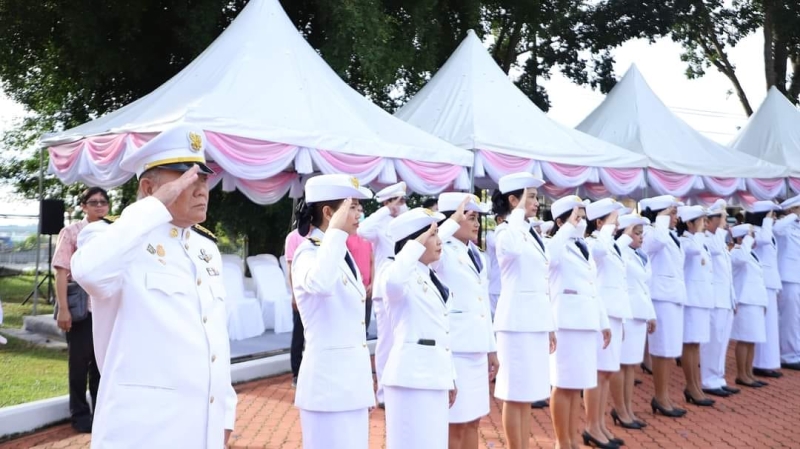
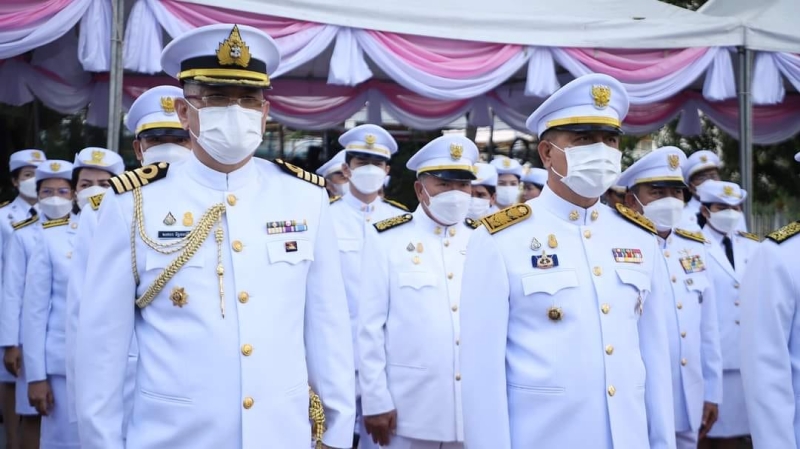
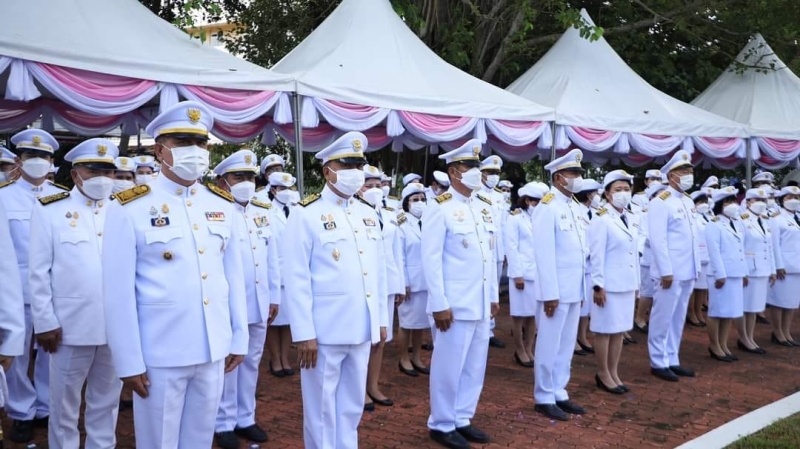
Phuket Governor Sophon Suwannarat, joined by his wife Mrs Busadee, led senior government officials, leading community representatives and members of the public at an event held at the King Chulalongkorn statue in front of the old Provincial Hall.
The wreath-laying ceremony held at the statue allowed those present “to pay their respects and pay tribute to King Chulalongkorn to show loyalty and bow in remembrance of His Majesty’s grace”, said an official report of the occasion.
Governor Sophon addressed the assembly present: “His Majesty King Chulalongkorn, King Rama V, is a monarch who performed his royal duties, small and large, with great skill, continuing the development of Thailand to progress in every aspect… in government government administration, education, public health, as well as various public facilities which have enabled Thailand to progress and maintain its independence,” he said.
“The Thai people have humbly offered the royal title ‘Phra Piya Maharaj’, which means ‘the great king who is loved by all the people’. And the government has designated October 23 of every year as ‘Piya Maharat Day’ to jointly remember His Majesty’s infinite kindness,” he added.
“King Chulalongkorn (Rama V) is renowned as the monarch who established the abolition of slavery in Thailand when he ascended the throne because he did not want there to be oppression and disrespect among the Thai people,” Governor Sophon continued.
King Chulalongkorn achieved the abolition of slavery in Thailand through several Acts issued over decades, beginning with the abolition that children those born into slavery since 1868 be free upon reaching 21 years of age.
“He saw that slavery was obsolete, not suitable for developed countries. Therefore, the Act on the Abolition of Slavery was issued, called the "Slavery Act R.S. 124" (1905) to abolish the issue of slave children,” Governor Sophon said.
Section 269 of the 1908 penal code explicitly criminalised slavery, with several exceptions still being phased out under previous Acts issued. Slavery finally became fully illegal in 1915.
King Chulalongkorn is also revered for reforming public administration regulations, bringing much of the Thai government and its administration in line with Western models by using ministries, Governor Sophon reminded the assembly.
“He improved the duties of many different departments and combined them into ministries. Each ministry has one main duty… For orderliness in education, His Majesty ordered the establishment of a royal school in the Grand Palace. He also had the royal family and government officials send their children to study in the judiciary.
“He established the Ministry of Justice to bring together the various courts under the same ministry; the Ministry of Transport to expand the Bamrung Mueang Road, the newly built Yaowarat Road, Ratchadamnoen Klang Road, Ratchadamnoen Nok Road, Burapha Road, and so on,” Governor Sophon added.
“Moreover, in the area of health, many hospitals were established, such as Siriraj Hospital.. In terms of foreign affairs, His Majesty travelled to many foreign countries to see the models of government and brought them to be modified and used in our country,” Governor Sophon said.
“In terms of religion, His Majesty was truly a patron of Buddhism, and in literature he was a novelist, skilled in both prose and poetry,” Governor Nophon noted.
King Chulalongkorn is also renowned for the abolition of the practice of lower-class citizens being required to prostrate themselves before high-ranking dignitaries.
The abolition of prostration was decreed through a proclamation the Royal Siamese Government Gazette in 1873/
“The practice of prostration in Siam is severely oppressive. The subordinates have been forced to prostrate in order to elevate the dignity of the phu yai. I do not see how the practice of prostration will render any benefit to Siam. The subordinates find the performance of prostration a harsh physical practice. They have to go down on their knees for a long time until their business with the phu yai ends. They will then be allowed to stand up and retreat. This kind of practice is the source of oppression. Therefore, I want to abolish it,” King Chulalongkorn declared in the proclamation.
“From now on, Siamese are permitted to stand up before the dignitaries. To display an act of respect, the Siamese may take a bow instead. Taking a bow will be regarded as a new form of paying respect,” King Chulalongkorn declared.
King Chulalongkorn is well known for his 92 consorts during his lifetime, who produced 76 surviving children.
One of his favourite residences, Vimanmek Mansion, also called the ‘Teak Palace’, in Bangkok, remains one the capital’s most popular attractions for tourists.