


Thaneth Tantipiriyakij, President of the Phuket Tourist Association, said the incident highlighted both the island’s strengths in crisis response and its vulnerabilities as one of Thailand’s busiest tourism hubs.
“Actually, I see this issue as having two or three overlapping points,” he said.
“Firstly, we must acknowledge that when the problem arose, Phuket’s response was commendable. All sectors reacted very quickly, from the governor and the airport authority to the air traffic control, both government and private. Everyone prioritised the issue, especially its impact on tourism. This kind of response is rarely seen elsewhere, but it was very evident in Phuket.”
He also praised the use of direct communication with the public.
“Another thing I admire is the use of SMS. As soon as the airport reopened, everyone received the message immediately. This is incredibly powerful; there was no need to rely on confusing social media updates. I hope this system will be continued in the future, even for minor incidents like traffic jams.”
However, Mr Thaneth said the disruption exposed deeper structural concerns.
“This sent a clear message to the government: Phuket has a very high volume of flights today. Just the runway closure for half a day resulted in the loss of approximately 150-160 flights, a much larger number than people could imagine,” he said.
“Normally, Phuket has around 300 flights a day. Therefore, when this incident occurred, it had a wide-ranging impact on people already in Phuket, those on their way to Phuket, those stranded in the air, and those with connecting flights, both domestic and international. The damage is very difficult to assess.”
He warned that reliance on a single runway leaves Phuket exposed when incidents occur.
“I see this as a wake-up call to the government, urging them to review Phuket’s infrastructure. The airport is the first ‘reception point’ for tourists, but we only have one runway. When a problem occurs, it takes seven to eight hours to resolve, which shouldn’t be that long if we had better equipment.”
While noting that all passengers were safe ‒ reinforcing confidence in aviation safety standards ‒ Mr Thaneth said long-term solutions would be difficult.
“Building a second runway is very difficult due to space limitations. Ideally, runways should be spaced approximately five kilometres apart, which is very challenging in Phuket. Therefore, the solution may not be to add a runway, but rather to increase the equipment and resources to resolve problems more quickly.”
On accountability, he said responsibility would depend on the outcome of the investigation.
“They need to investigate the details to determine the cause ‒ whether it was the airline, the pilots, or another agency. This is a technical matter that needs further investigation,” he said.
“But from our perspective, what’s clear is that when an incident occurs on a single runway and isn’t cleared quickly enough, the damage manifests itself in this way.”
ALL STOP
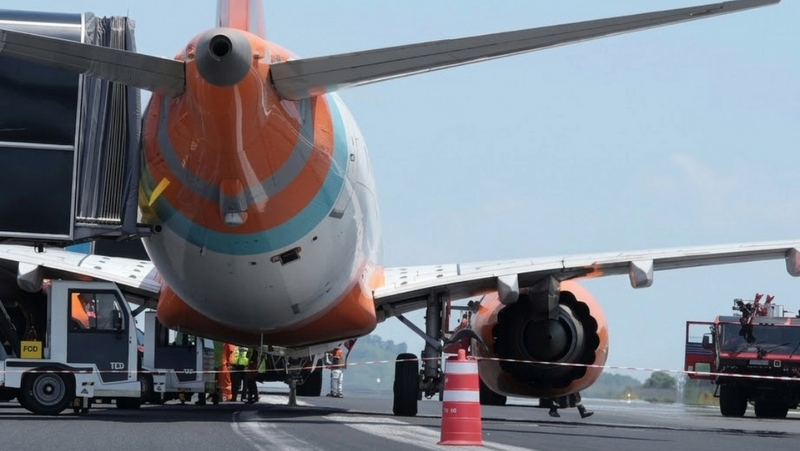
The aircraft, a Boeing 737-800 operating flight IX938 from Rajiv Gandhi International Airport in Hyderabad to Phuket, made a hard landing on Phuket Airport’s sole runway at about 11:29am on Mar 11.
The aircraft, registered VT-BWQ, suffered damage to its nose landing gear during the landing. Both front wheels detached, causing the nose gear assembly to scrape along the runway surface before the aircraft came to a halt.
Somehow, the aircraft remained upright while its front landing-gear strut ploughed down the runway, sending smoke and tarmac debris flying in its wake. Despite the extreme landing, all passengers and crew were safely evacuated and no serious injuries were reported.
Airport firefighters and rescue crews reached the aircraft within two minutes of the incident in accordance with the airport’s emergency response plan. Buses were dispatched to the runway to evacuate the 140 passengers and crew members from the aircraft and transport them safely to the passenger terminal. Medical teams and immigration officials were also deployed to assist passengers.
The damaged aircraft blocked Phuket’s only runway, forcing authorities to temporarily shut down operations.Airport officials issued a Notice to Airmen closing the runway from 12:08pm to 6pm, but the closure was later extended to 9pm as teams struggled to move the aircraft.
Engineers eventually decided against using cranes and instead lifted the aircraft’s nose with jacks while inflating the nose-gear system with compressed air. Emergency equipment was used to support the aircraft while replacement wheels were fitted one side at a time.
The operation took several hours before the aircraft could finally be towed off the runway at 6:47pm. After maintenance crews inspected and cleaned the runway surface, the airport reopened the runway at 7:08pm.
Airport officials said the closure disrupted 165 flights across Thailand. The affected flights included 97 at Phuket, 40 at Don Mueang International Airport, 22 at Suvarnabhumi Airport and six at Chiang Mai International Airport.
Phuket Airport General Manager Monchai Tanode confirmed that around 18,000 passengers were affected by delays, cancellations or diversions to other airports.
Airport staff coordinated with airlines, immigration officers and other agencies to assist stranded travellers, providing waiting areas and water while airlines arranged onward travel.
Officials that The Phuket News spoke to declined to comment on financial liability for passenger compensation, airline disruptions or potential runway repairs, saying those matters fall under the responsibility of airlines or airport operators rather than the investigation authority.
INVESTIGATION
The aircraft remains parked at Phuket International Airport under the airline’s control as investigators continue working to determine the cause of the incident.
The ‘hard landing’ has been classified as a “serious aviation occurrence” and is now under formal investigation by the Aircraft Accident and Incident Investigation Committee, operating through the Office of the Aircraft Accident and Incident Investigation Committee under Thailand’s Ministry of Transport.
Officials said the investigation is being conducted in accordance with standards set by the International Civil Aviation Organization (ICAO).
Investigators have already gathered information about the aircraft and its maintenance history. However, authorities said the analysis phase is still underway and no conclusions about the cause of the hard landing have yet been reached.
“The investigation process is currently gathering and analysing data, so it is not yet possible to determine the cause of the incident,” an official from the investigation office said.
Under international aviation rules, investigators must submit a preliminary report within 30 days of the incident, while a final report may take up to 12 months to complete.
Officials declined to provide further details while the investigation continues.