


Concerns spiked after the Chinese government banned all outbound travel from Wuhan, including flights, on Jan 23.
Phuket Tourist Association President Bhummikitti Ruktaengam told The Phuket News that the travel ban and fears of the virus spreading will certainly affect Phuket tourism, but declined to give any estimates on how deep the impact will be.
Instead, he said that there was not enough information to give any predictions at this stage.
“The impact of the health emergency is spreading and will affect the number of tourists and the island’s economy, because China is a major tourist source market for Phuket, but I just don’t know big the impact on the Phuket economy will be.
“I cannot estimate the value of the harm done – and I don’t want to estimate the impact for now,” he said on Tuesday (Jan 27).
“Today, I just sent a letter to hotels, resorts, tour operators, entertainment businesses and other operators in the tourism industry asking for updates on the number of cancelled bookings. Then we can estimate the number of cancellations,” he added.
“For now, we are just focusing on outbreak prevention and identifying any persons suspected of being infected so we can quickly report them to health officials.
“We need this Wuhan virus to be controlled, and we need to prevent it from spreading to Phuket. That is our priority right now,” Mr Bhummikitti said.
Bhuritt Maswongssa, General Manager of the Patong Resort Hotel and a key member of the Tourism Development Committee of South Andaman Tourism Development Area under the Ministry of Tourism and Sports, also dodged any estimates of the potential fallout of the outbreak on the island’s crucial tourism industry.
“Right now, it’s still not possible to draw any conclusions about the tourism situation in Phuket. We probably have to wait a couple of weeks for clarity on the situation. We will be able to have a clearer picture by then,” he told The Phuket News.
Mr Bhuritt said there was very little that Phuket operators could do about the situation at this stage.
“There is no need to even consider what policy options to take as we do not know what direction the virus will spread, but at least they [sic] are concerned about preventing the virus from spreading,” he added.
Both Mr Bhuritt and Mr Bhummikitti declined to elaborate on the current occupancy figures for hotels across the island in light of the Chinese New Year holidays, which began last Saturday (Jan 25).
Tourism Authority of Thailand (TAT) Phuket Office Director Kanokkittika Kritwutikon earlier this month said that the Chinese New Year holidays from Jan 25 to Feb 1 were expected to see more than 430,000 tourists visit Phuket and generate an estimated B15.825 billion for the local economy.
However, as of Tuesday Ms Kanokkittika had yet to respond to requests for comments about any revised outlook in light of the virus outbreak.
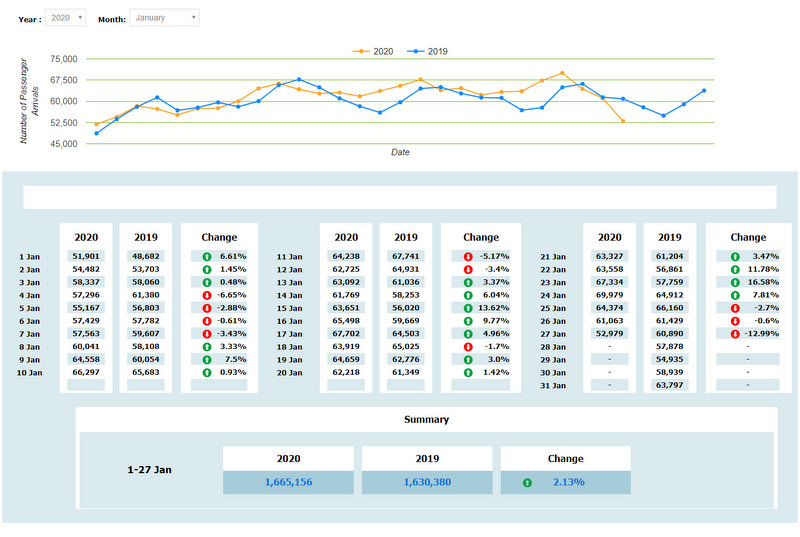
The TAT Intelligence Centre on Tuesday morning (Jan 28) reported a 10.98% increase in the number of tourist arrivals at Phuket International Airport so far for January year on year. However, that figure fell to an increase of just 2.13% by Tuesday afternoon after a plunge of more than 12% for Jan 27 was factored in, marking what might be the beginning of a huge downward trend.
Nationwide, the outbreak is expected to shaving economic growth by 0.5-0.7 percentage points this year.
In a meeting with the private sector on Tuesday, the Tourism Authority of Thailand (TAT) was seeking to devise a plan for the domestic market. Some operators are urging the government to order all state agencies to spend their budget to conduct countrywide meetings so that attendees fill hotels and provide assistance to the hospitality sector.
Supawan Tanomkieatipume, president of the Thai Hotels Association (THA), said that before the outbreak Thailand’s hotels averaged 50% occupancy. Of this, the share of Chinese guests was as high as 50% as the peak season for this market got under way, reported the Bangkok Post. (See story here.)
The THA expects advance bookings for February to plunge 30% as the health emergency’s impact spreads to independent travellers and incentive groups.
“The impact was felt across the country, as Chinese guests are the main source market for most hotels,” Ms Supawan said. “Usually the occupancy in February would be strengthened by incentive groups, but this market is uncertain too.”
She said the outbreak will stir up psychological effects for travellers who will not be confident about venturing beyond their hometowns. The THA expects the setback to last at least three months.
A source from the Thailand Convention and Exhibition Bureau said the agency is still waiting for confirmation from three incentive groups from China totalling 5,500 travellers who may cancel trips.
Vichit Prakobgosol, president of the Association of Thai Travel Agents (Atta), said that from Feb 5 onwards independent travellers will stop coming to Thailand, even though the Chinese government has not interfered with their decision.
“The Chinese are worried about the epidemic and in general they adhere to authorities’ directions strictly,” he said. “As sales activities have been halted since last week, bookings via agents stopped too.”
Atta vice-president Surawat Akaraworamat said independent travellers are affected by inconvenient transport: at least 10 cities in China are closed down and people cannot afford to find public buses to carry them to or from the airport.