


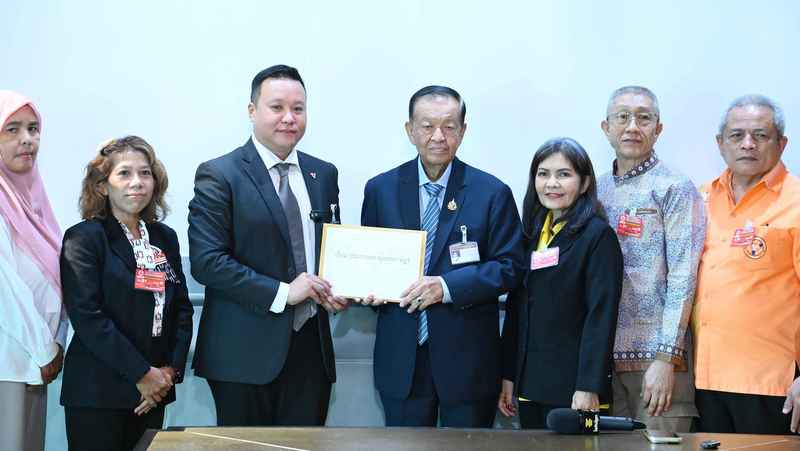
A formal “letter of initiation” for the creation of the Phuket Metropolis Act, was presented to Wan Noor on Aug 13 with the aim of decentralising administrative power, improving local governance and addressing persistent inequalities in tax and budget allocation within the province.
It is also hoped to be an avenue for Phuket to directly address critical issues facing the island, including traffic and construction.
The draft law was presented to Wan Noor by Phuket MP Somchart Techathaworncharoen and Chiang Mai MP Somdul Utcharoen, both from the People’s Party, along with Warunee Sakolrattanathara, representing local Phuket citizens, and Adisak Aksinthawangkun, Chairman of the Phuket City Community Organisation Network.
Ms Warunee explained that Phuket, despite being one of the country’s top revenue generators, suffers from tax and budget inequalities. Funds returned to the province do not meet local needs, she said, and residents have little say in shaping development priorities.
“We hope this draft will ensure Phuket’s resources benefit its people and become a model for other provinces,” Ms Warunee said.
Mr Adisak said on the day of submission that decades of a rapid increase in tourism have left Phuket struggling with a slew of critical issues, including traffic, solid waste disposal, untreated wastewater being dumped into Phuket canals and coastal waters, and crime.
“The draft represents a new hope to improve quality of life and make Phuket a livable destination for both residents and visitors,” Mr Adisak said.
DENIED
However, Wan Noor’s official reply, dated Aug 28, refused the draft law proposal on the grounds that it violated the Constitution.
Wan Noor pointed out that any proposals for new legislation must follow Chapters 3 and 5 of the Constitution. Failing to do so constitutes a violation of Chapter 6 of the Constitution.
MP Somchart explained that the Constitution provides two main ways for laws to be introduced. MPs can submit a draft law proposal, while the general public can submit a petition signed by at least 10,000 Thai nationals to have a proposed law put before Parliament.
However, he noted, “Under the Constitution, the general law on citizen proposals cannot be applied to changes in the state power structure.
“While Members of Parliament, as legislators, are allowed to propose such laws, the same does not apply to the public. Under the Constitution, if a draft law submitted by citizens affects the state’s power structure, it is considered inconsistent with the intent of the Constitution,” he said.
“Of note, it can be applied to other laws that do not touch the state power structure, such as the Alcohol Act, Marriage Equality Act, or laws related to the basic rights and liberties of citizens, such as the Ethnicity Act,” he added.
“Because this draft bill proposes to change the actual administration system for Phuket, it requires at least 20 MPs to sign a ‘letter of initiation’ that must be presented to the House Speaker,” MP Somchart continued.
“These are the requirements to amend laws affecting the form of government under Chapters 3 and 5 of the Constitution,” he said.
While Wan Noor cited the Constitution for refusing to accept the proposal, MP Somchart argued that the proposal is consistent with Sections 249-254 of the Constitution, which commit the state to decentralisation and local self-governance.
“Current laws fall short of this principle, leaving provinces like Phuket without the flexibility or independence needed to solve local problems,” he said.
“The existing system of regional administration is outdated. Phuket needs an administrative structure that matches its potential and addresses its people’s needs,” he added.
PRECEDENTS
House Speaker Wan Noor declined to answer questions from The Phuket News on the difference between Phuket gaining its autonomy and Pattaya, which already has long had special status under the law with greater autonomy in managing its own affairs.
House Speaker Wan Noor would only repeat which sections of the Constitution were relevant, saying that the draft law proposal violated the Constitution.
Of note, back in 2012, Patong residents and local leaders also raised the issue of making Patong a special administrative city like Pattaya, instead of giving autonomy to the whole province.
The issue was raised by Pian Keesin, Patong Mayor at that time, along with Weerawit Krueasombat, the long-standing President of the Patong Entertainment Business Association and today also serving as President of the Patong Council.
Other supporters of the move at the time included Charan Sangsan, Deputy Secretary-General of the Phuket Chamber of Commerce; Dr Suthep Chaowalit; and Preechavude ‘Prab’ Keesin, son of Mayor Pian and President of the Patong Council at that time.
They all believed that Patong had the potential to manage its own budget and powers. However, the move was stifled by Bangkok figures, with no reasons given other than the matter “was under consideration”. Many observers at the time commented that their understanding was that Bangkok figures, for various reasons, did not want to relinquish direct control over budgets allocated to Phuket.
Although the push to make Patong a special administrative area has so far failed, Phuket MPs this year are pressing ahead with the even bigger goal to turn the entire province into an autonomous province, and have gained much support, even among high-ranking officials such as Sophon Suwannarat, who served as Governor of Phuket for the past two years.
MOVING FORWARD
Following Wan Noor refusing the draft law proposal, Mr Somchart and his team are going through the proposal to make sure there are no more opportunities for opponents to stall the proposal any further.
“The real problem is if the Deputy Speaker of the House of Representatives, Aphat Sukhanan, from the Pheu Thai Party… He could reject the draft for another reason. That’s why we need to go through and review it thoroughly again,” MP Somchart said.
At time of press, MP Somchart and his team had arranged to speak with Wan Noor on Thursday this week (Oct 2) in order to ask Wan Noor to publicly clarify why the proposal was first rejected, and to discuss any other issues that may prevent the draft proposal from being accepted later.
Getting the required 20 MPs to endorse the draft law proposal law will not be a problem, MP Somchart assured.
“We nearly have the required 20 signatures now,” he said.
“Following this, the House will decide whether to accept the draft for its initial reading. Only after this step can the bill move through committee reviews, debate, and potential amendments before a final vote,” MP Somchart concluded.